
Today, ponds the size of football pitches glint across areas where uninterrupted sand once lay.
A vast desert that once frightened Silk Road caravans is becoming the setting for a low-key technological transformation. In Xinjiang, China’s far-western region, engineers and farmers are using chemistry, pumping equipment and tightly managed temperatures to turn one of the planet’s most forbidding environments into a major centre for farmed seafood. Marine fish are being raised thousands of kilometres from any coastline.
The desert that swallowed caravans
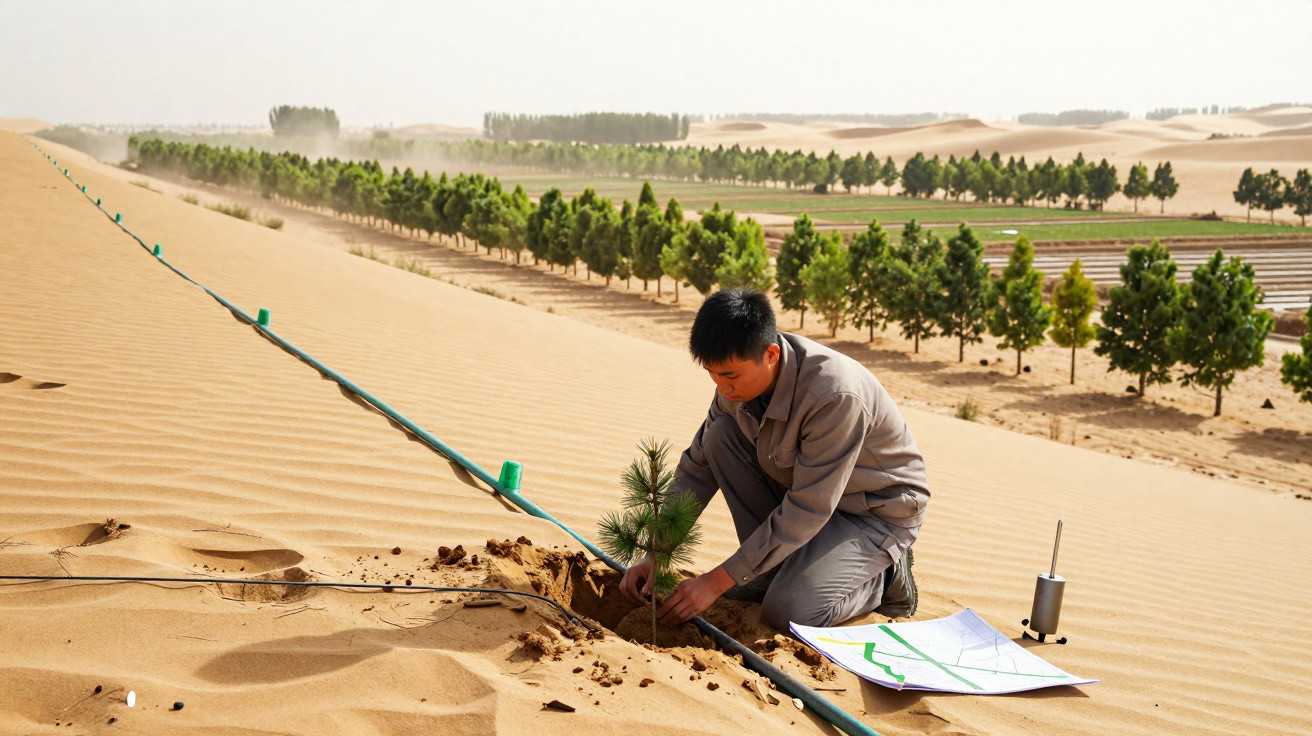
Set within the Tarim Basin and enclosed by mountain ranges, the Taklamakan Desert has long been regarded as a place not to be crossed. Its Uyghur name is commonly understood to mean “go in and you won’t come out”, reflecting its mobile dunes, dust storms and severe temperatures.
In the past, Silk Road caravans made lengthy diversions around the desert’s edges, following the oases scattered along the foothills. Rainfall is almost non-existent within this expanse of dunes; summer heat climbs beyond 40°C, while winter nights fall far below freezing. Hardly any plant life interrupts the skyline.
A desert once known as a point of no return now houses industrial ponds stocked with groupers, shrimp and other marine species.
In this setting, fish farming might seem more like speculative fiction than reality. However, regional figures referenced by Chinese authorities indicate that aquaculture operations in Xinjiang’s desert counties were producing nearly 200,000 tonnes of seafood by 2024.
Chemistry turns briny groundwater into “desert seawater”
The basis for this shift sits beneath the dunes. Aquifers below the Taklamakan contain saline, alkaline groundwater that has long hindered conventional agriculture. Its high salt levels damage the roots of most crops, and for decades the water was seen as a liability rather than an asset.
Engineers are now approaching it differently. Rather than removing its salt content to cultivate wheat or cotton, they process and balance the water for marine species that thrive in saline conditions.
From hostile brine to tailored habitat
At large recirculating aquaculture systems (RAS), water from the desert is pumped out, filtered and precisely modified. Technicians alter the pH, salinity and mineral balance in individual tanks to recreate coastal seawater.
- Deep saline aquifers supply the groundwater.
- Filtration and chemical processing remove impurities and surplus alkalinity.
- Salinity is adjusted for the requirements of particular species, including groupers and whiteleg shrimp (vannamei).
- Aerators and pumps maintain water movement and oxygen levels.
- Waste is removed, while much of the water is reused to reduce losses.
These closed-loop operations combine features of a farm and a laboratory: lines of ponds or tanks, sensors measuring oxygen and temperature, and automated feeders delivering controlled portions of high-protein pellets.
By recirculating and reconditioning water, desert farms limit evaporation losses and keep salinity stable even under searing sun and icy winds.
Thermal engineering against extreme swings
Temperature is among the Taklamakan’s greatest obstacles. A single pond may be exposed to intense daytime heat followed by sharp overnight cold. Rapid variations can place fish under stress, slow their development and even wipe out complete stocks.
To manage this, many sites rely on insulated ponds, buried pipework and heat exchangers to moderate fluctuations. Some schemes direct waste heat from neighbouring industrial facilities into their water networks. Temperatures are held within a narrow range appropriate to each species, commonly about 24–30°C for shrimp.
This combination of chemical control and thermal engineering supports what Chinese planners have called a new “inland sea” for aquaculture.
A strategic bid for food security
Farming seafood in a desert far from the sea is more than a technical demonstration. It forms part of Beijing’s wider effort to protect food supplies and limit vulnerability to unstable international markets.
China consumes more fish and seafood than any other country. Wild catches have been constrained by overfishing, pollution and tighter rules, while imports may be affected by trade disputes or disease outbreaks. Inland aquaculture, particularly in areas such as Xinjiang, can expand production without adding further pressure to coastal ecosystems.
Desert fish farms aim to shorten supply chains, feeding inland cities without relying on distant coasts or foreign fleets.
Xinjiang’s facilities are intended to supply local consumers as well as national distribution systems. Rather than transporting frozen seafood for thousands of kilometres from eastern ports, producers can send chilled fish and shrimp from desert centres to nearby cities via newer road and rail links.
Glacier melt and the Tarim Basin’s fragile balance
Much of the water supporting these schemes begins as snow and ice in the surrounding mountains, including the Tianshan and Kunlun ranges. During warmer months, melting glaciers feed the Tarim River and its tributaries, replenishing aquifers around the desert’s perimeter.
This water flow is limited, however, and faces pressure from climate change as well as competing uses, including cotton irrigation and urban demand. Any major enlargement of aquaculture will have to operate within this constrained hydrological system.
| Factor | Potential benefit | Potential risk |
|---|---|---|
| Use of saline groundwater | Less dependence on high-quality freshwater for farming | Salts could accumulate in nearby soils if water is poorly managed |
| Recirculating systems | Reduced water consumption per kilogram of fish compared with open ponds | Greater energy requirements for pumps, filters and heating |
| Local seafood production | Shorter supply chains and fresher products for inland consumers | Pollution risks if waste and chemicals are not rigorously managed |
Ecological and social questions
Converting sand into seafood brings unavoidable compromises. Environmental scientists emphasise the need to control effluent strictly, because wastewater rich in nutrients could pollute limited freshwater supplies or vulnerable desert soils.
Energy consumption is another concern. Maintaining consistent water temperatures, operating aerators and running treatment equipment all require electricity. Where that power is generated by coal-fired plants, a shrimp raised in the desert could have a larger carbon footprint than fish caught at sea.
Social issues also surround these projects in a region already subject to international scrutiny. Large state-supported developments in Xinjiang, including farms and industrial parks, have prompted concerns over land rights, working conditions and the speed of demographic change. The fish ponds form part of a wider economic drive that is reshaping livelihoods among local Uyghur and Han communities.
What “recirculating aquaculture” really means
The phrase recirculating aquaculture system appears frequently in policy speeches, though its meaning can seem unclear. Essentially, an RAS resembles a very large aquarium equipped with its own life-support system.
Rather than living in cages in lakes or at sea, fish are kept in tanks. Water flows constantly through mechanical filters that extract solid material, then through biological filters, where bacteria turn toxic ammonia from fish waste into less harmful substances. UV lamps or ozone can be used to destroy pathogens. The treated water is returned to the tanks, requiring only a relatively small daily top-up.
A well-run recirculating farm can reuse 90–99% of its water, trading liquid waste for higher technical complexity and energy use.
This approach enables the Taklamakan experiment. Without extensive recirculation and treatment, evaporation alone would make open ponds extremely inefficient in the desert.
Scenarios for the future desert “seas”
There are several possible outcomes. If equipment becomes cheaper and renewable sources such as solar power are more fully incorporated, desert aquaculture could provide inland protein in a comparatively resource-efficient manner. Policymakers in other dry regions, from Gulf states to parts of North Africa, are already considering comparable schemes.
A less positive outcome is also possible. The environmental cost may rise if energy remains carbon-intensive, effluent controls fail to keep pace with growth, or groundwater extraction overtakes natural recharge. Desert ecosystems can be resilient in certain respects, but they cope badly with persistent salinisation and pollution.
For shoppers in Beijing, Urumqi or Shanghai, a fish fillet in a refrigerated supermarket display may soon have an unexpected origin story: not a trawler operating on the Yellow Sea, but an arrangement of ponds far inside a desert once regarded with fear. The change shows how far food production is moving beyond conventional landscapes, and how dependent it has become on engineering, data and sensitive trade-offs in places where life was, until recently, scarcely imaginable.












Comments
No comments yet. Be the first to comment!
Leave a Comment