The celery seemed to be judging me from the vegetable drawer.
It was limp, curved like a question mark, with leaves fading to that mournful grey-green shade that appears shortly before a trip to the compost bin. I had bought it four days before, imagining soups and green juices. By then, it resembled the ‘before’ half of an advert, with no ‘after’ in sight.
Over coffee, a friend casually suggested: “Wrap it in foil. Stays crisp for weeks.” It sounded like one more kitchen legend, somewhere between putting a spoon in a champagne bottle and using bread on the fridge door to prevent odours.
A week later, though, I took out that same celery. Its stalks broke with a clean snap, the colour looked livelier, and it had an almost freshly picked scent. Clearly, something rather clever was happening in the drawer.
It all comes down to the way plants breathe.
Why your celery wilts so fast – and what foil really changes
A newly bought bunch of celery appears almost indestructible: sturdy, water-filled stalks, a compact centre and leaves reaching upwards as though it were still growing in the field. Put it into the crisper drawer in its plastic bag, leave it there for several days, and it will often fail the bend test spectacularly.
The stalks sag, the exterior becomes rubbery, and that satisfying snap disappears. Instead, there is a soft crunch and plenty of frustration. On a hectic weekday evening, that is often when a planned healthy meal quietly becomes pasta again.
The change is not only about moisture. Even in the fridge, the plant continues its silent, ongoing life.
Like every vegetable, celery continues to respire after it has been harvested. Water escapes through minute pores in its skin, and losing that water is what transforms firm cells into floppy ones. When celery is sealed tightly in plastic, its own moisture gathers as droplets while the air around it becomes dense with humidity and trapped gases.
After only a few days, the cut end can develop a slimy coating and a faintly stale odour. The celery is drying out while also being smothered by its own respiration. Neither condition helps it remain crisp.
Aluminium foil alters that balance in a remarkably neat way. It reduces moisture loss without completely containing the plant’s respiration. That small distinction can extend freshness from a matter of days to several weeks.
Every celery stalk contains cells filled with water pressing against their walls. This force, known as turgor, is what lets a stalk snap rather than bend. If water leaves more quickly than it can be redistributed, the pressure falls and the plant tissue becomes limp.
Plastic is almost a complete barrier, trapping both water and gases, particularly ethylene and carbon dioxide. With leafy vegetables, this confined setting accelerates ageing and may encourage microbes. The cut ends tend to soften first, before decay spreads along the ribs.
Foil behaves differently. It keeps out light and reduces airflow, while its minute gaps and folds allow a small amount of gas exchange. The celery remains in a cool, dark, gently humid microclimate, where moisture loss is slowed rather than halted. Scientists call this a modified atmosphere; your crisper drawer simply calls it ‘still crunchy after two weeks’.
How to wrap celery in foil properly (and the easy mistakes people make)
The process begins before the foil goes anywhere near the celery. Keep the bunch whole, including its leaves, and remove any pieces that are visibly damaged or yellow. If soil remains around the base, rinse it quickly and pat it dry with care. It should be just damp, never wet.
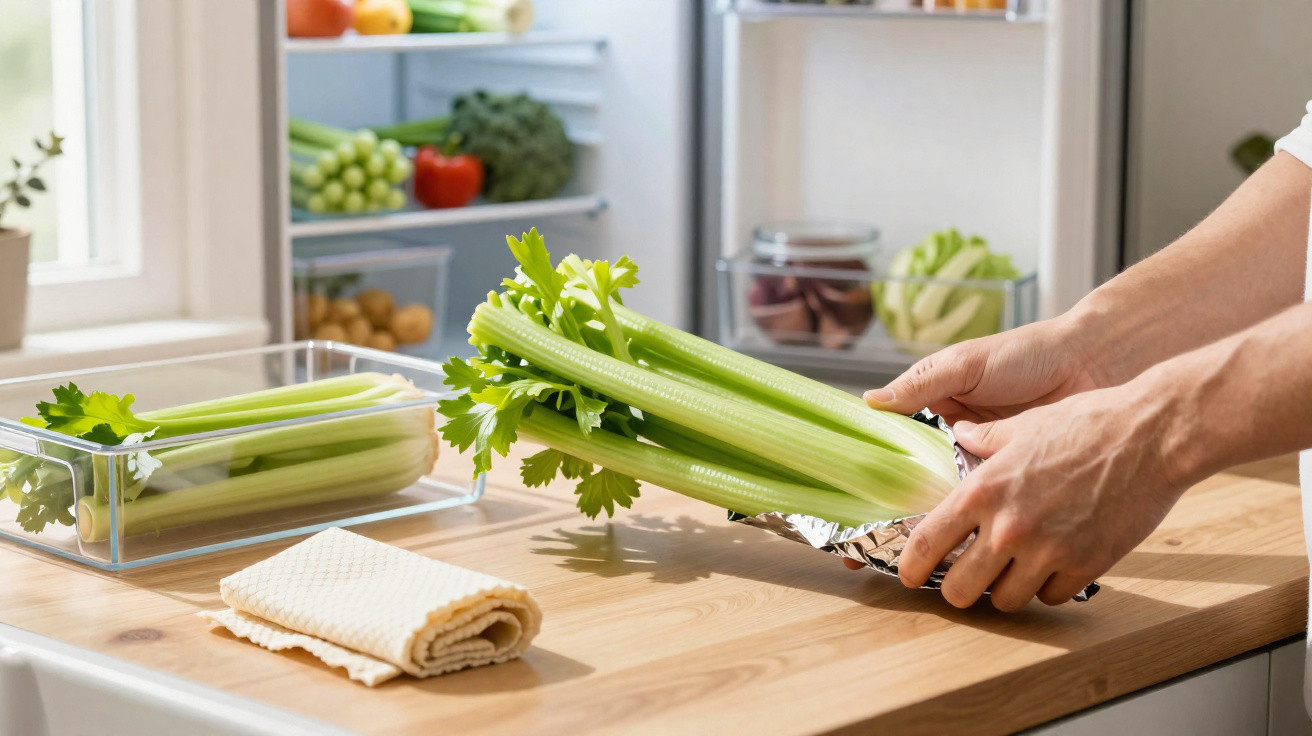
Spread a sheet of aluminium foil across the worktop with the shiny side facing inwards. Set the celery along one edge, then roll it up as you would a relaxed burrito. Fold in the ends without pressing them down firmly. It needs to be covered, not vacuum-packed.
Put the wrapped bunch into the crisper drawer. There is no need for elastic bands, additional bags or elaborate folding. The approach is so straightforward that people tend to doubt it until they see the results.
In practical terms, this loose wrapping method finds a slightly awkward middle ground. Foil limits direct contact with the fridge’s dry air, preventing the stalks from losing water too rapidly. Its reflective surface can also lessen temperature changes caused by opening the fridge door, helping the contents stay more stable.
Meanwhile, the loose fit creates small spaces through which air and gases can circulate. As a result, the celery is not left sitting in condensation or enclosed ethylene. It carries on ‘breathing’ gradually rather than speeding towards deterioration.
Most people who claim that ‘the foil trick doesn’t work’ have usually made one of three very understandable errors.
First, they wrap celery immediately after a thorough wash, while it is still dripping, and then leave it there. Excess water held against the stalks creates ideal conditions for bacteria. Second, they press the foil too tightly and crush the ends, bruising the base where decay is most likely to begin. Third, they store it in the warmest area of the fridge and hope for the best.
Shortcuts are completely normal during a busy week. Let’s be honest: nobody really does this every day. But after throwing away a third soggy bunch in one month, spending five seconds wrapping it carefully can suddenly seem worthwhile.
Once you understand the ‘why’, repeating the ‘how’ becomes much easier without making it complicated.
“Foil doesn’t magically ‘preserve’ celery,” explains a food scientist I spoke to. “It just creates a calmer little world around the stalks, where water, gas and temperature swings don’t hit as hard. Plants love stability – even in a fridge.”
That calmer environment becomes apparent in ordinary ways. The cut ends remain pale instead of turning brown, while the ribs do not become hollow. Even the leaves, normally the first part to wilt, retain an impressive amount of structure. Ten days later, you can still chop them into soup without that dispiriting wilted look.
For people who prepare meals on Sunday and genuinely eat them on Thursday, that modest reliability is invaluable.
- Wrap celery while it is still fresh rather than waiting until it has gone floppy.
- Pat lightly rinsed stalks dry with a clean cloth before wrapping them.
- Make the foil wrap loose: sealed, but not tightly compressed.
- Keep it in the crisper drawer rather than on the fridge door.
- Inspect it weekly, wipe away any moisture inside and wrap it again.
The surprising ripple effects of a simple foil wrap
At first glance, it is merely a bunch of celery in foil at the rear of the fridge. It is not the sort of thing that inspires poetry. Still, this minor adjustment affects all those occasions when food waste quietly consumes a week’s time, money and energy.
On an exhausting Tuesday, discovering celery that is genuinely crisp can mean the difference between adding it to a quick stir-fry and giving up to order a takeaway. It is a small endorsement of the version of yourself who did intend to cook. That modest win matters more than we tend to acknowledge.
We have all pulled out a forgotten, slimy bag of greens and felt equally guilty and annoyed. Foil will not remove that experience entirely, but it can make it far less common, which is already significant.
There is a wider question behind this unassuming method. If a basic grasp of plant respiration can double or triple celery’s usable life, what else in the kitchen responds in a similar way? Lettuce kept in containers with kitchen paper. Herbs treated like flowers, with their stems in water and a loose covering. Carrots stored in damp sand in traditional cellars.
None of these approaches requires advanced technology. They come from observing what plants need after harvesting: darkness, cool temperatures, mild humidity and room to breathe. The foil method is simply the 2020s version, designed for a modern fridge rather than a stone pantry.
Mention it at work or in a group chat and you will soon identify those who have quietly used it for years, as well as those dealing with their third wilted bunch that month. Somewhere between those groups, a fresh habit begins, one loose sheet of foil at a time.
| Key point | Details | Why it matters to readers |
|---|---|---|
| Use foil, not plastic | Foil excludes light and slows airflow while permitting tiny gas exchanges, unlike airtight plastic bags that retain moisture and ethylene. | It can help celery remain crisp for 2–3 weeks rather than only a few days, reducing waste and last-minute trips to the shops. |
| Wrap loosely, not tightly | Roll the celery in foil as a soft parcel, folding the ends without squeezing and leaving some space around the stalks. | This avoids bruising and condensation build-up, preventing stalks from becoming slimy or brown at the base. |
| Control moisture before storage | Wash away any dirt, then dry the bunch until it is only slightly damp, never dripping, before wrapping. | This maintains useful humidity without creating a wet environment where bacteria and mould develop quickly. |
| Store in the crisper drawer | Keep the wrapped bunch in the coldest, most stable part of the fridge, away from the door. | This limits temperature changes whenever the fridge is opened, helping preserve that satisfying crunch. |















Comments
No comments yet. Be the first to comment!
Leave a Comment