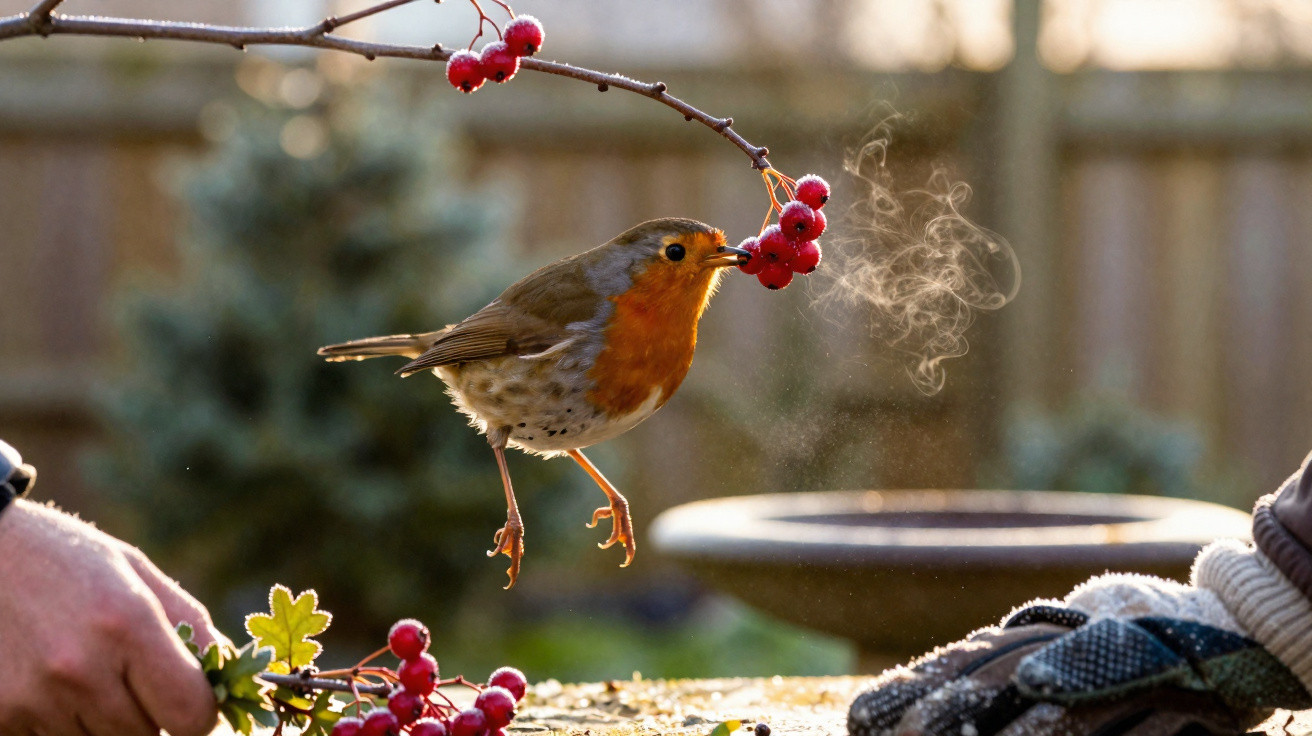
For days, frost had covered the lawn, making each blade of grass resemble a sliver of glass. Most birds had retreated to more sheltered spots, away from the sharpest wind. But a bold flash of red kept returning to one small part of the garden, hopping beneath bare branches as though it belonged there. The robin stopped, cocked its head and then shot towards a bunch of orange-red berries, which glowed like fairy lights against the grey sky.
The shrub had seemed unremarkable throughout summer. By January, however, it had become the garden’s pulsing centre.
Gardeners who notice these things insist it is no coincidence.
They maintain that a single winter fruit can make an occasional robin a dependable regular.
The winter fruit robins simply cannot resist
Spend enough time listening to winter birdwatchers and the same plant is mentioned repeatedly: pyracantha, more commonly known as firethorn. This shrub is covered in vivid orange or red berries at a time when nearly everything else has died back. It may look ornamental to us, but for a robin searching for food on a freezing morning, it can be essential.
Its berries hold fast to the branches, even following severe frosts. While softer fruits have become pulp or disappeared altogether, pyracantha remains in place like an unlimited winter buffet. That is where a robin’s attachment can begin.
On a suburban street in the Midlands, a retired teacher told me that the robin visiting her pyracantha hedge is so regular she could set her watch by it. “He’s there at 8am, 11am and late afternoon,” she said, gesturing towards the bright berries. “He even sings from the satellite dish, like he’s guarding the place.”
Bird counts by local ringing groups support her experience: gardens containing berry-rich shrubs retain visiting robins for longer periods during the coldest part of the year. The birds do not simply appear briefly and leave; they return, patrol and stay nearby. Reliable food and secure cover create a routine.
Robins survive by travelling short distances. Most do not go far, instead shaping their winter days around a mental map of dependable feeding places. Pyracantha suits this approach perfectly. Its berries are high in energy, easily seen from afar, and the dense shrub gives birds somewhere to hide. For a bird weighing about the same as a £1 coin, that is an invaluable combination.
A feeder may attract a robin for ten minutes, whereas a fruiting pyracantha can make your garden part of its routine for weeks. That is the understated strength of one carefully selected plant.
Making pyracantha a robin magnet rather than simply an attractive shrub
Planting pyracantha alone is not the answer; its position and the way it is allowed to develop matter too. Robins prefer feeding close to shelter, so they can quickly dart away if a sparrowhawk or local cat appears. A pyracantha beside a fence or wall, with some tangled growth around it, is ideal. Keep a few branches thick and untidy: a perfectly neat garden is not always a wildlife-friendly one.
Select berry colours that show up clearly in the light in your own garden. Against a winter sky, orange and red berries are generally the easiest for robins to find. It is also worth placing at least one shrub where it can be viewed from the kitchen window. Seeing the robin’s daily pattern is a large part of the pleasure.
Many gardeners prune at the least helpful time for birds. Cutting the shrub back heavily in late summer or early autumn can remove precisely the berry clusters that robins need. It is much better to trim gently immediately after flowering, while retaining plenty of stems that will carry berries.
Try not to be too eager to clear fallen leaves and debris from beneath the shrub either. This untidy area provides hiding places for insects, which offer robins protein on days when fruit is not enough. Let’s be honest: nobody really does this every day, but adopting a looser, less immaculate approach once or twice annually can still make a difference.
One seasoned birdwatcher from Devon told me:
“The moment I stopped gardening for the neighbours and started gardening for the birds, the robins stopped being visitors and became residents.”
His pyracantha now spreads rather more freely than a designer garden might permit, and he has no wish to alter it. Birds move through it like thread through cloth, slipping in and out among the thorny branches.
For an easy approach, many people who enjoy robins keep a short checklist pinned to the shed door:
- Put at least one pyracantha in a sheltered spot that is easy to see.
- Prune sparingly after flowering rather than immediately before winter.
- Retain some low growth and leaf litter beneath the shrub.
- Place a shallow water source close by and refill it whenever you remember.
- Look out at similar times every day – robins follow a schedule of their own.
Sharing your garden with a winter robin that returns time after time
Once a robin adopts your pyracantha as part of its winter territory, a subtle change takes place. You begin to recognise the individual bird through its habits: the tilt of its head or the way it fluffs its feathers against the cold. On an otherwise gloomy Tuesday, that small visitor can brighten the entire day.
On a blustery morning, it may cling to a swaying branch, refusing to abandon its preferred feeding place as the berries move in the wind. There is something infectious about that little display of determination. We have all had times when the garden feels like little more than background clutter, until a robin appears and brings everything into sharp focus for a few seconds.
Adding one berry-laden shrub will not transform your home into a wildlife reserve. Instead, it creates something more modest and personal: a shared routine with a bird that weighs less than your phone. Looking towards the shrub as the kettle boils, or noticing that the berries are beginning to disappear, can make winter seem less like a season to get through and more like one with its own rhythm.
After watching a robin defend “its” pyracantha from other birds, you realise that loyalty is not a grand emotion. It is repetition and habit: returning to the same berries on every frosty morning.
Many readers who try this change more than a single garden corner. They begin planting other berry-bearing plants, leaving seed heads in place and permitting a few nettles to grow at the back. The robin becomes a kind of barometer: when it stays around, they know they are doing something right.
In a world that feels increasingly fast and digital, a simple shrub bearing winter fruit provides a different sort of notification: a red breast flashing among orange berries. It is not urgent and it will not buzz on your phone, but it invites your attention more gently. Once you have noticed it, it is difficult to stop looking.
| Key point | Detail | Why it matters to the reader |
|---|---|---|
| Pyracantha attracts robins in winter | Its berries remain available for a long time, offering both energy and shelter | Explains why one shrub can encourage a bird to return regularly |
| Positioning and pruning the shrub | Plant it near a wall, prune lightly and leave some mess at ground level | Turns an ordinary planting into a genuine robin spot |
| A garden designed for birds | Combine berries, insects, water and peaceful areas | Creates a lively garden that remains interesting to watch throughout winter |












Comments
No comments yet. Be the first to comment!
Leave a Comment