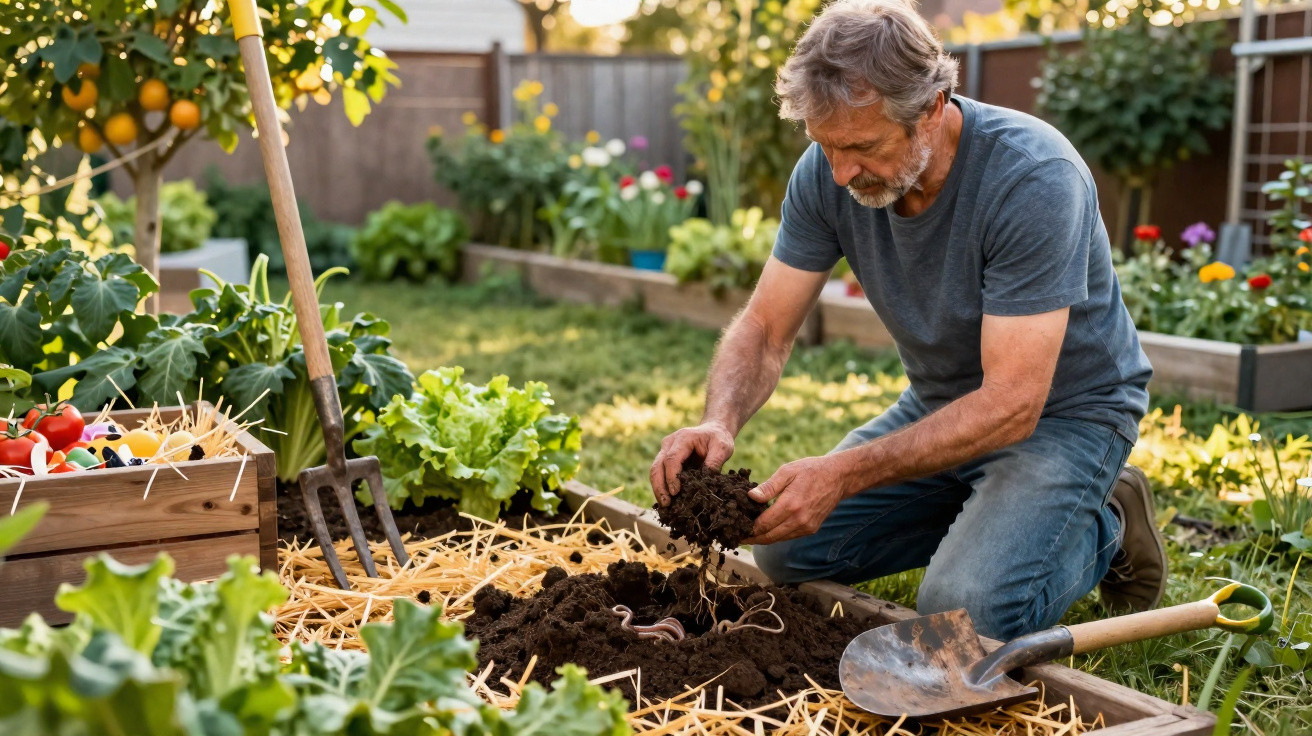
“You have to turn it every year,” he says, breathless. “Otherwise the ground dies.” He flips the earth as though it were a pancake, sending clods flying, ripping through roots and leaving worms exposed to the sun like tiny pink question marks.
It looks like a labour of love, the sort of annual ritual that makes someone feel like a “real” gardener. The border is raked over, fresh compost is scattered and flowers are planted. On the surface, it all appears perfectly proper.
But several months on, the soil develops a crust. Rainwater sheets away, while the bed bakes during heatwaves and becomes waterlogged in storms. Plants demand extra feed, extra watering and extra attention. The garden may look flourishing on Instagram, yet seem exhausted in reality.
One repeated practice could be gradually damaging the very thing gardeners believe they are improving.
This popular gardening habit quietly wrecks your soil
The persistent myth is straightforward: “Good gardeners dig deep.” It encourages double-digging, vigorous tilling and turning the soil every spring as if preparing a field for wheat. It feels like useful work: the ground shifts, lumps break apart and the bed looks “clean”.
For generations, gardening magazines and older books have promoted the same message: aerate the ground, break up the pan and let the soil breathe. Armed with spades and rototillers, gardeners set out to save beds they assume are suffocating.
What is rarely explained is that continual disruption gradually kills the underground life that keeps soil in good condition.
An amateur gardener with a small suburban plot in Kent began recording results in a notebook. The plants, seed packets and level of sun were identical. Each spring, one side of the vegetable patch was deeply dug, while the other was largely left alone and simply mulched.
By the end of three seasons, this was no longer merely “gardening theory”: there were clear figures. During hot weather, the dug section required around 30% more watering. Its lettuce ran to seed sooner, carrots split around compacted layers and slugs favoured the uncovered areas.
In the no-dig half, the earth broke apart between the fingers like chocolate cake. There were fewer weeds, more worms and slightly better yields from the same space. It was not instant, dramatic magic, but a modest and consistent difference that increased each year.
Repeated tilling or double-digging slices fungal networks apart. It also breaks down stable soil aggregates-the small structures that balance water and air-and exposes organic matter to oxygen, causing it to decompose too rapidly, much like dry wood thrown on a bonfire.
Within a few years, the soil structure can fail. Although the surface seems loose immediately after digging, it eventually compacts into a hard crust. Beneath it, regular work at the same depth may create a compacted “plough pan”, a concealed, concrete-like barrier that roots struggle to cross.
The soil then loses its sponge-like capacity. It cannot absorb intense rainfall or shield plants during dry spells. In response, gardeners often purchase more compost, more fertiliser and more equipment, attempting to solve a problem that began with good intentions and a spade.
How to break the digging habit without losing control of your garden
The alternative is surprisingly uncomplicated: interfere with the soil as little as you can. Rather than turning it, nourish it from the surface. Think of a woodland floor rather than a building site. Place organic material on top, then allow roots, fungi and worms to do the “digging”.
Begin with a small area, perhaps the bed nearest the kitchen door. Leave it undug. Hand-pull large weeds, but let the roots of harmless plants rot where they are. Once or twice yearly, spread a 3–5 cm layer of compost or well-rotted manure across the top.
Plant directly into this soft upper layer. It may feel unfamiliar in the first year, and you may want to turn everything over. Resist that impulse. Gradually, the soil will relearn how to function as a living system.
Most gardeners know that anxious spring weekend: time finally becomes available, the sun comes out and there is a rush to “get the garden done”. That is often the moment the spade appears and the harm starts. The answer is to redefine what “getting it done” involves.
Rather than judging progress by the amount of soil you have moved, pay attention to the life you can see. More worms in a spadeful of earth is a stronger sign than neatly turned rows. Let’s be honest: nobody really does this every day. Design a system, then, for helpful laziness rather than one that punishes the soil.
Avoid the rototiller. Where an area is severely compacted, use a broadfork or garden fork to lift and crack it gently without inverting the layers. Mulch any bare ground with shredded leaves, straw or slightly dried grass clippings. In July, your future self-sweating less-will be quietly grateful.
“When gardeners stop waging war on their soil and start cooperating with it, they often discover they can grow more food with less effort,” says a soil ecologist in Bristol who runs community veg plots. “The hardest part isn’t the technique. It’s letting go of what we were taught.”
After giving up deep digging, another issue soon arises: how should weeds, slugs and untidy corners be handled? This is where manageable routines matter more than heroic weekend efforts. Pulling young weeds during one evening walk is better than spending hours hacking at them later.
- Change your view from “clean and turned” to covered and living.
- Maintain a light but continuous mulch rather than leaving soil bare.
- Try spot-composting: place kitchen scraps in small holes instead of trenches.
- Watch how water behaves: if it runs off, increase the organic cover instead of digging more.
When the beds look unruly on a difficult day, remember that nature’s apparent chaos often conceals highly ordered work below ground.
Letting the soil heal changes more than your harvest
When soil is no longer treated as something that must be forced into shape, it gradually displays its own organisation. Microbes establish themselves, fungi send threads between roots and worms pull leaves down into the ground. A bed that seemed neglected in March can look quietly plentiful by late summer.
The change also affects the gardener. Control gives way to cooperation, machines make less noise and there is more time to notice the plants themselves. The belief that “good gardening equals hard digging” begins to disappear, replaced by a different measure: how much life your small plot can support.
Whether the space is a tiny balcony, a narrow urban strip or a large country garden, the principle remains unchanged. Healthy soil is not made in a weekend with tools; it is created by no longer damaging it, season by season.
| Key point | Details | Why it matters to readers |
|---|---|---|
| Repeated digging destroys soil structure | Intensive tilling and double-digging disrupt natural aggregates and can form a compacted layer below the worked depth, making it difficult for roots and water to pass through. | You may believe you are “loosening” the soil when you are actually making it harder for plants to access deep moisture and nutrients, resulting in weaker growth and more work. |
| No-dig beds hold water better | Soil that remains undisturbed beneath surface mulch behaves like a sponge, reducing evaporation and letting rainfall soak in rather than run across the top. | During heatwaves or hosepipe bans, beds that retain moisture longer require fewer emergency watering sessions and help plants cope better with stress. |
| Feeding from above mimics natural systems | Applying compost and organic matter at the surface mirrors leaf fall in woodland, where living organisms gradually move material into deeper layers. | This low-effort method develops lasting fertility, meaning less spending on fertilisers and more reliable harvests year after year. |











Comments
No comments yet. Be the first to comment!
Leave a Comment