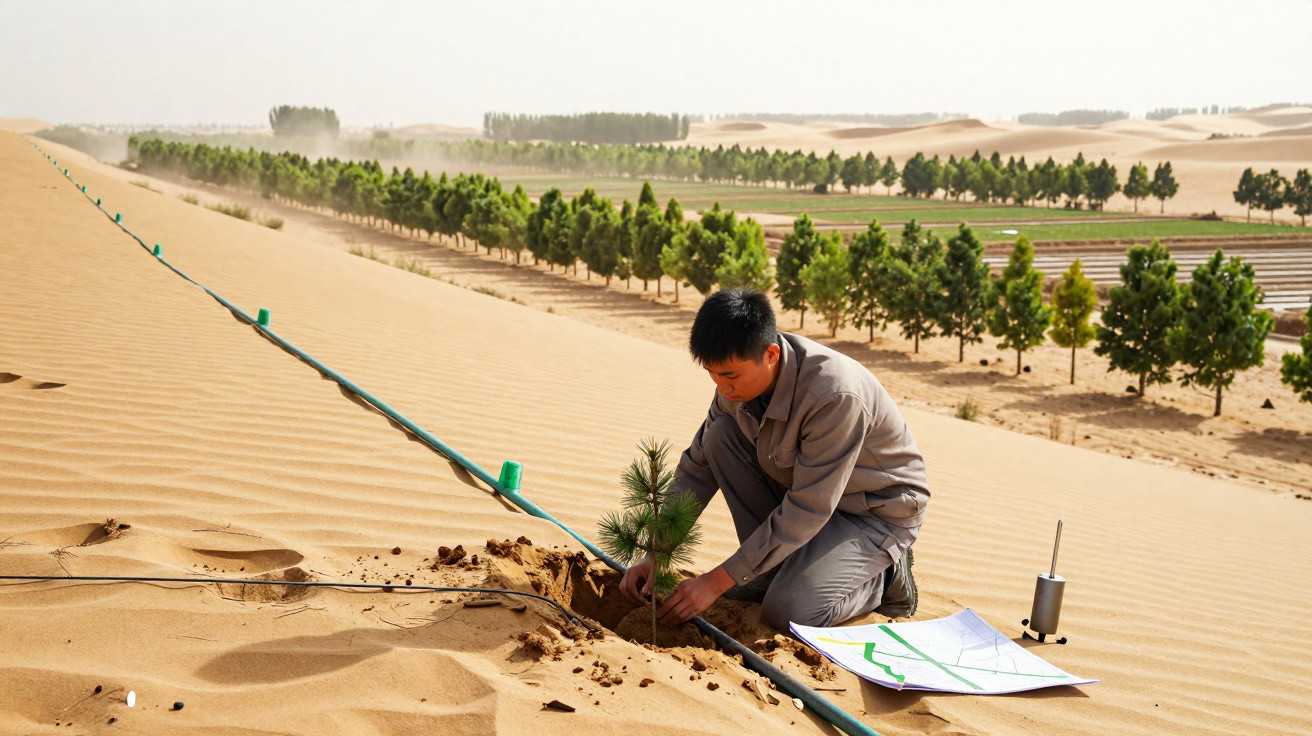
For almost five decades, Beijing has sought to create a green barrier through the sands, using forests to separate expanding cities from encroaching deserts. The idea appears straightforward: plant trees, contain dust and shield communities. On the ground, however, the situation is much more complex, with consequences extending far beyond China.
Why northern China is becoming drier
Northern China has never been an especially forgiving environment. The Himalayas prevent moist southern air from reaching the region, creating a “rain shadow” that leaves the vast plains and plateaus comparatively dry. This geographical reality helps explain why the Gobi and Taklamakan deserts already occupy more than 1.6 million square kilometres combined - a larger area than Mongolia.
Since the 1950s, however, climatic pressure in the region has coincided with intense economic expansion. Growing cities have consumed farmland, while forests have been felled or converted into agricultural land. Sheep and goat herds have also overgrazed vulnerable grasslands, removing the vegetation that kept shallow soils stable.
When plant cover disappears, wind erosion takes control. Researchers estimate that in sections of Inner Mongolia and along the Gobi’s edge, desertification has claimed more than 3,500 square kilometres annually, advancing over land that previously grew crops and sustained rural settlements.
Sand travels far beyond the place where it originates. Field research and satellite observations indicate that severe sandstorms can strike certain northern areas as often as ten times a month during the storm season. They cast a dense yellow haze over cities including Beijing, raise concentrations of fine particulate pollution, and lead to cancelled flights and closed schools.
The same process that strips organic matter from the soil destroys its future: once the top layer blows away, it becomes much harder for plants to recover and for farmers to stay put.
Entire communities have been displaced already. Authorities have moved villages on the desert frontier after agriculture became unviable, turning an issue that began with land management into a social and economic challenge as well.
The origins of China’s “Great Green Wall”
Confronted with intensifying sandstorms and concerns over food security, Beijing began one of modern history’s largest tree-planting programmes in 1978. Formally called the Three-North Shelter Forest Program, it covers three extensive northern areas and broadly traces a belt from the north-east, through the north, and into the north-west.
Its central aim is simple: establish a living defence against the desert’s spread. By 2050, the network of forests and shelterbelts is projected to extend for around 4,500 kilometres, creating the feature that the media soon named the “Great Green Wall”.
The reported scale is already extraordinary. More than 66 billion trees have reportedly been planted since the late 1970s, and roughly 34 billion additional trees are planned for the decades ahead. In 2024, Chinese officials said a forest belt had completely surrounded the Taklamakan, among the driest and most isolated deserts on Earth.
From space, large sections of the once bare frontier now show up as thin but visible bands of green, stitched between dunes, steppe and cities.
In certain locations, vegetation coverage has risen to 25% or more, more than twice the level recorded in the late 1940s. Local authorities cite stabilised dunes, recovered farmland and lower dust levels as evidence that the approach is working.
Does the Great Green Wall really alter the climate?
In theory, converting sandy terrain into forest could bring considerable climatic advantages. Trees provide shade, retain moisture and absorb carbon dioxide. Darker surfaces covered by vegetation may influence local temperatures and wind flows, potentially reducing the force of sandstorms and making small changes to rainfall.
Evidence gathered in the field indicates that tree belts do, at least in some areas, slow winds close to the ground and prevent soil from being blown away. A number of studies associate individual shelterbelt schemes with a reduction in severe sandstorms affecting nearby urban areas.
The broader evidence, though, is still uncertain. Climate researchers note that natural rainfall cycles and wider regional climate changes make it difficult to attribute any single trend solely to forests. Some years bring fewer sandstorms before numbers rise again, while one wet decade can conceal longer-term drying.
Forest composition is equally important. Early planting programmes often depended on fast-growing monocultures, with extensive blocks of a single poplar or pine species selected for convenience and rapid growth rather than durability. That decision proved costly.
In 2000, one disease outbreak destroyed about a billion poplars in Ningxia, an important section of the shelterbelt system. The episode revealed how exposed uniform plantations can be in harsh environments.
Diversity is not a luxury in dryland forestry; it acts as insurance. When one species fails, others can hold the line.
Water presents a further limitation, beyond disease and pests. Many of these areas receive under 200 millimetres of rainfall annually. Trees with deep roots can access limited groundwater, but overly dense planting can deplete soils more quickly than natural processes can replenish them.
When tree planting can worsen deserts
Chinese scientists and environmental bodies are now considering a question that might have seemed strange during the 1980s: could poorly planned tree planting actually speed up desertification?
Researchers including Xian Xue of the Chinese Academy of Sciences have cautioned that this is possible. Dense, water-hungry plantations established on active dunes, particularly in places with extremely low rainfall, may lower groundwater levels. When the water table drops, trees die back and leave bare sand and dead trunks in areas that may previously have supported at least thin grass cover.
This form of “green drift” - forcing forests into landscapes naturally suited to scrub, steppe or scattered shrubs - may also conflict with established land practices. Nomadic and semi-nomadic herders, traditionally moving livestock with the seasons, can find their routes cut off by plantations. This may concentrate flocks in smaller spaces and intensify overgrazing there.
Policy makers therefore face a careful balancing task: reducing erosion while protecting livelihoods and preserving water supplies. Those objectives rarely suit one uniform solution.
A move towards smarter local solutions
The latest stages of the Great Green Wall reveal a distinct strategic shift. Rather than planting uninterrupted rows of tall trees, many areas are testing a patchwork of land uses designed around local conditions.
- Low, drought-resistant shrubs in areas where rainfall is very limited
- Dispersed woodland “islands” near villages and fields, rather than standardised belts
- Rehabilitated native grassland in places better suited to grazing than timber production
- Woody crops, including fruit and nut trees, that offer both soil protection and economic returns
Officials also encourage grazing bans or seasonal limits in some fragile areas, allowing vegetation time to regenerate. Satellite monitoring alongside ground surveys enables authorities to alter planting density, species combinations and irrigation timetables each year instead of committing to one fixed national blueprint.
The project has evolved from a one-size-fits-all wall into a vast, messy experiment in dryland management stretching across northern China.
Internationally, China’s programme contributes to a wider discussion about large-scale tree-planting initiatives. Sahel nations, for instance, have created their own “Great Green Wall” across Africa. China’s experience suggests that outcomes depend less on impressive headline totals than on what is planted, where it is planted and whether it matches local water and soil conditions.
What the Great Green Wall means for climate, food and daily life
China’s drive to green its northern landscapes involves more than appearances. Stable soils help safeguard harvests for millions of farmers working near arid zones. Fewer sandstorms may also reduce health costs and lost productivity in cities downwind.
In climate terms, northern China’s forests and renewed grasslands retain substantial quantities of carbon, though estimates differ greatly and many plantations are still young. Their greatest value may be not their total carbon storage, but their role in securing the systems that supply the country with food.
| Aspect | Potential benefit | Main risk |
|---|---|---|
| Tree belts | Slow wind, capture sand, protect crops | Excessive groundwater use, pest outbreaks |
| Grassland restoration | Helps herders, prevents soil crusting | Needs grazing control and lasting enforcement |
| Woody crops | Farmer income alongside erosion control | Reliance on markets, monoculture risk |
People living at the desert margin are already experiencing both outcomes of the transformation. Some households now make an income from maintaining shelterbelts or caring for orchards in places once dominated by exposed sand. Others encounter limits on traditional land and water use, or watch schemes fail following several dry years.
Beyond China: lessons from a continent-sized trial
Several lessons stand out for other dryland countries following China’s progress. First, reforestation in dry areas works best when it follows native vegetation patterns and respects water constraints. Low, drought-adapted shrubs and native grasses can protect land as effectively as tall trees while requiring less water.
Second, diversity and adaptability are essential. Using a mix of species distributes risk, while changing methods as climate information and local feedback develop stops early errors becoming permanent damage to the landscape.
Finally, every green-barrier scheme is closely connected to food supply, migration and public health. A successful shelterbelt can support a reliable wheat crop and cleaner city air. A failed monoculture can leave fields abandoned and drive another movement of people towards cities that are already overcrowded.
As the Great Green Wall moves towards its 2050 goal, scientists continue improving models that assess how varying planting designs influence wind, rainfall and groundwater. Together with satellite images and field experiments, these models are producing more realistic expectations: no forest can halt the Gobi on its own, but a well-planned mosaic of trees, shrubs and grasslands can slow the sand and give communities more capacity to adapt.
For the moment, northern China remains a live laboratory for the consequences of trying to redefine the border between forest, city and desert - not through concrete barriers, but through billions of small green wagers on the future.
















Comments
No comments yet. Be the first to comment!
Leave a Comment