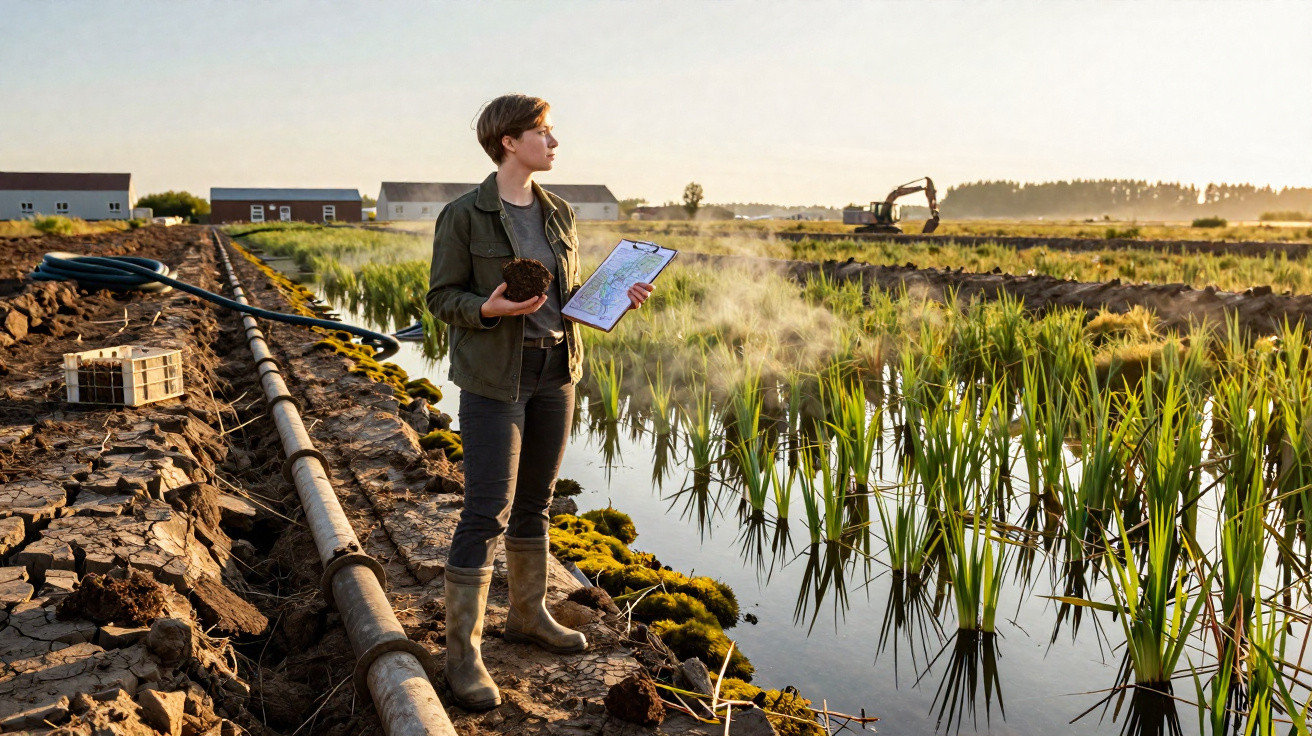
A gentle give beneath your boot, followed by a muted sucking noise, almost courteous, as the bog holds your foot. Everything around you seems motionless: brown moss, scattered sedges and a light wind crossing the level horizon. Then it comes into view: a slim drainage ditch slicing through the peatland, with water draining away and black earth laid bare like an open wound.
A nearby farmer shakes his head, gesturing towards ground once too waterlogged for tractors. Now, he says, “we can finally use it.” The air has a pungent, earthy, faintly sour scent. You cannot watch the carbon escaping molecule by molecule as the peat dries and breaks apart. Instead, there is the far-off growl of machinery and the soft drip of water vanishing.
What appears to be progress is silently changing a natural vault into a leaking safe.
When the ground begins to breathe out carbon
Peatlands hardly look like climate champions. They have no spectacular cliffs, towering forest canopy or oceans stretching to the horizon. They are simply low, wet and sometimes unremarkable expanses of moss and reeds, often absent from tourist itineraries. But underfoot sits something extraordinary: hundreds of years of partly decayed plants preserved within a dense, dark carbon sponge.
Left undisturbed, that sponge releases very little. Moss settles in layer upon layer, becomes saturated and never completely decomposes. With oxygen unable to penetrate, carbon remains stored below ground, like an ancient book whose pages are never turned. A healthy peatland is not so much a landscape as a vault. Drain it, and that vault is opened.
As soon as the water table falls, air enters. Microbes become active, feeding on the old plant material as the peat starts disappearing. Carbon accumulated over millennia can be released within decades. Land that once absorbed carbon almost unnoticed begins emitting it, shifting from sink to source.
The pattern is repeated in Indonesia, the United Kingdom, Finland and Canada. Drainage channels are cut into peat soils for crops, tree planting or housing. Initially, the change can look orderly: straight ditches, drier fields and neatness replacing the confusion of wetlands. Governments record additional hectares of “productive land”, while farmers gain space for machinery and modern farming.
On satellite photographs, drained peatlands can be indistinguishable from neighbouring farmland. Nothing about them immediately signals a crisis to an untrained observer. Scientists monitoring emissions, however, produce very different maps. These drained sites repeatedly show up in red on carbon charts, generating emissions far beyond what their area would suggest. In some countries, peatlands occupy only a modest share of the land yet account for a substantial proportion of land-use emissions.
A striking assessment from the Global Peatlands Initiative is frequently quoted: peatlands contain around twice as much carbon as all of the world’s forests combined, despite covering only a very small proportion of the land surface. Drain even a limited share, and the calculation changes. The quiet bog behind a dual carriageway may suddenly be causing more damage than the town factory everyone likes to blame.
The science behind this is straightforward. Saturated peat resembles meat kept in a freezer: preserved, stable and almost outside time. Dry it out, and it is more like leaving that meat on the kitchen worktop during summer. It does not remain unchanged; it decomposes quickly. In climate terms, that decomposition releases CO₂ and often nitrous oxide into the atmosphere, continuously and year after year.
For this reason, drained peat can release more carbon per hectare than nearly any other soil type on Earth. This is not minor seepage but a fundamental change. Without a chimney anywhere in sight, the landscape switches from climate ally to climate saboteur. As peat disappears, the ground itself subsides, leaving farmers and developers on an ever-sinking surface.
How to keep peatlands wet without halting progress
One practical answer begins with a seemingly simple action: lift the water table again. Re-wet the peat. In reality, this involves blocking or filling drainage ditches and allowing rainfall and groundwater to saturate the sponge once more. The soil becomes squelchy, machinery has difficulty operating, and the land may look “useless” to those accustomed to firm, dry fields.
But that saturation is precisely what protects it. Restoring water reduces oxygen, slows microbes and sharply cuts emissions, which can gradually approach zero. It is rather like pressing pause on an archive of decomposing ancient plant material. Some countries are testing crops suited to these wet conditions, including reeds, cattails and sphagnum moss. This approach already has a name: paludiculture, or farming with wetness rather than resisting it.
In theory, there is broad agreement. In practice, it is complicated. Farmers fear losing arable land and earnings. Builders and local authorities may already have invested in adjacent roads and homes. Families can feel deeply connected to fields their grandparents drained. Standing knee-deep in mud in a waterlogged ditch on a damp morning, climate policy can seem remote.
At a personal level, transition can hurt. Few farmers welcome the prospect of flooding their own land. Many recognise that their soil is subsiding, drainage pumps need to run for longer every year and yields have become unpredictable. Yet social expectations, bank debts and tradition all favour the same message: keep it dry and keep it productive. Let us be honest: nobody really gets up every day thinking first about the carbon balance of their soil.
There are encouraging developments, however. In Germany, certain peatland sites are being re-wetted and used to cultivate reeds for building products and insulation. In the Netherlands, pilot schemes are testing biomass harvested from wet land for energy and packaging. These projects are modest, vulnerable and sometimes frustrating. Even so, they demonstrate that wet ground need not be wasted ground.
The most useful approach is to view peatland restoration not as a penalty but as an exchange: replacing one form of value with another. Rather than measuring only tonnes of grain, societies can also value tonnes of carbon retained underground, lower flood risks and returning biodiversity. This is a cultural as well as a technical change. At a kitchen table or on a village bench, somebody needs to say plainly that a bog can be as valuable as a wheat field.
“When you stand in a drained peat field on a hot day, you can literally smell the carbon leaving,” says a wetland scientist in Scotland. “The question is not whether we act, but how long we pretend it’s still just ‘damp soil’ and not a slow-motion fire.”
For those wondering what signs to watch for, these are several quiet warning signals that a local peatland could be in difficulty:
- Old drainage ditches crossing land that was once marsh or bog.
- Dark, crumbly peat exposed in fields that previously felt springy underfoot.
- Drained ground sitting below the level of nearby roads or rivers.
- Repeated peat or forest fires in places naturally known to be wet.
- New roads or housing developments running through former wetlands.
What future are we building on sinking ground?
After walking across drained peatland, the word “ground” can feel less dependable. It becomes clear that homes, supermarkets and power lines often sit on soil that was once underwater in some form. We straightened rivers, cut ditches, subdued bogs and built our lives on the surfaces that dried out. Now the cost is arriving at our feet.
What is unusual is the quietness of this crisis. There are no crashing waves, falling cliffs or roaring wildfires. There is only land gradually subsiding, cracking and exhaling. On a cool evening, the invisible gas rising from below can be easy to overlook as it joins the shared atmosphere. We blame cars and aircraft. Peatlands say nothing, but they may be speaking more loudly.
Viewed on a screen, this may seem abstract, another part of the climate puzzle. Yet many readers will already have encountered something similar. It may have been during a childhood walk through a wet field, on a holiday route where the “boggy bit” always felt slightly unsettling, or in an old family story about draining marshland to “finally use the land”. At a deeper level, we recognise the feeling of taking from a place, then understanding only years later what has been lost.
The decision is not between farming and swamps, or between progress and puddles. It is between landscapes that store carbon and landscapes that leak it daily. It is between homes built on slowly sinking soil and homes placed where the ground can truly support them. It is also between regarding peatlands as untidy remnants of a wilder past or recognising them as the quiet infrastructure of a liveable climate.
Some nations are already mapping their peatlands and discussing which areas should be re-wetted, managed differently or left entirely to nature. Such conversations are uncomfortable, because they involve land rights, history and identity. But they also create an opportunity: if even the mud beneath our feet can be reconsidered, what else might we imagine differently?
The next time a map labels a flat, apparently empty field as “bog”, “fen” or “marsh”, it may look different. Rather than wasted space or a blank patch on a development plan, it is a deep, dark archive containing a climate story written across thousands of years. Once that archive is opened and drained, it does not wait silently. It begins speaking in carbon.
| Key point | Detail | Why it matters to the reader |
|---|---|---|
| Peatlands as carbon vaults | They preserve centuries of plant carbon in waterlogged, oxygen-poor soil | Helps explain why seemingly unremarkable bogs matter as much as forests |
| Drainage reverses their climate role | Lowering the water table turns peat from a carbon sink into a major source of emissions | Shows how land-use choices can quietly drive climate change |
| Re-wetting as a solution | Blocking ditches and raising water levels can greatly reduce emissions | Provides a tangible route for action at local, regional and policy levels |









Comments
No comments yet. Be the first to comment!
Leave a Comment