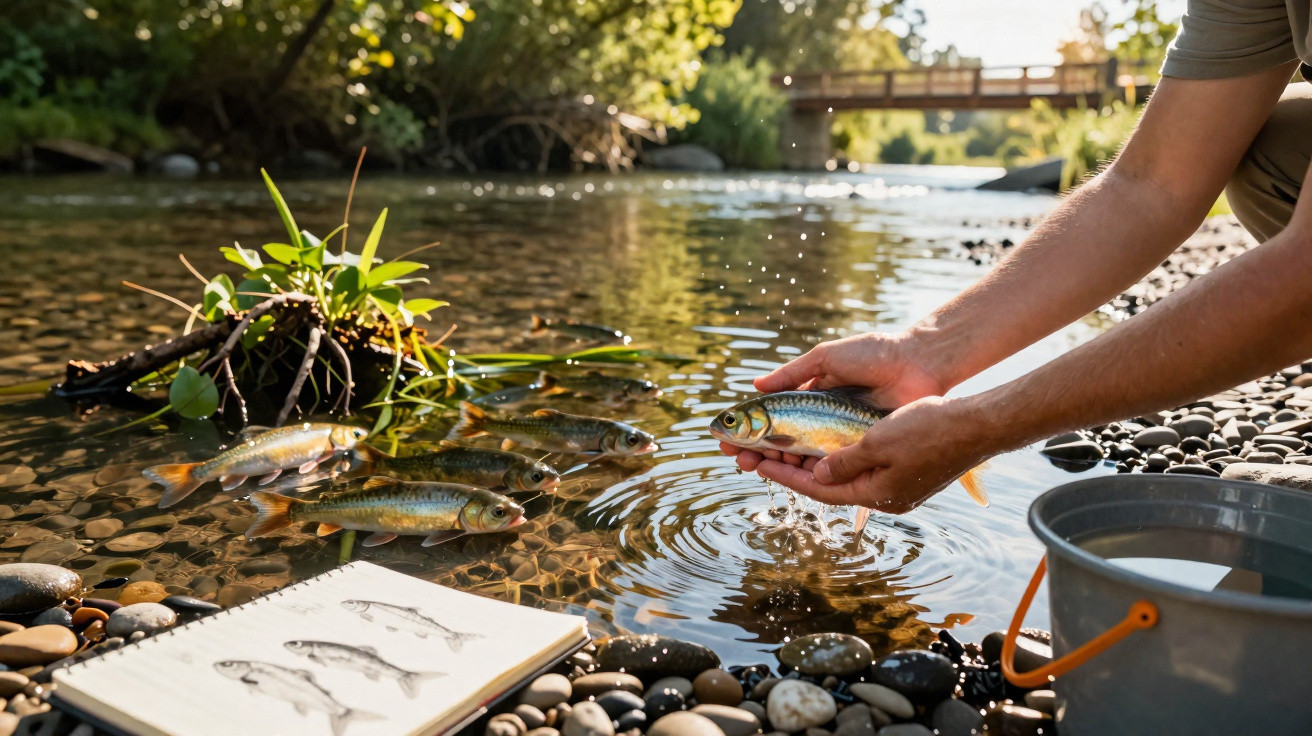
Grey-green water, a light haze, and a heron standing statue-still on one leg. Yet peer over the railings and allow your eyes to settle, and the scene changes. Beneath the surface, the water is active. Silver and bronze forms dart just below the light. More fish are here than many local people can recall seeing at any point in their lives.
A low-key revolution is under way in rivers, lakes and wetlands where native fish had once been depleted to almost nothing. Harvest restrictions, community patrols and restored habitats have safeguarded more than six million native fish in important watersheds around the world. It may sound like a dry, bureaucratic figure. In reality, it represents food, income, employment and the gradual repair of damaged ecosystems.
It also prompts an unexpected question: what happens when fish return to a river?
The silent return of native fish beneath the surface
Visit the bank of a recovering river at dusk and you sense the change before you spot it. The water feels fuller and more animated, as though a current of life is vibrating below. Then the surface flickers: shoals of small native fish rise to chase drifting insects. Behind them, a larger body turns slowly - a native predator returning to a hunting ground lost long ago.
This is increasingly the reality in freshwater systems where excessive harvesting has at last been brought under control. More than six million native fish, ranging from tiny darters to substantial suckers and barbs, are protected by catch limits, closed seasons and no-take areas. In policy documents, it is regulation. In the river, it means movement, abundance and sound: life splashing back into waters that had become unnervingly still.
Speak to people raised beside these waters and they tend to say much the same thing: “It feels like the river is breathing again.”
Consider Australia’s upper Murray-Darling Basin, which has endured drought, dams and persistent fishing pressure for years. Two decades ago, local anglers could fish all afternoon and perhaps land one or two worn-out native fish, alongside invasive carp that had made the water resemble muddy soup. Now, following strict harvest controls and restocking programmes for native species, survey teams are finding thousands of young Murray cod and golden perch in stretches that were previously nearly empty.
In the Pacific Northwest of the United States, tribal nations that co-manage rivers have documented native lamprey and salmon returning in large numbers to side channels and wetlands once dismissed as dead ends. Across parts of the Balkans, trout populations reduced by overharvesting to a handful of ageing survivors are now joined by crowds of young fish weaving among the rocks in community-enforced no-take zones. These are not isolated feel-good schemes. They demonstrate visibly that limiting overharvest can shift a system from collapse to recovery within a human lifetime.
The evidence behind the six-million figure is substantial. It is not an estimate taken from one NGO report, but a combined picture drawn from fisheries surveys, eDNA monitoring and catch records across many regions. Biologists measure age groups, growth rates and breeding success to establish that native fish are doing more than merely persisting: they are rebuilding populations capable of sustaining themselves. In numerous rivers, counts of fish in their first year have doubled or trebled since stronger harvest rules were introduced.
What may appear to be simply “more fish” is in fact a chain reaction. Native species regulate algae, disturb sediment, transport nutrients and provide food for birds, otters and people. When fish return, water clarity often improves, aquatic plants help stabilise riverbanks, and insect populations recover. Such waterways begin functioning as genuine rivers again rather than drainage channels. The key shift is stark and straightforward: do not remove more than an ecosystem can withstand.
How people enabled rivers to recover
The central measure behind this recovery is surprisingly simple: allow native fish a meaningful respite from continual pressure. This involves closing fisheries during spawning periods, applying catch-and-release rules to important species, imposing firm limits on total catches and banning fishing outright in vulnerable nursery habitats. When both government and local communities support the approach, these measures gradually become social practice rather than distant legislation.
Even short protected sections can act as life-support systems. Adults can breed without disturbance, young fish can survive their most vulnerable stage, and older fish - often the most productive breeders - can live long enough to restore numbers. Freshwater ecosystems do not require lavish intervention; they need space. Several years without intense pressure, together with access to clean gravel beds, shaded banks and connected side channels, may be sufficient to transform the outcome.
Let us be honest: nobody likes being asked to bring fewer fish home. This is where many conservation plans break down - in the human part of the equation.
In community after community, the first response is usually tension. Fishers may be angry and concerned about both their income and their traditions. Enforcement officers are often too few in number and may be viewed with suspicion. However, several of the strongest recoveries began to gather pace when local residents helped devise the rules rather than simply receiving them by email or seeing them posted on a noticeboard.
On one river section in eastern Europe, for instance, an overharvested trout population started recovering only after residents established rotating “rest zones”, where no one - including local people - could fish for two years at a time. In other places, Indigenous guardians monitor ancestral rivers and explain to weekend anglers why releasing a large female is more important than taking a photograph with it. On a good day, that discussion ends with a nod and the fish sliding back through someone’s hands.
On a bad day, it ends in an argument on the riverbank and a fine. Progress is not always tidy.
As native fish numbers rise, the surrounding ecosystem begins to rearrange itself. Small fish that feed on insects reduce mosquito larvae. Snails and algae-eating species spread into areas of riverbed that had been bare. Predators including otters, kingfishers and ospreys can find sufficient food without living close to starvation. What had become a simple chain of a few resilient survivors turns once more into a dense network of relationships.
Scientists describe this as “trophic rebuilding”, but jargon is not necessary to recognise it. Water that previously smelt sour after a hot day may carry a cooler, leafy scent. Sandbanks that once washed away each winter begin to retain their form. Children previously told that “there’s nothing left in that creek” return home talking about a fish that nearly pulled the rod from their hands. We all recognise the feeling when somewhere from childhood suddenly seems alive again, even if we cannot explain why. Native fish are often the missing piece.
What readers can do to support native fish
There is a practical side to this, even for people living nowhere near a celebrated river. The fish in question are not abstract wildlife: they are connected to the food people buy, the holidays they choose and the water flowing through their towns. One useful action is to support products and activities based on native species managed under strict harvest limits, rather than inexpensive, overharvested wild-caught fish from unclear sources.
This could involve selecting local freshwater fish from a certified sustainable fishery rather than imported fillets with no obvious origin. It might mean taking a weekend trip to a river managed as catch-and-release for native species, bringing income to communities that selected restoration over immediate profit. Such choices can seem minor at the till, but they support the people and policies that gave those six million fish another chance.
Let us be honest: nobody checks every label on every occasion. The aim is not perfection, but direction.
For those who fish, small changes in behaviour can make a real difference. Fish for abundant species that are not under threat. Follow local closed seasons, even if “everyone else” appears to disregard them. Learn to handle and release native fish in ways that give them a genuine chance of survival - use wet hands, keep air exposure to a minimum and choose barbless hooks where possible. Individually, these actions may seem small and almost dull.
The greatest mistake is all-or-nothing thinking: “If I can’t be perfect, why bother?” Or the familiar claim: “One more fish won’t change anything.” Overharvesting consists of millions of small decisions like these. Recovery does too. Rangers and biologists often repeat an empathetic truth quietly: nobody is born knowing how to do this properly. People learn and adapt when they can see a river responding.
As a river guardian in the Balkans told me on a cold morning, as we watched a shoal of young trout scatter from our shadows:
“I used to take every fish I could. Now I take my son and a camera. The river gave me a childhood. This is how I pay it back.”
For anyone asking what helping really involves, this straightforward mental checklist can keep action grounded amid busy, complicated lives:
- Choose local, well-managed freshwater fish whenever possible.
- Observe no-take areas and closed seasons on the nearest river or lake.
- Learn fast, careful release methods for native fish.
- Give time or money to community-led or Indigenous-led river projects.
- Share stories of recovery, rather than discussing only the damage.
Why the native fish recovery matters beyond fishing
Once noticed, accounts of native fish recovering from overharvest can feel remarkably infectious. A protected river section in one country encourages a similar restriction upstream. A community that shows tourism employment can last longer than short-term overfishing can become an example for nearby areas. The figure of six million starts to look less like a statistic and more like proof of principle: people can choose to stop damaging a system, and that system may recover more quickly than expected.
There is an emotional adjustment, too. Freshwater has often been viewed as background scenery - the murky water passing through town, or something crossed on a bridge without another thought. Seeing native fish repopulate those waters changes the perspective. Rivers become places again, rather than infrastructure. People begin naming pools, observing the seasons and becoming emotionally invested in waters they had previously considered lost.
Nothing about this process is guaranteed or linear. Climate shocks, pollution and fresh waves of exploitation are always waiting. Even so, the recovery of native fish after years of overharvesting is a quiet indication that some harm can be reversed within a human timescale. It poses a basic but disarming question: if a river can begin again when it is allowed to breathe, what else in our shared landscape is waiting for the same pause?
| Key point | Detail | Why it matters to readers |
|---|---|---|
| Recovery of native fish | More than 6 million fish protected from overharvesting in key freshwater systems | Shows that collective decisions can reverse a decline often presented as unavoidable |
| Effect on ecosystems | Predators return, water quality improves and food chains are repaired | Demonstrates how river health directly affects local health, recreation and economies |
| The reader’s role | Consumer choices, fishing practices and support for local projects | Identifies practical ways to contribute to ecosystem recovery |







Comments
No comments yet. Be the first to comment!
Leave a Comment