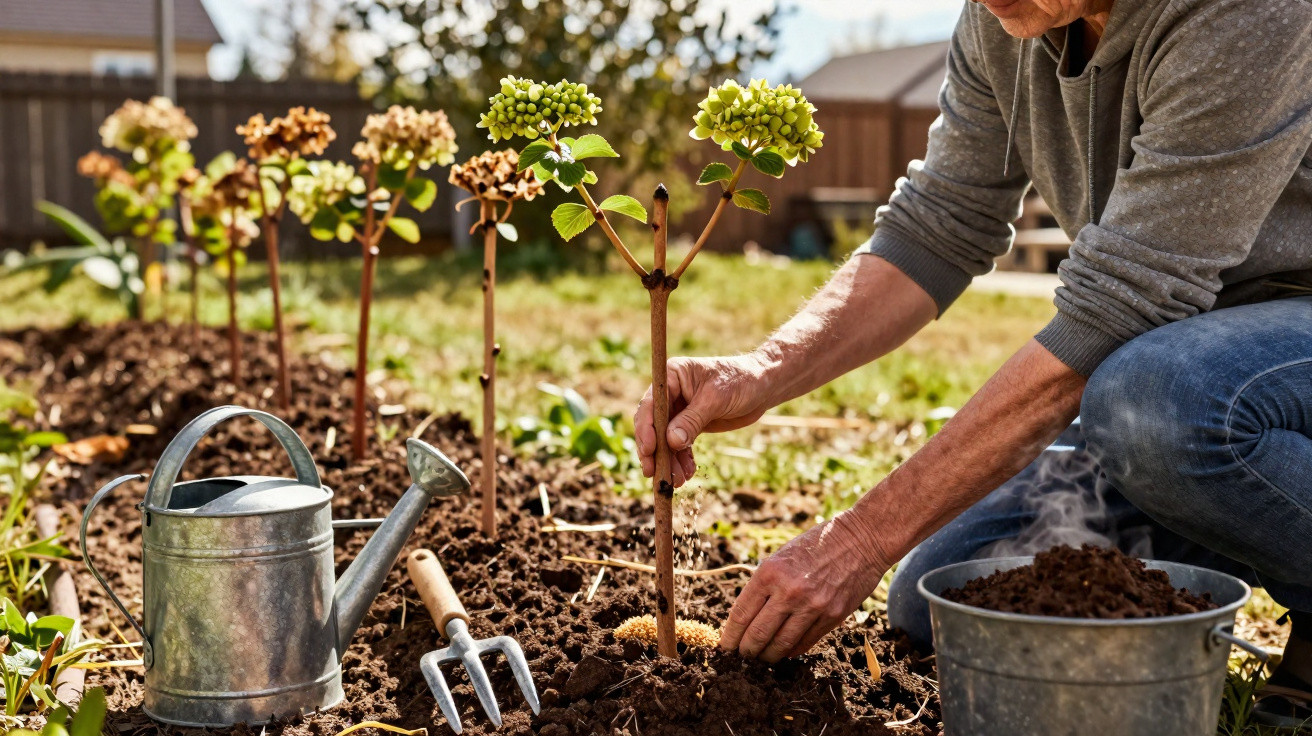
Many hydrangeas look like green balls with no colour in summer – yet the crucial mistake is often made quietly in late winter.
Anyone who sees only lush leaves rather than large flower heads on their hydrangeas in July is often left puzzled. The cause is rarely summer itself, but what happens – or fails to happen – in February. A targeted nutrient boost before March determines whether the shrubs later overflow with flowers or produce nothing more than attractive foliage.
Why late-winter care determines the abundance of hydrangea flowers
Hydrangeas are classic shrubs for partially shaded borders and containers. However, many gardeners underestimate how strongly these plants begin preparing for the coming season at the end of winter. As the days lengthen and temperatures rise slightly, sap starts moving through the plant. This is when the shrub begins forming the buds for summer.
At this point, the plant needs ample nutrients to develop flower buds. If the soil provides too little, it automatically directs its energy into fresh shoots and leaves. The shrub may then look healthy and richly green, yet produce disappointingly few flowers.
“Feeding hydrangeas deliberately before March directs the plant’s energy early towards forming flower buds – rather than pure foliage.”
Depending on the region, the critical window is roughly from late February to mid-March. In milder areas, it may start a little sooner, while at higher elevations it can begin one or two weeks later. Anyone who acts too late at this stage will struggle to make up for the deficiency later in the season.
Which fertiliser hydrangeas really benefit from now
Hydrangeas are considered hungry plants, but they do not tolerate harsh, aggressive fertilisers. What they need is a gentle, consistent supply of nutrients. Well-rotted compost has proved particularly effective.
Compost as a gentle all-round booster
Mature compost acts like a long-term buffet for the roots. It feeds the hydrangea, improves soil structure and supports soil life. This strengthens the shrub without overwhelming it.
- Layer depth: around 7–10 cm
- Area: approximately 40–50 cm around the shrub
- Spacing: do not place it directly against the shoots; leave a small gap around the stem
The compost forms a loose mulch layer. Each shower of rain and every watering gradually washes nutrients into the root zone. This gives the plant small, readily available amounts over several weeks instead of a brief “nutrient shock”.
Specialist fertiliser for gardeners without their own compost
If you do not have garden compost available, a specialist hydrangea fertiliser from a garden centre is the better choice. Organic or organo-mineral products with slow nutrient release are ideal. Hydrangeas suit formulations with a moderate nitrogen content and a good proportion of potassium, for example NPK values in the range of 7-4-5 or 8-3-9.
Important points when choosing one:
- long-lasting action rather than a rapid “turbo treatment”
- suitable for ericaceous plants or specifically labelled for hydrangeas
- no extremely high nitrogen values
“With hydrangeas, less but more regularly is the rule. Too much fertiliser produces leaves, not flowers.”
It is best to use an amount towards the lower end of the recommendation on the packet. A reduced dose is entirely sufficient, especially for plants that have been well established for several years.
How to apply hydrangea fertiliser correctly
Simply tipping fertiliser directly around the stem wastes much of its potential. The important area is where the fine roots are located. These usually extend much farther out than the visible shrub suggests.
Step-by-step guide for a border
- Clear leaves and weeds from the soil around the hydrangea.
- Spread fertiliser or compost in a broad ring – most active roots are found beneath the outer tips of the shoots.
- Do not press the layer directly against the shoots; leave a narrow circle around the stem clear.
- Work it lightly into the surface with a rake, taking care not to damage thick roots.
- Water thoroughly afterwards so that the nutrients dissolve and reach the soil.
For hydrangeas planted in the ground, one main application in late winter is generally enough. On very sandy soils, a light additional feed in early May can be useful, but it should be applied at a much lower rate.
Feeding hydrangeas in containers correctly
In pots and containers, watering and rain leach nutrients from the compost much faster. Here, a single application before March is usually insufficient. Alongside the basic late-winter feed, the plant needs one or two additional, very moderate applications from May to July.
A practical schedule for container-grown plants:
- in February/March: a base feed with compost or specialist fertiliser
- in May: a small additional feed, around half the base amount
- in July: a final light nutrient boost so flowering does not falter
If you use liquid fertiliser, it is better to add small amounts to the watering can more often rather than applying a high dose infrequently. This protects the roots and keeps growth even.
Common mistakes that cost hydrangea flowers
Many issues with hydrangeas that are reluctant to flower can be traced back to recurring misunderstandings. A few adjustments can greatly improve the chance of abundant flower heads.
Too much nitrogen, too little flowering power
General-purpose fertilisers with a very high nitrogen content mainly encourage leafy growth. With hydrangeas, this creates the familiar result: lush green and vigorous, but with only a few flowers. If you have these products in the shed, they are better used on lawns or vegetable plants, not hydrangeas.
A further issue arises when several products are combined. For example, if a slow-release fertiliser is mixed into the compost and liquid fertiliser is also applied regularly, the total amount can rise sharply. The plant then responds with soft growth that is more susceptible to problems.
Poor timing and stressed plants
A late, heavily dosed application of fertiliser in high summer acts like a growth command at the wrong time. The hydrangea then mainly produces fresh shoots that cannot mature properly before autumn. They are more likely to die back in winter, and the plant needs considerable energy simply to recover in the following year.
Stress factors such as waterlogging, prolonged drought or intense sunshine weaken hydrangeas further. Even with ideal nutrition, the shrub may reduce its number of flowers in these conditions to conserve energy. Feeding is therefore no substitute for suitable growing conditions.
What else affects hydrangea flowering and colour
As well as fertilising, pruning and soil reaction play a part. Many popular varieties flower on the previous year’s wood. Anyone who removes these shoots radically in spring simply cuts away the buds that have already formed. Light shaping immediately after flowering is gentler.
The well-known shift in colour between pink and blue depends largely on soil pH and the availability of aluminium. Specialist hydrangea “blueing agents” usually contain alum and work only in fairly acidic soils. Overapplication damages the roots and makes the plant more sensitive. Anyone using these products should follow the manufacturer’s instructions very carefully.
To strengthen hydrangeas over the long term, use a combination of thoughtful nutrient supply, a suitable position and restrained pruning. The early fertiliser application before March provides the foundation. Used correctly, it turns an otherwise robust green shrub into a flowering star that defines the patio and garden for weeks.













Comments
No comments yet. Be the first to comment!
Leave a Comment