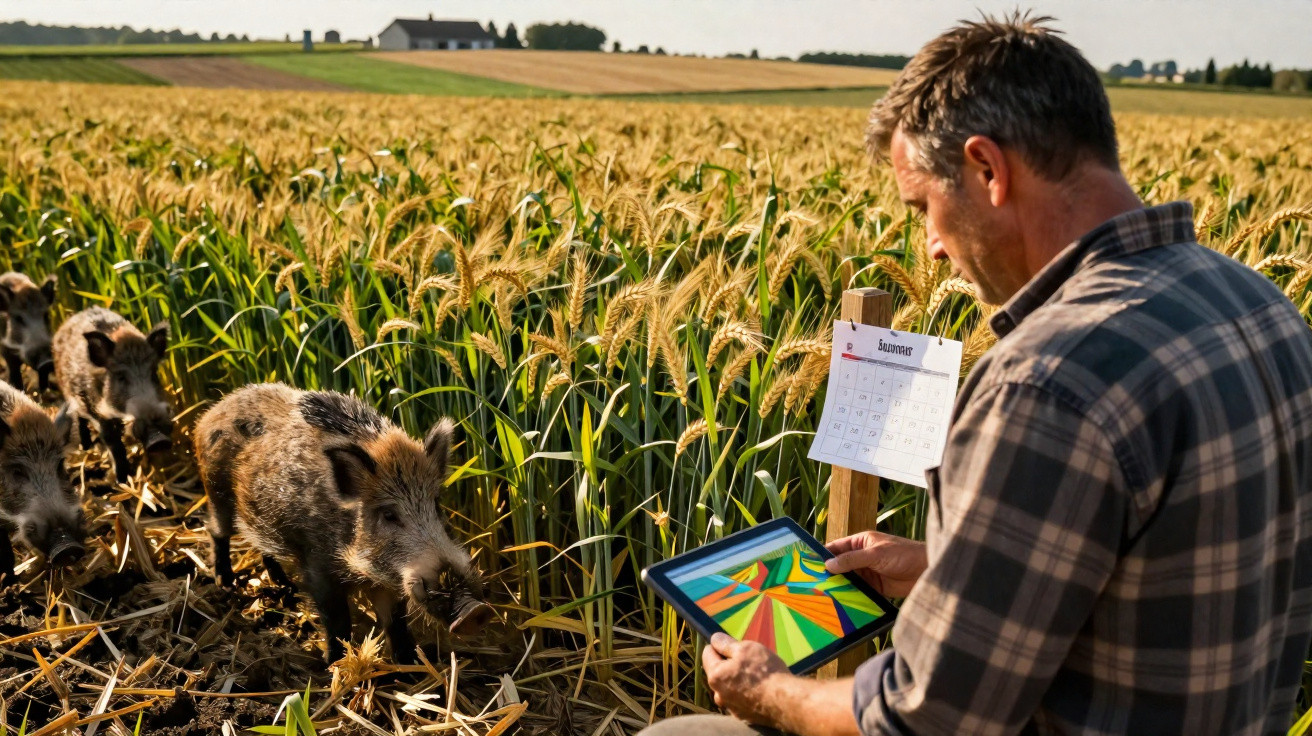
A long-term scientific investigation has shed new light on how wild boar use agricultural landscapes. Rather than behaving unpredictably, these strong, adaptable animals follow a distinct seasonal routine, with farmers facing the greatest impact during the warmest part of the year.
Wild boar raids follow the farming calendar, not chance
The research, conducted across more than 20 years on roughly 5,000 hectares of farmland, examined 9,871 documented incidents of crop damage caused by wild boar. Over that period, the landscape changed very little: crop types remained the same, field sizes were comparable, and planting and harvesting schedules stayed consistent.
When the countryside stays predictable, wild boar behaviour becomes predictable too – and that makes their raids painfully regular.
Researchers found that boar follow the agricultural calendar much like experienced farm workers. As the seasons progress, they switch between crop types, targeting the food source that provides the greatest nutritional return for the smallest effort.
Why summer and autumn are the danger zones
Although boar damage crops in every season, the evidence reveals a pronounced rise from summer through to late autumn. This schedule is closely linked to events in the fields rather than being random.
Spring: fewer attacks, but often brutal
Wild boar populations are comparatively low in spring. Many animals are still recuperating after winter, while the year’s young have not yet fully joined the intensive feeding activity.
- Their attention turns to grassland, pasture and meadow.
- Damage events occur less often.
- However, a single raid can destroy extensive areas overnight.
With fewer animals competing for food, groups can focus on one area and churn up the ground with their snouts in search of roots, bulbs and invertebrates. Farmers may file fewer reports in spring, but the losses from each individual incident can be severe.
Summer: cereals become the main target
The arrival of summer changes the situation completely. As grain crops ripen, they provide an energy-rich food supply defended only by slender stems and fences that frequently prove ineffective after dark.
Wheat, barley and other cereals become the centre of attention just as the wild boar population swells with new litters.
A higher number of animals across the landscape leads to:
- More entries into fields.
- More individual plots being affected.
- Slightly less severe single events that happen much more often.
At this point, boar can visit multiple fields within one week. One sounder – a family group – may trample and consume enough grain to eliminate a small farmer’s seasonal profit.
Autumn: legumes and roots take the hit
As autumn begins, cereals become less attractive. Harvesters move through the fields, remaining grain is cleared, and boar redirect their feeding once more.
Early in autumn, legumes including beans and peas draw hungry animals. Later, root crops become the priority, including potatoes, beet and other underground food stores rich in starch and sugar.
The highest number of damage incidents occurs in early and mid‑autumn, when wild boar numbers and food demands peak together.
Root crops are especially exposed because boar are instinctive diggers. A field that appears undisturbed at sunset may be covered with craters by morning, with plants pulled out and rows destroyed as though a plough had crossed it at irregular angles.
Why the pattern repeats every single year
The most notable finding is not merely that this seasonal cycle occurs, but that it returns almost unchanged year after year. Its cause is the consistent nature of the agricultural landscape.
Fields remain small, crop choices change little, and farmers continue with established rotations and sowing dates. For an intelligent and opportunistic species such as the wild boar, these conditions provide a clear opportunity.
Boar hit the crops that give them the most calories for the least effort, and they do it on roughly the same dates every season.
During spring, when competition between animals is lower, boar can devote more time to a single site, resulting in highly damaging raids. As the year progresses and new litters are born, more animals must feed across the landscape. The pressure then becomes more dispersed: instead of a small number of severe attacks, farmers face a wider spread of smaller yet more frequent incidents.
Since the available food changes so little, boar have little reason to change their strategy. The agricultural timetable sets the pattern, and the animals follow it.
From reaction to anticipation: what this means for farmers
For many years, farmers have regarded wild boar damage as misfortune: one disastrous year followed by another that is relatively quiet. By mapping raids over two decades, the scientists demonstrate that the issue is not random. That creates new possibilities for managing it.
If the calendar of attacks is predictable, prevention can be targeted, cheaper and more effective.
Timing defences, not just building them
Rather than applying equal levels of protection throughout the year, the research supports a more strategic approach:
- Strengthen protection around cereal fields in early and mid-summer.
- Move efforts towards legumes during early autumn.
- Give root crops particular protection in late autumn, when pressure is greatest.
Measures may include temporary electric fencing, night patrols during key weeks, or deterrents based on noise, light or scent barriers. No single tool is fully effective on its own, but using them at the correct time can substantially reduce losses.
Health risks: when crowded boar meet domestic pigs
The study also highlights concerns beyond financial damage. Large groups of boar moving through farmland raise the risk of animal disease transmission, particularly where pig farms are nearby.
High boar densities in late summer and autumn can act as a bridge for viruses between wild populations and domestic herds.
One of the principal concerns is African swine fever, a viral disease that does not affect people but can devastate pig herds and lead to trade restrictions. Boar may carry the virus, release it into the environment, and move close to fencing around outdoor pig units.
Health authorities already advise measures including:
- Limiting avoidable contact between boar and domestic pigs.
- Securing feed stores and carcass disposal sites.
- Arranging targeted population control in areas with high numbers.
Here too, the seasonal cycle is important. Understanding when and where boar gather enables veterinarians and farmers to reinforce biosecurity at the appropriate time, rather than doing so months too soon or too late.
What “density” and “damage incidence” really mean
Two terms regularly used in this type of research may sound theoretical. For people working on the land, however, their meaning is very practical.
“Density” describes the number of boar within a particular area, normally expressed as animals per square kilometre. On the ground, it indicates how often tracks, droppings or the animals themselves are seen. Greater density nearly always results in more field visits.
“Damage incidence” describes the number of distinct recorded events rather than their seriousness alone. One area may experience dozens of minor incursions, while another has only a few major raids. Both patterns cause harm, but each requires a different response: widespread monitoring for dispersed incidents, and intensive protection where severe raids recur.
Imagining the next harvest: a realistic scenario
Imagine a mixed farming area containing cereal, bean and potato fields. In May, torn turf appears in two meadows, and one farmer dismisses it as “just boar being boar”. By July, the grain is tall and golden, while camera traps begin recording family groups moving through hedgerows at night.
By late August, damaged cereal ears and flattened areas lead to insurance claims. A month later, the boar begin raiding bean fields before digging into potato crops. Without preparation, every farmer must deal with the issue separately. With an understanding of the seasonal cycle, they could have shared resources, taken turns on patrols and put up temporary fencing only during the one or two months when their crops were most appealing.
This is the understated change supported by the long-term evidence: less panic and more effective timing, based on a clear understanding of how wild boar align their feeding movements with the agricultural year.







Comments
No comments yet. Be the first to comment!
Leave a Comment