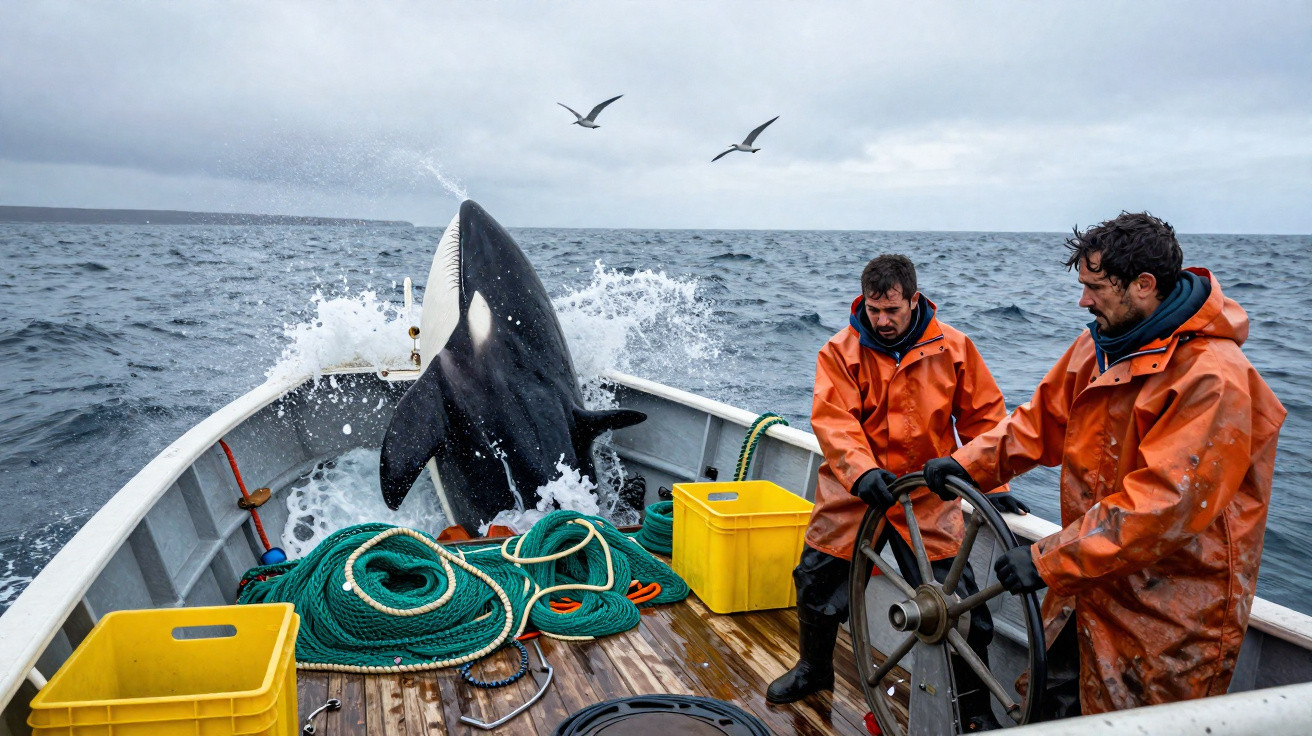
By mid-afternoon, the VHF radio was alive with half-serious jokes about “orca season” and damaged hulls - the sort of dark humour fishermen resort to when real concern is setting in. Then the first shark struck the boat with the force of a swinging sledgehammer, scattering coffee, knives and shouted curses across the deck. Beyond the turmoil, black dorsal fins traced slow circles through the water, always just beyond reach. The crew became convinced that the orcas were driving the sharks towards them, turning the predators into living weapons. A longstanding fear had collided with a distinctly modern nightmare, and the ocean suddenly seemed to be on the other side.
“They used the sharks on us”: a terrifying day at sea
It began with a sound no fisherman is likely to forget: the deep, bone-jolting crack of something substantial hitting the hull. The crew of a small commercial vessel offshore said they heard it three times before they grasped what was taking place. It was neither a floating log nor debris. A shark was hurling itself against the boat with a brutal, near-rhythmic impact. A short distance away, two orcas surfaced, blowing sharp white plumes before slipping beneath the dark green water again, as if awaiting a response.
Radio chatter quickly moved from joking to short, breathless reports. From farther out, the captain of a nearby boat watched as the vessel lurched hard and its bow swung clumsily into the swell. He later said he saw at least three sharks making tight circles around the hull, while two orcas observed the entire event from a broader circuit. It did not resemble a feeding frenzy. There was no clear blood in the water and no burst of foam at the surface. Rather, the scene appeared almost organised, as though every animal had a task. Drenched and trembling, the fishermen aboard felt not like hunters, but like the targets of somebody else’s experiment.
Marine behaviourists are wary of calling it an “experiment”, although they acknowledge that something out of the ordinary may be occurring. During the past three years, reports of aggressive orca interactions with boats have increased, particularly in the North Atlantic and southern oceans. In some incidents, orcas directly ram vessels. In others, including this account, sharks behave unusually while orcas remain nearby. Scientists stress that firm evidence is still limited, and that nature does not “plot” in a human way. However, orcas are recognised for inventive hunting techniques that can be culturally passed between pods. Set that alongside pressured shark populations and changing sea temperatures, and the result is an unsettling picture: predators may be adapting more quickly than people can interpret.
How fishermen are changing their behaviour at sea
At the docks the following morning, the prevailing mood is a mixture of anger and subdued reassessment. The skipper whose vessel was struck now carries out safety drills he once overlooked. Life jackets are clipped in accessible places rather than hidden beneath equipment, while radios are checked twice before the boat leaves the harbour. He has also altered his routes, staying away from recognised orca hotspots and deep drop-offs where sharks commonly circle. That decision reduces his earnings on calm days. When conditions are rough, he says it seems to be the only sensible choice remaining.
Some vessels have begun taking basic deterrent kits aboard: metal pipes for striking the hull, waterproof speakers that send low-frequency sound into the water, and even bright strobe lights for night passages. Nobody believes these measures guarantee safety. Even so, having a response plan is preferable to waiting silently for another unseen collision. Over coffee, crews discuss “if this, then that” situations: how to react if a shark damages the rudder, how rapidly to send a mayday, and who should remain inside while another person watches the deck. This is not panic. It is a restrained, hard-won recognition that the terms of engagement with the sea are changing.
Marine authorities advise combining traditional seamanship with greater awareness. Boats should keep clear of any orca group, even one that appears playful. If large sharks repeatedly circle a hull, crews should stop the engine or alter course. Fish waste should not be thrown overboard in places where predators could associate boats with easy food. Such precautions do not “control” wild predators; they simply improve the odds. In a world of stronger storms and less predictable migrations, those small advantages matter more than ever. The fishermen who adjust most effectively may not be the bravest or most daring, but those who accept that the ocean is revising its own rulebook.
Fear, anger and an uneasy new pact with the ocean
For many crews, the emotional consequences are more severe than the physical damage. Some fishermen have worked the same waters for three decades without one dangerous encounter involving orcas. Now, when they try to sleep, they replay the sound of sharks striking steel. Insurance offers no payment for that. Nor can it cover the instant when a teenager in their first season at sea grips the rail with white knuckles and understands that the boat is not the largest or toughest presence out there. On a small quay, news moves quickly, and every retelling makes the details slightly more vivid.
Anger is also entwined with an uneasy sense of guilt. These fishermen and women depend on the ocean for their livelihoods, yet they love it with a fierce, almost irrational devotion. When they speak of “weaponized” orcas or sharks apparently gone rogue, they are not demanding culls or crackdowns. They want to know why the balance feels wrong. Many believe overfishing, warmer waters and reduced prey stocks are forcing apex predators into more hazardous, experimental behaviour. At a human level, that does not make a night crossing in heavy swell feel any safer. But it does make it harder to cast the animals as villains. In the most literal sense, everyone out there is simply trying not to starve.
One experienced skipper, his hands marked by rope burns and engine grease, sums it up with a shrug:
“The orcas aren’t evil, the sharks aren’t crazy. They’re hungry and smart. We’re the ones who changed the rules and forgot we had.”
Behind that blunt observation lies a quieter collection of realities:
- Fishermen are reconsidering routes and seasons through necessity, not preference.
- Scientists are working urgently to understand emerging patterns despite limited data and funding.
- Coastal communities feel trapped between conservation aims and their own survival.
Personally, the most difficult part is the anticipation: seeing a black fin break the surface in the distance and not knowing whether it signals a peaceful sighting or another report for the evening news. Let us be honest: nobody faces that every day without sacrificing some part of their peace of mind.
The ocean’s next move
On the calm morning before the first collision, one member of the crew had been recording the horizon on his phone merely to pass the time. The footage shows the camera drifting aimlessly, casual conversation and waves gently slapping against the hull. Then a dark shape slips beneath the surface, scarcely visible, like a ghost passing along the edge of the image. He did not notice it at the time. Only when he replayed the recording later did he stop the video and feel his stomach sink. The distance between normal routine and chaos was no more than three seconds.
Accounts like this travel more quickly than scientific research. They influence how people perceive the sea, how children picture orcas and sharks, and how coastal communities discuss climate change without naming it directly. On social media, some viewers support the animals and call it “nature’s revenge.” Others strongly back the crews, angry at what they regard as a system that safeguards predators more than people. Neither response fully captures the complexity. Yet both reveal how deeply these confrontations awaken something ancient in us: awe, fear and persistent curiosity when the ocean reminds us who truly owns the map.
No one can say with certainty whether orcas are deliberately “manipulating” sharks in a strategic way, or whether people are seeing overlapping behaviours within a stressed ecosystem. What is certain is that the era of treating the sea as an unchanging backdrop has ended. It is shifting, responding and adapting before our eyes. The next time a fishing boat heads out beneath a pink dawn, its crew will make jokes, drink coffee and complain about fuel prices. Then someone will watch the surface for slightly longer than they once did, searching for a dark fin cutting through the light. The issue is not whether predators are watching; it is how people choose to live with that awareness.
| Key point | Detail | Why it matters to readers |
|---|---|---|
| Orcas and sharks: an unexpected pairing | Witness accounts describe sharks striking boats while orcas circle nearby | Understand why these shocking scenes are becoming more common along coastlines |
| Fishermen on the front line | Altered routes, new safety habits and a persistent fear aboard | See the practical effect on the lives of people who genuinely make their living from the sea |
| An ocean changing its rules | Pressure on prey, warming waters and bolder predator behaviour | Consider how choices on land can have consequences far offshore |















Comments
No comments yet. Be the first to comment!
Leave a Comment