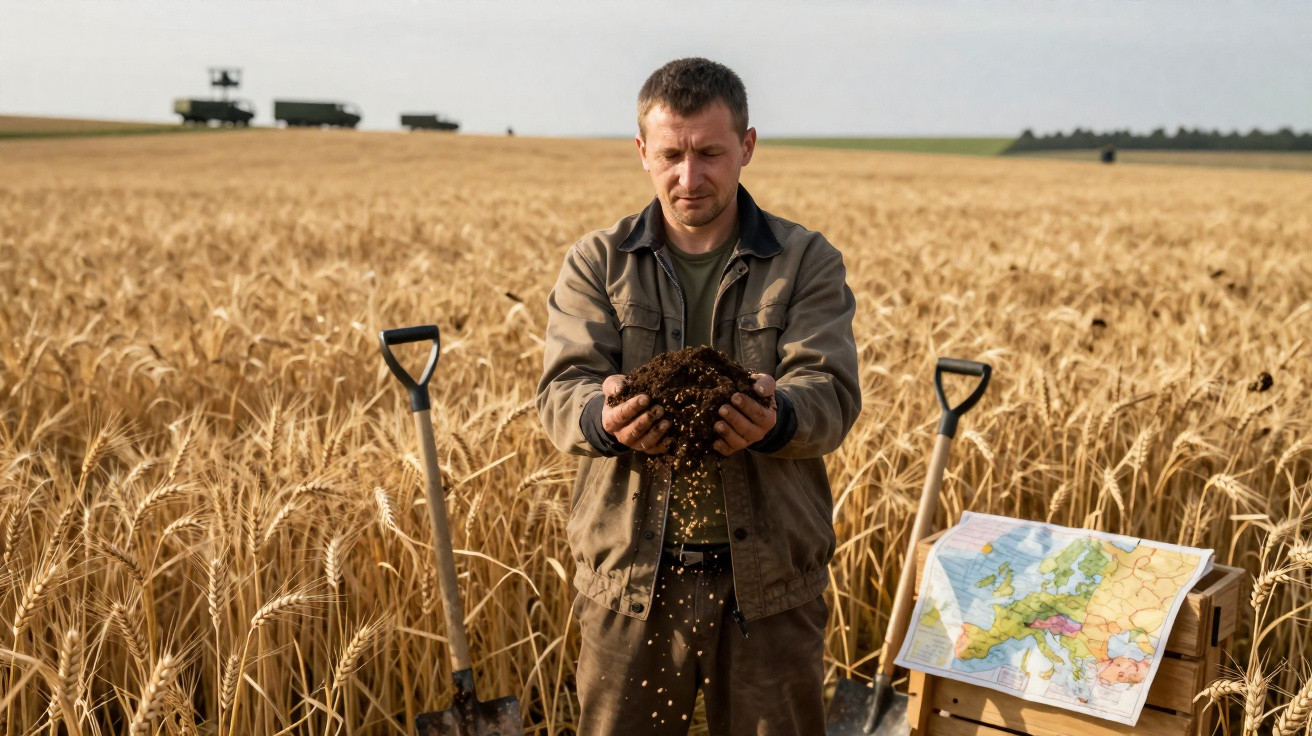
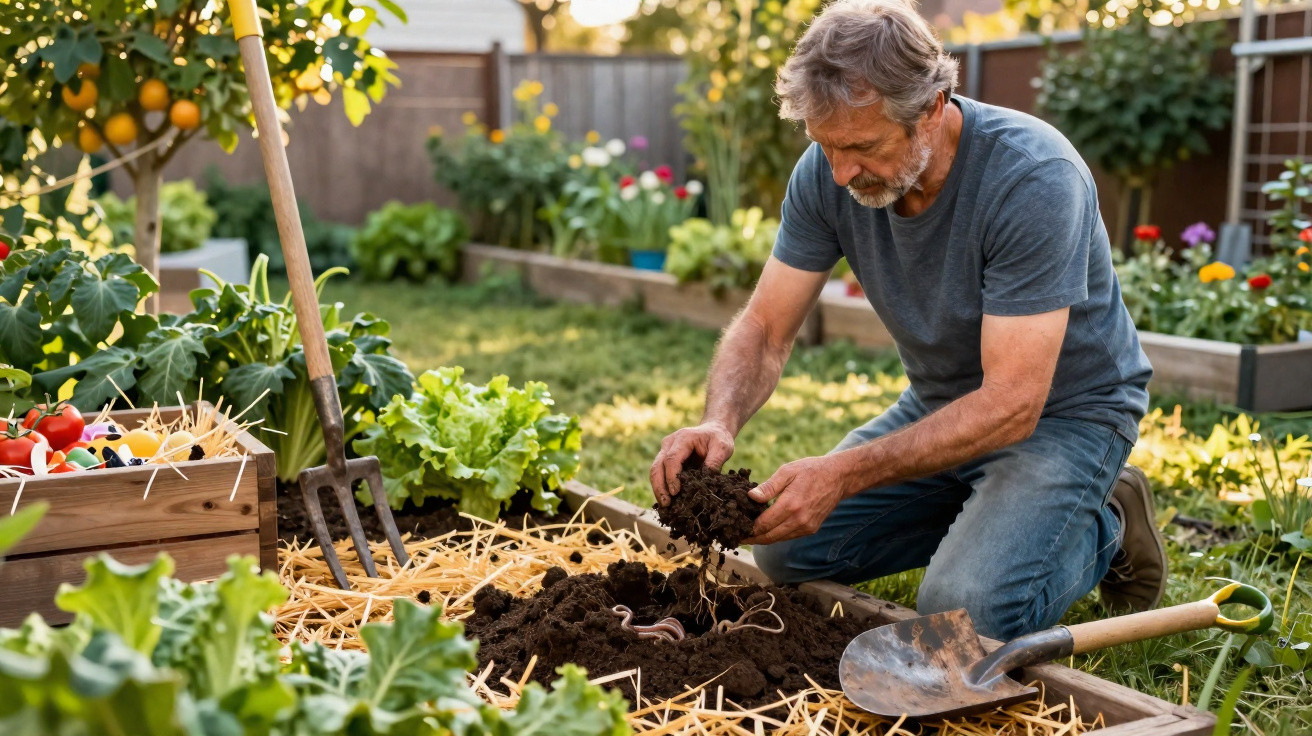
One of the men crouches, rubbing a handful of soil through his fingers as his father and grandfather once did. It drops in soft, fragrant clods, full of the scent of life. But their conversation is not about forecasts or harvests; it is about solicitors, boundaries and neighbours who have disappeared.
Known in the past as “black gold”, this earth created wealth and fed empires. Now it drives disputes over title deeds and satellite imagery. Families that once shared tractors now face one another in court. Soil that was once simply soil has become the prize in a drawn-out struggle reaching from village tracks to faraway capitals.
The land beneath their boots is no longer just land. It is leverage.
Black gold on the steppe: when soil becomes a weapon
Viewed from space, Eurasia’s “black belt” resembles a vast bruise spreading across the map through Ukraine, southern Russia and northern Kazakhstan. At close range, chernozem is striking: intensely black, deep and velvety. Farmers say that you could push a broom handle into it and grow a tree. For generations, this ground offered a straightforward promise: work it, and it will feed you.
That promise remains, but its value has risen. With climate shocks unsettling harvests worldwide and wars interrupting shipping routes, this soil is becoming a strategic resource. Fields once relevant only to a local cooperative now feature in geopolitical calculations in Moscow, Kyiv, Astana… and Washington.
When land turns into strategy, neighbours can turn into competitors.
Before Russia’s full-scale invasion, two brothers in a dusty village near Kherson cultivated neighbouring wheat fields. Their boundary was no more than a shallow ditch, along with a running joke about whose tractor was older. Then came land reforms, overseas purchasers and unexpected attention from a company whose connections nobody could properly establish. One brother agreed to sell; the other declined. The ditch became a legal boundary, and the joke vanished.
Similar accounts are heard throughout the steppe. In Russia’s Black Earth region, farmers allege that major agro-holdings use political links to absorb small parcels. In Kazakhstan, herders say that fenced-off black-soil areas are cutting them off from grazing routes used by their grandparents. One local campaigner told me about farmers waking to find new stakes defining “new” boundaries that had previously existed only in an office hundreds of kilometres away.
The figures reveal the same strain in clearer form. Ukraine’s black soils cover approximately 60% of its territory and, before 2022, helped make the country one of the world’s leading exporters of wheat, maize and sunflower oil. Russia’s chernozem belt supports its own rise in grain exports, which in many years now exceed those of the European Union. Kazakhstan, whose black-soil areas are more extensive but less continuous, is presenting itself as an alternative source for markets uneasy about Russian and Ukrainian risk. On paper, these are trade statistics. In the fields, they feel like pressure.
The reality is brutally straightforward. As the world recognises how scarce this exceptionally fertile soil is, the land above it begins to resemble oilfields rather than countryside. Ownership boundaries become more rigid. Corruption finds inventive forms. Satellite-steered tractors share the skyline with military drones. The same black earth that puts food on tables from Cairo to Beijing has become a negotiating token in sanctions discussions and grain-corridor talks.
For farmers, the change can be disorientating. In one season, they are deciding which seed varieties to sow. In the next, they are receiving delegations, completing intricate lease agreements and reading foreign-policy reports about their own villages. The soil did not transform overnight; the world’s view of it did.
How “black gold” deepens the rift between Ukraine, Russia and Kazakhstan
Consider the recent disputes over grain agreements between Russia and Ukraine, and black soil sits behind every headline. Ukraine’s most productive chernozem areas are in regions that have experienced front lines, bombardment and occupation since 2014, and much more intensely since 2022. Fields that once loaded grain on to ships crossing the Black Sea are now mined, burned or controlled under competing flags.
Both sides invoke the soil to support their own account of events. Ukrainian officials speak of harvests stolen and farmland seized at gunpoint. Russian authorities describe the same territory as “liberated” land with roots stretching back to imperial times. Kazakhstan, while officially more restrained, is quietly increasing cultivation on its fertile northern land in the hope of attracting buyers unwilling to rely entirely on either side of the war.
Here, the conflict becomes granular - literally at ground level. In border areas between Russia and Kazakhstan, farmers dispute drainage schemes and irrigation channels that can alter the value of a strip of ground on one side or the other. In Ukraine, cooperative members accuse one another of “collaboration” over who sold grain during which occupation. Once this is visible, it is difficult to ignore: the battle for territory is also a battle over control of the most productive land.
On a cold morning near Kursk, a Russian agronomist explained to me that his company’s new fields had “come back” into national ownership after previously being linked to Ukrainian investors before 2014. He spoke with the pride of someone who had heard that account repeatedly. Across the border, a Ukrainian farmer showed photographs of the same place on his phone and called it “our black soil, stolen twice - first by oligarchs, then by invaders.” Two men, two narratives, and one strip of dark earth no wider than a village road.
Kazakhstan occupies a different, though equally precarious, position. Its northern chernozem regions have mixed populations, including substantial Russian-speaking communities, as well as long memories of Soviet agricultural campaigns. As climate change gradually alters weather patterns, these soils may become still more valuable than land in drier southern areas. Astana’s land policy is therefore quietly strategic: promote investment and greater yields, certainly, but without provoking fears over land sales to foreigners or inflaming ethnic tensions.
When black soil extends across borders, it brings tension with it. Ukraine fears losing not merely territory but the farming engine that finances much of its economy. Russia deploys its chernozem-driven export strength as both a soft instrument and hard leverage - offering cheap grain to allies while threatening supply shocks when relations with the West deteriorate. Kazakhstan carefully promotes itself as a “reliable partner”, while recognising that any abrupt land dispute could revive old anxieties.
International actors follow these signs closely. Grain traders monitor satellite images of harvests across black-soil areas in much the same way that energy analysts follow oil rigs. Development banks provide loans for “modernisation”, sometimes arriving in villages just as local farmers are bitterly contesting leased hectares. Amid it all, one simple fact remains in the background like a stubborn mark.
We are not merely disputing borders. We are disputing soil capable of feeding half the world.
Living with black gold: strategies, fears and quiet acts of resistance
For farmers caught within these seismic changes, getting by means becoming strategic in unexpected ways. Some establish small alliances, sharing machinery and intelligence to preserve bargaining strength against large agro-holdings or politically connected purchasers. Others discreetly record everything - agreements, GPS field coordinates and even mobile-phone footage of where their grandparents once planted sunflowers.
One Ukrainian cooperative near Dnipro started mapping its land collectively with inexpensive drones and shared software. Its purpose was not to impress investors, but to create evidence in case boundaries are challenged in court or, worse still, redrawn by force. Across the border in Russia, a group of smallholders exchanges yield data in a private chat to challenge what they say are unfair state quotas favouring larger farms. These are not prominent demonstrations. They are modest defensive measures in a landscape where soil has become political.
Kazakh farmers, who often manage enormous areas of steppe, test blended approaches: they grow export crops on the best black soil while retaining some land for local cereals and fodder. This helps prevent complete dependence on outside shocks. They know how fast policies can change in a distant capital. On the steppe, memories run deep and promises are met with courteous scepticism.
At a human level, the emotional cost is considerable. Farmers in all three countries describe sleepless nights spent wondering whether the land they cultivate will still belong to them in five years. Some regret accepting early leases that now seem worth very little. Others carry the opposite fear - that rejecting deals may have left them exposed to the worst effects of conflict or economic crisis.
During a hot July afternoon on the Kazakh side of the border, a farmer admitted that he sometimes missed the harsher days of Soviet collectives. “At least then,” he said, “we fought over tractor parts, not over who owns the horizon.” This mixture of nostalgia and resignation is widespread. On a productive harvest day, golden wheat rippling above black soil can restore faith in the future. Then a rumour of fresh land legislation, or a neighbour suddenly arriving in a far newer car, sends the anxiety rushing back.
We have all experienced the moment when something that seemed wholly personal - a home, family history or small business - is suddenly drawn into much larger forces. Land in the black-soil belt is experiencing precisely that, caught between local lives and global stakes. Let us be honest: nobody reads every legal page of a lease agreement each day. Yet within those dry clauses lie the seeds of future disputes, or of a fragile peace.
“This soil remembers everything,” an elderly Ukrainian farmer told me. “Wars, famines, good years, bad years. It will outlive all of us. The question is who it will listen to next.”
The remark stays with you because it suggests that a choice still remains, however limited. Black soil can be treated like oil - extracted, speculated upon and secured through legal and military force. Or it can remain something more complicated and human: shared, fiercely disputed, but with some recognition that you will still greet your neighbour at the field’s edge tomorrow. Neither course is untainted. Both are already unfolding at once across Ukraine, Russia and Kazakhstan.
- Ukraine relies on its black soil to fund resistance and rebuild its future, while managing war damage and the difficulties of land reform.
- Russia uses its fertile belt as an economic shield and a diplomatic weapon, even as consolidation puts pressure on rural communities.
- Kazakhstan follows a narrow path, wagering that its chernozem can raise living standards without triggering a backlash over who truly controls the land.
What this “black gold” story really says about us
The story of the world’s most fertile soil is no longer solely about yields and export figures. It concerns how rapidly something that sustains life can become divisive when scarcity and fear take hold. Once black soil is seen as “black gold”, the language becomes that of an investor or a general rather than a neighbour. “Our field” becomes an “asset”, “harvest” becomes “volume”, and a “border” becomes a “buffer zone”.
This change has consequences far beyond Eastern Europe and Central Asia. Whenever grain prices rise because a Black Sea corridor is closed, families in Cairo, Lagos and Dhaka feel the effects at market stalls. Whenever Ukrainian farmers lose access to their land, or Russian exports become a bargaining tool, another layer of vulnerability is added to the global food system. The richest soil on Earth is quietly showing how closely security, climate and the cost of bread are intertwined.
There is also a more personal, almost uncomfortable question: how should we respond to land when it suddenly becomes valuable to powerful people? Do we hold on more tightly, sell more quickly, resist discreetly or attempt to navigate the grey areas? Across the black-soil belt, every one of these responses exists side by side, sometimes even within a single family.
The fields outside Poltava, Kursk and Kostanay are indifferent to who walks over them. They will continue turning seeds into food long after today’s leaders have gone. But decisions now being made about ownership, access and force will determine who can stand in those fields in ten years’ time and call them “ours”. It is an uncomfortable thought, and perhaps that is the point. Some stories are not intended to reassure; they are meant to make us pay closer attention to the ground beneath our feet.
| Key point | Detail | Why it matters to the reader |
|---|---|---|
| Rarity of black soil | Chernozem covers limited areas in Ukraine, Russia and Kazakhstan, yet supplies global markets | Helps explain why distant land disputes affect food prices everywhere |
| Soil as geopolitical leverage | Control of fertile areas shapes grain deals, sanctions and diplomatic pressure | Demonstrates how apparently ordinary fields become instruments in international power struggles |
| Local human impact | Farmers face legal disputes, displacement and difficult decisions over land agreements | Makes a remote conflict tangible through real lives and emotions |








Comments
No comments yet. Be the first to comment!
Leave a Comment