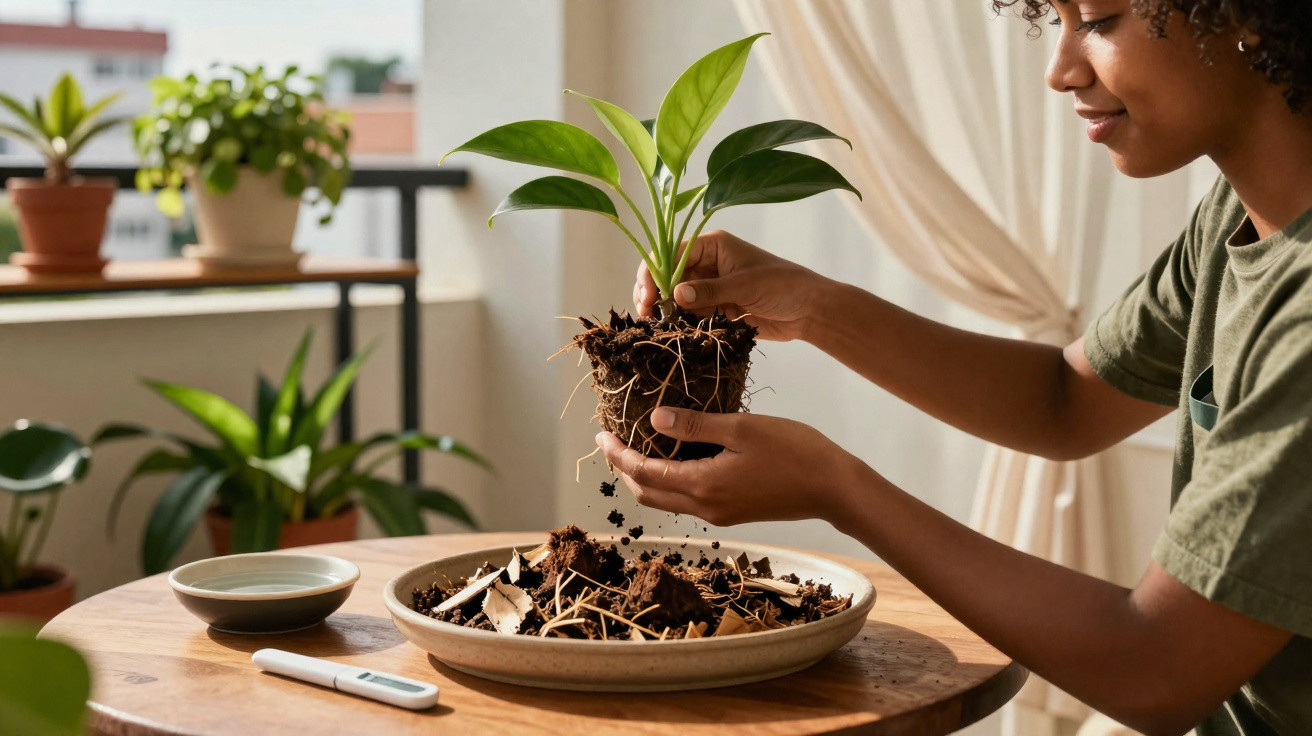
Two weeks on, its leaves were hanging over the pot as though its desire to live had simply been switched off. The light, watering can and attentive owner were all unchanged, yet the result was completely different. Nothing appeared different above the compost; below it, everything had started to become more complicated.
If you have ever pressed a finger into compost and thought, “But the soil is still wet, so it can’t be thirsty”, you are far from alone. Plant specialists hear this almost every day, and more of them are blaming the compost sold with plants rather than the people caring for them.
The understated reality is that some potting mixes do more than retain water: they imprison it. When that happens, a plant is not being hydrated – it is being suffocated.
When “good” soil turns into a silent trap
On a damp Tuesday in London, horticulturist and houseplant consultant Sarah James poured a freshly opened bag of “premium all-purpose potting mix” into a transparent glass jar. Initially, it seemed light, fluffy and promising. She then added water. In moments, the compost sank into a dense, shiny mass that stuck to the glass like cake batter.
“That,” she said, tapping the jar, “is what your roots are dealing with.” There is no air and no space to breathe, only a cold, wet barrier pressing against every root hair. A plant growing in that compost can still appear healthy from the outside, with glossy leaves, dark soil and a neat pot on its shelf.
Inside, though, it resembles a room with closed windows and dwindling air.
Researchers working on container substrates have a familiar joke: by squeezing a handful of compost, they can often predict a plant’s future. A mix that makes a firm, sticky ball and keeps its form is a warning sign. In one small study circulated by a UK houseplant nursery, dense, waterlogged compost straight from the bag was associated with more than 60% of returned “mystery deaths”.
One distraught customer sent the nursery a dying monstera. She had followed every watering guide she could locate, provided good light and used fertiliser sparingly. However, once the plant was removed from its pot, its roots were brown and soft, surrounded by compacted peat and decomposed fine particles with a faintly sour smell. Neglect had not killed the plant; it had effectively drowned where it stood.
Her experience is far from unusual. Similar stories are playing out repeatedly on windowsills in Manchester, Marseille and Melbourne.
Why dense potting mix suffocates roots
What, then, is taking place inside the pot? Plant physiologists put it simply: roots require oxygen just as much as they require water. In soil outdoors, small air pockets exist between mineral particles and organic material. That equilibrium is much more delicate in a pot. Fine, peat-heavy mixes gradually collapse, replacing those spaces with wet sludge.
Once water fills every pore, oxygen cannot enter. Beneficial microbes decline, while anaerobic bacteria take over and produce swamp-like compounds that can damage sensitive roots. A plant reacts to this lack of air as any living organism would: growth slows, foliage turns yellow and roots decay.
From above, it appears to be overwatering. Under a microscope, however, the problem is poor physics and even poorer soil structure.
How to make a potting mix your plants can breathe through
The answer does not begin with a watering timetable; it begins with the potting mix. Before shop-bought compost ever goes into a pot, many indoor-plant professionals discreetly modify it. They blend in materials that create structure and air: coarse bark for orchids and aroids, perlite or pumice for succulents, and a handful of coarse grit for Mediterranean herbs grown on a windowsill.
Rather than viewing it as simply “soil”, imagine it as a breathable mattress for roots. You need particles that retain their form when wet. Many professionals follow one straightforward guideline: at least one third of the mix should be visibly chunky. If it resembles chocolate powder, it will act like it once wet. If a handful springs back after being broken up rather than smearing across your fingers, you are heading in the right direction.
For everyday houseplants including pothos, philodendrons and monsteras, one widely used formula is approximately 50% quality peat-free compost, 25% bark chips and 25% perlite or pumice. It is not an exact science; it simply provides enough structure for air to keep circulating.
During a video call from her small Leeds flat, plant collector Amirah laughed while showing two snake plants. They were the same species and had been bought from the same supermarket on the same day. One remained in its original dark, fine compost, while the other had been repotted into a grittier blend containing extra pumice and bark.
“This one,” she said, indicating the original, “looked great for six months. Then the leaves started folding in and going mushy at the base.” Its roots had rotted in the waterlogged bottom half of the pot, where dense compost had blocked the drainage holes. In contrast, the plant in the airier mix had grown to twice its original size and produced new, firm leaves.
We all know somebody whose home is full of flourishing plants, despite irregular watering and a shrug when asked for their secret. Often, the explanation is almost embarrassingly simple: their compost drains well enough that exact timing becomes less important. Your care routine may not be at fault; suffocating compost may be making success difficult from the start.
In more technical terms, soil scientists refer to “porosity”: the proportion of a mix made up of air spaces and the proportion that holds water. Potting mixes that suffocate plants generally suffer from two problems. First, they contain too many fines – tiny particles that pack together and close off air spaces. Second, their organic material decomposes rapidly, causing the mix to shrink and leaving roots in a dense, oxygen-poor layer at the base of the pot.
Potting mixes slump as they age, while gravity draws smaller particles downwards. This explains why water may seem to run straight through a pot even though a heavy, saturated zone remains around the roots. It can seem as though the plant is drying out too quickly, prompting another watering. The surface dries while the bottom never does, and the cycle takes hold.
Seeing this changes the familiar explanation. Plants are not always harmed simply by “too much water”; often, the real damage comes from “too little air in the wrong kind of soil”.
Simple habits for keeping roots breathing instead of drowning
The most useful advice experts repeat is also rather unglamorous: repot before a plant becomes visibly distressed. New, well-structured compost restores the air-and-water balance. Fast-growing plants may need this each year, while slower-growing varieties may only need it every two or three years. If that sounds demanding, you are not the only one. Let us be honest: nobody really does that every day.
Many people rely on a small but deliberate repotting routine. Carefully loosen some of the old, compacted compost from the root ball, then set the plant in a pot with a layer of chunky mix underneath. Fill around the sides without pressing the mix down. Water it thoroughly once and allow the pot to drain freely in the sink. This is less about being naturally “good with plants” and more about giving roots space to breathe from the outset.
One of the most helpful things you can do is let go of the guilt around watering. Most people described as “overwaterers” are merely reacting to what they can see at the surface. When the top centimetre feels dry and dusty, reaching for the watering can is a natural response. Problems begin when that dry upper crust conceals what is happening deeper in the pot.
Botanist friends often give new plant owners the same straightforward checks. Pick up the pot: is it unexpectedly heavy for its size? That weight is trapped water beneath the surface. Ease the plant out and inspect it: are the roots firm and white, or brown and mushy? If the compost emerges as a dense, solid block, that is likely the true source of the problem. You are not letting the plant down; the soil is letting both of you down.
On a grey Sunday, when another calathea collapses, it is easy to conclude, “I just don’t have a green thumb.” The experts I spoke to strongly reject that idea.
“Plants aren’t dying because people don’t care enough,” says soil specialist Dr. Elena Ruiz. “They’re dying because we’ve normalised selling them in mixes designed for transport and shelf life, not long-term breathing. Once you switch to airier substrates, people suddenly ‘get good’ at plants.”
To make the change feel less daunting, many nurseries now offer simple visual guidance rather than technical language. They focus on how “good breathing soil” should look and feel, rather than listing ingredients alone.
- Compost should crumble easily when squeezed instead of forming a sticky ball.
- You should be able to see separate chunky materials, such as bark, pumice and perlite, rather than only fine dark dust.
- After watering, the surface should drain within a minute instead of remaining shiny and puddled.
These subtle hands-on checks contribute more to healthy roots than any elaborate watering-schedule app. They move attention away from the calendar and towards the compost itself.
Rethinking what a “healthy” plant is actually growing in
After seeing roots thrive in a well-structured mix, the contrast is difficult to ignore. The roots are thicker, whiter and almost eager in appearance. They grip bark pieces, thread through gaps in pumice and branch confidently into every part of the pot. The foliage above then becomes easy to understand: sturdier stems, more consistent leaves and fewer problems.
There is a broader change in thinking, too. You begin to see plants less as delicate ornaments and more as housemates with particular needs beneath their roots. When somebody says, “My fern keeps crisping, but I water all the time,” you no longer immediately blame their ability; you think instead of the suffocating peat plug in which that fern may still be trapped. The focus moves from moisture alone to air.
There is also an element that no guide can fully capture: the quiet pleasure of emptying old, saturated compost into the compost bin and creating something better from scratch. This time, the leaves do not wilt after watering. The soil becomes darker, then lighter again. The pot feels less heavy in your hands. The plant simply… carries on.
Somewhere on a shelf in your home, one of your plants may already be revealing something about its compost. It could be an unexplained yellow leaf, a pot that NEVER seems to dry out, or a slightly unpleasant smell when you water it. These are not accusations; they are prompts to investigate below the surface – both the surface of the pot and the old explanations we give ourselves for why plants die.
We live in compact homes and lead busy lives. We cannot control the weather or conjure up south-facing windows. Yet, right in front of us, in a plastic pot on a sill, is one of indoor gardening’s simplest improvements: compost that allows roots to breathe. Air, just as much as water, can transform “I always kill plants” into “I’m starting to get the hang of this”.
Sharing this realisation – that compost may be suffocating your plants and that a bag of bark plus a few minutes at the sink can change that – is often when friends suddenly understand. It is not about secret tricks or rare species. It is about giving quiet green companions the one thing they cannot ask for aloud: room to breathe.
| Key point | Detail | Benefit for the reader |
|---|---|---|
| Roots need air as much as water | Dense, waterlogged mixes prevent oxygen reaching roots and cause root rot | Explains why plants “overwatered” in some soils survive in others |
| Structure matters more than brand | At least a third of the mix should be visibly chunky (bark, pumice, perlite) | Provides a quick visual way to select or improve potting compost at home |
| Regular repotting restores porosity | Old compost slumps and compacts, gradually depriving roots of air | Helps you plan repotting before plants unexpectedly deteriorate |







Comments
No comments yet. Be the first to comment!
Leave a Comment