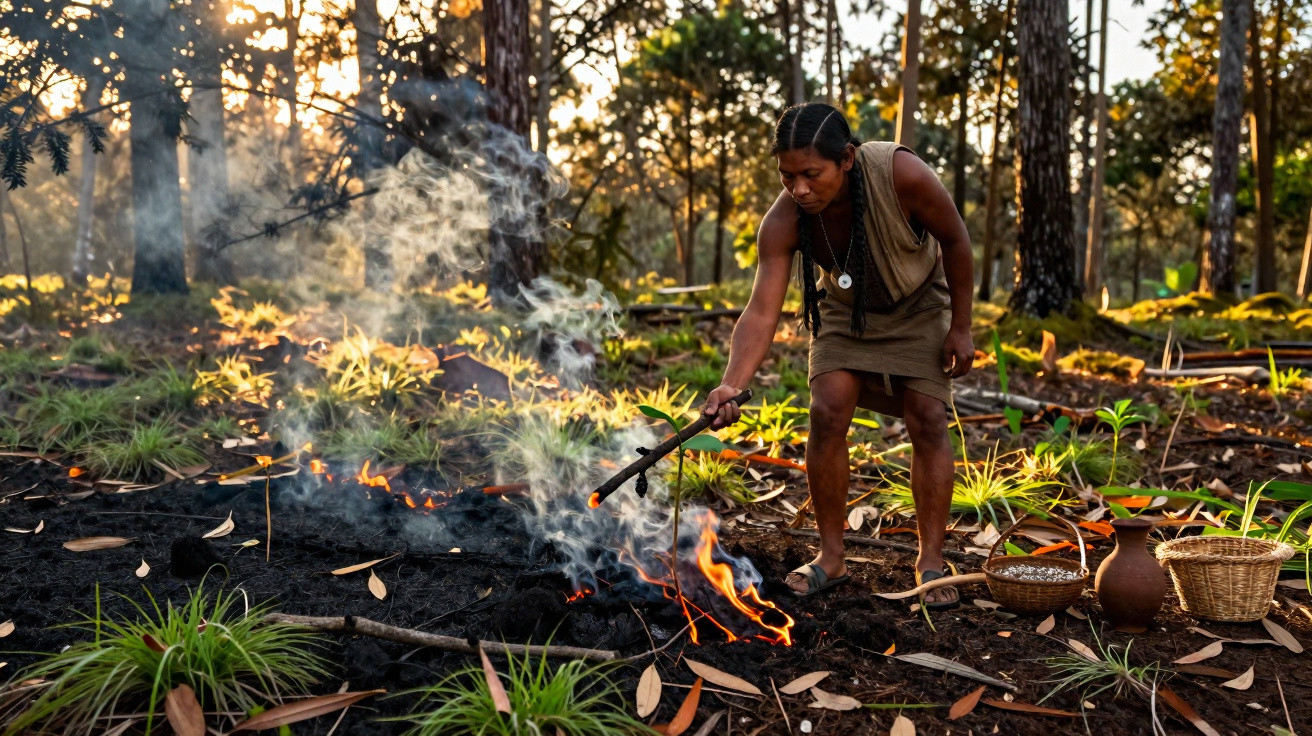
Low, blue smoke curls between pine trunks while children play beside a dusty car park, their bicycles left in the grass. Up on a ridge, elders lean over a slowly advancing line of fire, speaking softly as they observe needles ignite and flames inch forward. A water truck sits nearby with its engine running, yet nobody is alarmed. People laugh, and dogs weave through the gathering.
It is a burn day on Karuk tribal land in Northern California, and it resembles a community picnic with a clear purpose more than an emergency. A helicopter moves across the distant sky before disappearing. Apart from that, the sounds are the crackle of flames, birdsong and someone shaking a can of iced coffee before opening it.
Beyond these hills, mega-fires still tear through the landscape every summer.
Fire remembered, not feared
For more than a hundred years, Western policy regarded every wildfire as an enemy: extinguish it immediately, whatever the cost. This approach left forests crowded with undergrowth and dead timber, so densely packed that one spark could turn a whole valley into a blowtorch.
Indigenous communities had long offered another view: fire is not only destructive; it is a tool and a relationship. That understanding is now beginning to gain ground. Across North America, Australia and parts of Europe, more than 18,000 traditional fire practices are being recorded, revived and incorporated into formal fire-management plans.
These are not dramatic infernos. They are controlled, low-intensity burns led by people who can interpret wind, moisture and vegetation as if reading a book. Quietly, they are changing the meaning of a “fire season”.
On Yurok and Karuk lands in California, on Noongar country in Western Australia and in Canada’s boreal forests, Indigenous-led burn crews are returning to landscapes from which their grandparents were displaced. Researchers following these initiatives have identified a striking pattern: areas managed with cultural burning are not merely less prone to erupt into mega-fires. They are greener, calmer and more full of life.
Consider the 2021 fire season in parts of Northern California. Satellite information later found that forest sections repeatedly treated with cultural burns performed far better than untreated neighbouring slopes. Fewer trees died and fire intensity fell. In certain places, flames stayed close to the ground, meeting previously burned strips as though they had struck a wet towel.
In Western Australia, traditional mosaic burns have reduced the scale and severity of late-season wildfires across some Aboriginal-managed land. Fire behaviour is not the only thing that shifts. Kangaroo populations recover. Some seeds germinate solely after a cool burn. Berry patches reappear, followed by the people who once gathered from them.
When fire is absent, forests do not simply become “safer”; they become imbalanced. Species that favour shade overwhelm those that need sunlight. Pests flourish in tightly packed, stressed woodland. Large, intense fires become more probable rather than less so. This is the paradox now acknowledged by many scientists: the drive to suppress fire helped create the ideal fuel bed for disaster.
Traditional burning cycles break that pattern. Frequent, mild fires effectively reset sections of woodland according to a timetable suited to local wildlife and plants. Woodpeckers gain new snags. Oaks have room to expand. Grasses emerge in sunny clearings where elk and deer can feed.
This is not romantic nostalgia. It is ecosystem engineering, refined over thousands of years by people who depended on the land to provide food year after year.
How traditional fire works in practice
For a crew using traditional methods, conversation comes before the drip torch. Elders discuss wind patterns, earlier fire scars, and which plants “like” being burned and which do not. Timing matters: a spring burn over damp ground behaves differently from an autumn burn in a dry northerly wind.
Crews commonly begin around a patch’s edges, igniting brief test strips to learn how the fire “speaks”. If it runs too quickly, they stop. If it creeps along, they build a gradual moving front. They may retain islands of scrub for birds to shelter in, or avoid plants that would not withstand even a mild flame.
The aim is precise rather than spectacular: it is like pruning a landscape with fire instead of shears.
Modern agencies generally design burns using models and spreadsheets. Indigenous fire knowledge contributes something far more difficult to programme: memory. People recall where a previous fire became too hot, where an old path formed a natural break, and where smoke drifted towards a vulnerable village. This experience-based mapping informs every subsequent burn.
At a recent cultural burn training event in Oregon, tribal fire practitioners guided agency staff along a meadow boundary scattered with oak trees. They discussed acorn harvests, the trees’ cultural importance and the insects inhabiting their bark. They then demonstrated exactly how high they wanted flames to reach on the trunks: high enough to remove moss and ladder fuels, but not enough to damage the cambium.
From above, the outcome resembles an uneven quilt, with blackened sections, green refuges and charred lines that later act as firebreaks. That patchwork is invaluable to wildlife and forms an obstacle to mega-fires.
There is an uncomfortable reality, however: “traditional burning” can easily be misapplied. Conducting large, hot “prescribed” fires at the wrong time of year and describing them as Indigenous practice entirely misses the point. Genuine cultural fire is gradual, adaptive and deeply rooted in place.
Fire crews collaborating with tribal partners often describe learning to operate at another pace. They watch humidity, feel changes in the wind on the back of their neck rather than only consulting an app, and accept that on some days they will leave with a full fuel tank because the land is saying, not today.
Let us be honest: nobody really does this every day. Agencies are structured around efficiency, metrics and rapid outcomes. Traditional fire calls for patience, humility and long-term thought that does not always fit into a quarterly report.
“My grandmother used to say, ‘Fire is our oldest relative,’” explains a Karuk cultural fire practitioner. “You don’t boss around your elders. You listen to them, you visit often, and you don’t show up only when you’re desperate.”
That perspective is gradually entering policy debates, climate plans and even insurance models. Some regions are considering legal frameworks that would enable Indigenous communities to lead burns at the scale required to make a difference. Others remain caught up in arguments over liability and complaints about smoke.
- Where traditional fire is comprehensively integrated, mega-fires decline in size and intensity.
- Where regulation or politics prevents it, fuel loads continue to grow.
- Where communities participate in burns rather than merely watch them, fear of fire begins to ease.
What this change means for everyone else
At an individual level, hearing about “18,000 revived fire practices” may feel abstract. Yet these practices are already influencing the places where people walk, hunt and make their homes. In some towns in the western United States, residents now receive text alerts not only about extreme fire risk but also about forthcoming cultural burn days.
Parents take their children to see them. They watch firefighters wearing tribal badges, not rushing to extinguish a blaze but calmly walking beside a line of flame. That small change in what people see matters: fear loosens slightly, and curiosity takes its place.
Most people know the feeling of seeing smoke on the horizon and becoming tense. Is it coming this way? Should we take the bags? As communities encounter good fire at close range-low, slow and purposeful-that instinctive dread can increasingly give way to a practical distinction: not all smoke signals bad news.
Good fire will not eliminate climate-driven extremes. Drought will still worsen, and heatwaves will still dry out hillsides. But landscapes regularly exposed to cool, traditional burns tend to face those conditions with greater resilience. Trees have the space and strength to endure. Surface fuels remain sparse. When lightning strikes, the resulting fire is less likely to become a monster.
It is easy to seek one answer to mega-fires: more aircraft, larger budgets or new technology. Traditional practices offer something different-a relationship that is messy, local and often slow. They ask who understands a place well enough to burn it with care, and who will still be there in 30 years to judge whether today’s choices were wise.
As fire seasons lengthen and headlines become more severe, that question carries greater force. Perhaps escaping the era of mega-fires is not simply a matter of fighting harder. Perhaps it begins by listening to people who never stopped lighting small, careful flames, even when the wider world told them they were wrong.
| Key point | Detail | Why it matters to the reader |
|---|---|---|
| Traditional fire reduces mega-fires | More than 18,000 revived practices use low-intensity burns to reduce fuel loads and fire severity. | Helps explain why some regions burn less catastrophically than others. |
| Forests and wildlife recover | Mosaic burns restore habitat, strengthen tree health and increase biodiversity over time. | Demonstrates how “good fire” can create richer, more resilient landscapes. |
| Indigenous leadership is central | Cultural burning depends on local knowledge, memory and a long-term presence on the land. | Encourages readers to reconsider who should shape fire policy and practice. |









Comments
No comments yet. Be the first to comment!
Leave a Comment