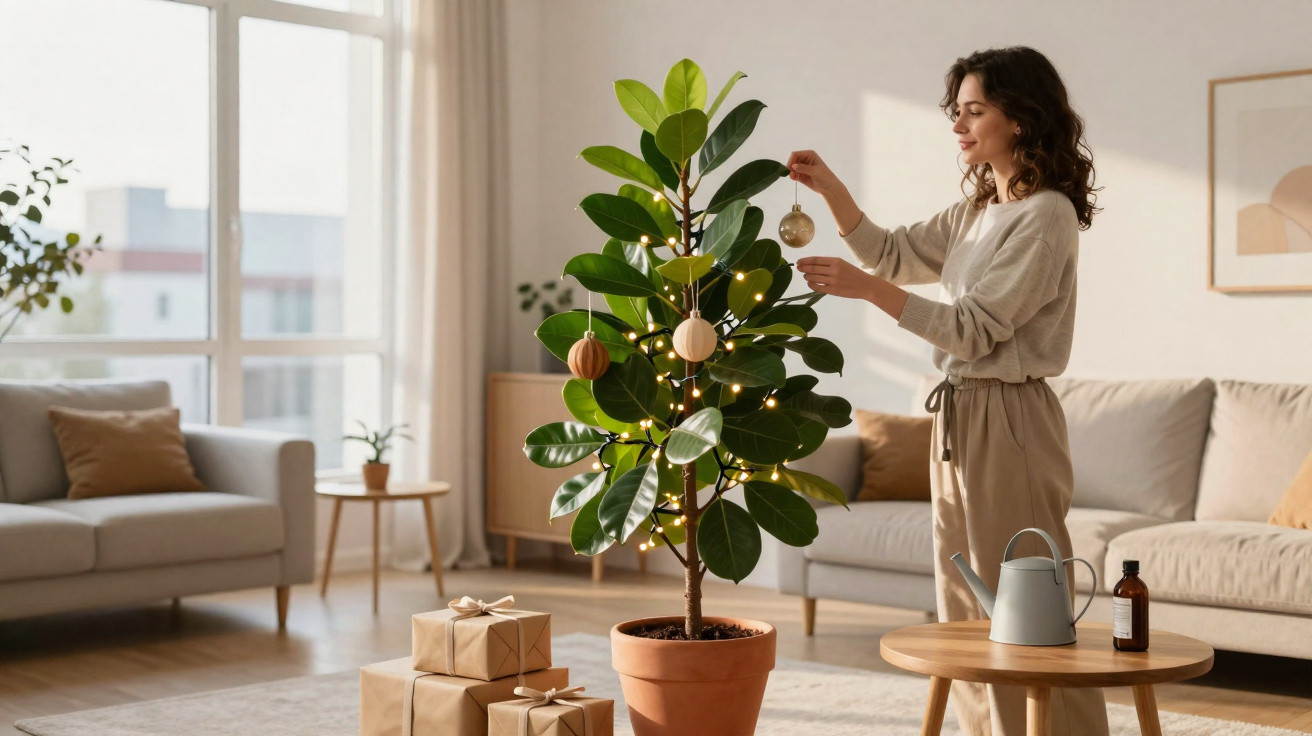
The florist takes a glossy, sculptural plant from a crate and places it beneath a strand of fairy lights.
There are no pine needles and no tinsel – only long, dark leaves reflecting the light like polished leather. Two customers pause halfway through their conversation. One reaches for their phone, picturing it beside the sofa already. The other cocks their head, as though Christmas has subtly moved a few degrees off-centre.
For years, we have argued over real versus artificial Christmas trees. Now, a third choice is discreetly appearing in shop displays and Instagram feeds. Lush, potted and slightly theatrical, this “new Christmas tree” has none of the scent of a forest, but still feels unexpectedly festive. Florists say they are struggling to keep it available.
The plant in question is the rubber plant, Ficus elastica. According to trend watchers, it is set to make an entrance in 2025.
Why florists are swapping pine trees for rubber plants
Step into a progressive flower shop this winter and the change is clear: there are fewer lofty pine trees and more sculptural pots filled with deep green foliage. Florists are positioning rubber plants where spruces once stood, threading lights between their thick, glossy leaves. The effect is less “forest cabin” and more “boutique hotel at Christmas”.
A rubber plant has real presence. Rather than demanding attention, it simply looks naturally well styled. Placed against a white wall or beside a velvet armchair, it creates the same tall focal point as a small Christmas tree. The difference is that it remains once the baubles have been packed away.
Last year, Bloom & Brick, a small florist in London’s East End, began selling “rubber plant Christmas packages”: a medium-sized Ficus elastica, a warm micro-light garland and several brass decorations tied with velvet ribbon. The shop anticipated only a few inquisitive buyers, but every package had sold within two weeks.
Comparable reports are emerging from Berlin, Copenhagen and Toronto. On TikTok, a French florist gained more than a million views by showing how she transformed a rubber plant into a moody, minimalist “Christmas tree”. There was no red and no glitter – just dark foliage, candlelight and a small selection of ceramic ornaments. Rather than debating it in the comments, viewers were tagging their friends.
Beneath the visual appeal lies a gradual change in priorities. For many people, the conventional Christmas tree now feels wasteful: it is cut down, decorated, enjoyed and then left on the pavement in January. Plastic trees can also feel uncomfortable in an age of eco-anxiety. A rubber plant offers a different narrative. It is a living feature to keep and nurture, a seasonal centrepiece that becomes part of daily life at home. For younger urban residents, that longer-term appeal matters as much as December’s magic.
How to style a rubber plant as your 2025 “Christmas tree”
The essential approach is straightforward: select a rubber plant with a sturdy central stem, place it in an attractive pot and style it as a tree rather than concealing it as a houseplant. Its height is important. Choose one that reaches at least mid-thigh, or, where space allows, one that sits just below eye level.
Position it where a Christmas tree would naturally go in your home: in a corner beside the sofa, next to the television unit or close to a window where its lights will reflect after dark. Wind a warm-white micro-light string around the stems, hiding the wire behind the leaves to create a gentle, layered glow. One or two understated decorations on each branch are more than enough.
People generally make one of two mistakes: they either overload the plant or leave it almost entirely undecorated. Treat it like dressing a friend who already has excellent style: the aim is to add details, not alter their character. One particularly effective combination is a dark green rubber plant, cream pot, brass or wooden decorations, and champagne-coloured lights.
For added colour, introduce it around the base instead: use a deep-red tree skirt, a woven basket or a pile of wrapped presents. This keeps the plant poised and elegant while its surroundings provide the festive exuberance. Let’s be honest: nobody really does this every day, but for a few weeks in December, it is worth the effort.
We have all experienced that moment when, on 2 January, a bare tree looks rather forlorn in the middle of the living room. With a rubber plant, that uncomfortable transition vanishes. Remove the ornaments, switch off the lights and you are simply left with a striking indoor tree. The visual clutter fades, without making the room feel sparse.
To keep it content throughout the festive period, avoid overwatering and unnecessary fuss. Rubber plants prefer bright, indirect light and soil that is allowed to dry slightly. Rather than following a fixed watering timetable, water it when the top 2.5 cm of soil feels dry. Before decorating, wipe the foliage with a soft cloth; clean leaves reflect fairy lights in an almost cinematic way.
“The rubber plant is the first Christmas ‘tree’ people don’t want to get rid of,” says Hannah Rhodes, florist and studio owner in Manchester. “They come back in spring with photos. The plant’s grown, the pot’s changed, but it all started with Christmas.”
A few straightforward guidelines make the trend easy to try:
- Pick a secure pot so the plant cannot topple under the weight of the lights.
- Choose LED lights that will not become hot against the leaves.
- Avoid weighty glass decorations that may pull the branches down.
- Keep the plant clear of hot radiators and draughty doorways.
- Carry out a weekly “leaf check” to identify drooping foliage or dry soil early.
Beyond December: what this new “tree” reveals about the way we want to live
Once the final carol has played, something noteworthy occurs: the rubber plant remains. It still occupies that prime spot in the living room, catching the morning sunshine and quietly filling the vertical space that a seasonal tree once occupied temporarily. You may begin to notice how good it looks in March, or how effectively it softens a Zoom background in May.
As more people discuss the idea, the pattern becomes increasingly obvious. We are looking for festive rituals that do not feel disposable. A plant kept for years suits that mood more naturally than something destined for the kerb. It is not merely décor; it is continuity. Children remember “our Christmas plant” getting taller each year. Couples take it with them, pot and all, when they move home.
For florists, using rubber plants in December also brings less physically demanding tree-hauling, fewer needles to sweep up and greater creative freedom. They can build styled scenes with a rubber plant “tree”, a vase of amaryllis and a bowl of clementines. It resembles a lifestyle photoshoot set rather than a supermarket aisle during tinsel season. At home, it means one fewer substantial purchase to regret in January and one more item with a story behind it.
As 2025 draws nearer and the first moodboards for “next year’s Christmas” begin to circulate, do not be surprised if the traditional pine quietly has to share its place. The rubber plant is not intended to replace nostalgia or childhood memories. Instead, it provides a modern alternative: calmer, greener, a little more grown-up and oddly reassuring in a world changing faster than we might wish.
| Key point | Detail | Benefit for the reader |
|---|---|---|
| Rubber plant as a Christmas tree | Use a medium-to-tall Ficus elastica with lights and minimal decorations | Provides a stylish, Instagram-ready alternative to conventional trees |
| Sustainable and long-term | The plant lives throughout the year and can grow for many seasons | Cuts waste and turns a festive purchase into a lasting feature in the home |
| Easy care and styling | Bright indirect light, moderate watering and warm LED lights | Makes the trend accessible even to beginners who “kill every plant” |









Comments
No comments yet. Be the first to comment!
Leave a Comment