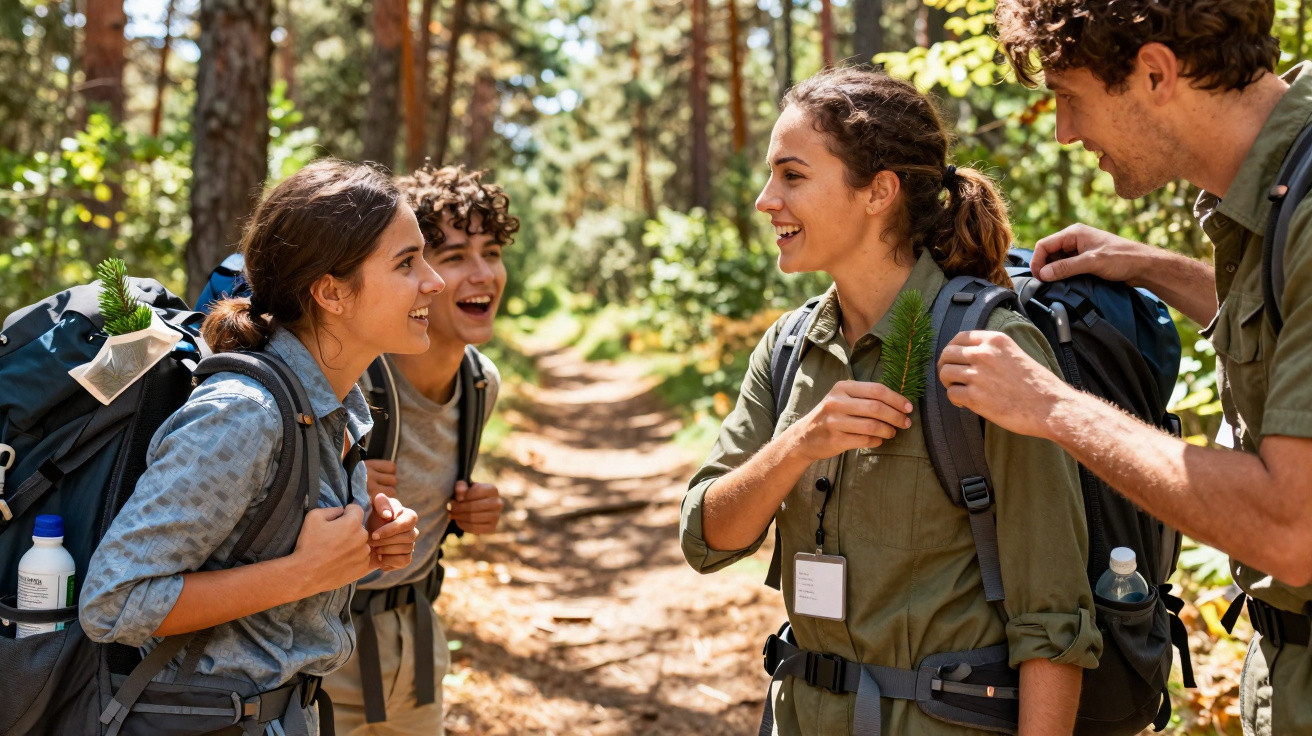
You catch a piercing whine at your ear, shrug a shoulder and feel a flicker of dread: ticks lurking in the grass and mosquitoes waiting in the shade. A forest ranger once showed me a simple trick using something green, resinous and widely available beside the trail.
Just after sunrise, the ranger was waiting at the trailhead, his boots powdered with dust and a coffee tin fastened to his pack. Sap already scented his hands. He ducked beneath a white pine, gathered a handful of needles and worked them between his palms until the air became crisp and minty, as though a cold-room door had swung open. He spread the glossy resin over his cuffs and socks, his hat brim and even his pack straps. As we set off, the effect seemed visible: a faint cloud of scent surrounded him while mosquitoes hovered, then reconsidered. Later, crouched beside young fir trees, he explained how ticks pause when the air changes-tiny creatures making choices according to chemistry and wind. It felt like a low-key piece of knowledge handed down through boots and breath. The secret was in the needles.
Why pine needles alter the insect equation
Everyone knows the moment when the woods seem alive and hostile: a buzz at the ear, a prickling sensation on the calf. Crushing a pine needle between your fingers releases something useful in that moment. Its volatile oils-alpha-pinene, beta-pinene, limonene and bornyl acetate-can interfere with insect sensors, obscuring the trail left by your skin and breath. Pine’s volatile oils throw off how blood-seeking insects find you.
I saw the ranger test the approach with a family walking a hot July circuit: two children, one permanently looking for snacks and the other seemingly irresistible to mosquitoes, plus a father already swatting at his neck. They rubbed needle resin along their sock seams and behind their knees. The ranger then led them in a slow zigzag near a cattail pool, where Aedes mosquitoes like to patrol. The result was striking: mosquitoes paused, turned a fraction too late, circled and then moved on, while the familiar routine of slapping at them simply happened less often. A few days later, the ranger emailed a figure: an estimated 476,000 Lyme disease cases a year in the U.S., a reminder that small habits outdoors can add up.
Ticks do not “smell” through noses. Instead, they interpret their surroundings with Haller’s organ, a sensory structure on their front legs that responds to CO2, warmth and compounds from human skin. Mosquitoes follow many of those same signals, as well as lactic acid and ammonia in sweat. Pine terpenes create a brief aromatic haze that muddles those clues, particularly when movement continually renews the scent plume. That renewal matters: these compounds evaporate fast, like a brightly lit match that quickly burns out. Reapplying therefore becomes part of the trail rhythm, shaped by the temperature, wind and speed of your walk.
How to use pine needles on the trail
Choose green needles from low branches of pine or fir species you can identify with confidence, including white pine, red pine, lodgepole pine and Douglas-fir. Roll a small bundle in your palms until the needles squeak and leave a sheen on your skin. Apply the resin to areas with greater exposure: sock cuffs, trouser hems, the outer edges of shirt cuffs, behind the knees, the collar and the brim of your hat. Give your pack straps and hip belt a quick wipe too, as they rest near pulse points. Reapply every 30–45 minutes while walking, or when the fragrance becomes faint, as if you were refreshing a signal at the limit of reception.
If your skin is sensitive, use only a small amount and avoid getting resin on your face or in your eyes, as the oils may sting. Select supple, green needles rather than the brown, brittle layer on the ground, because living needles contain more active terpenes. If staining is a concern, test the resin on the inside of a cuff before putting it on a favourite shirt: sap can leave dark marks that seem to appear from nowhere on the drive home. Let’s be honest: no one actually does that every day.
You can also make a straightforward “trail sachet”: fill a small breathable pouch-an old bandana, coffee filter or mesh bag-with fresh needles. Squeeze it before each section of the walk to revive the aroma, then attach it high on your pack so the scent trails behind you. It is not a force field; it is a prompt to an insect’s brain. Those prompts become more useful when combined with long socks, close-fitting cuffs and a route that goes around tall grass rather than directly through it. This is not magic; it is chemistry carried on the wind.
“Pine won’t replace your repellent on a swampy dusk portage,” the ranger told me, “but it will buy you space, especially when you’re moving, and it teaches you to pay attention to the air around your body.”
- Crush fresh needles, apply them to fabric first and skin second.
- Renew the scent every 30–45 minutes, and more frequently in heat or wind.
- Combine it with long socks, tight cuffs and tick checks after a walk.
- Avoid the eyes, lips and any irritated skin.
- Use pine as one protective layer, rather than the entire system.
The quiet alliance between hikers and pines
There is something gently old-fashioned about this practice, rather like tying knots or reading clouds, and it changes the way you travel through the landscape. Your hands brush the lower branches; you notice which trees are young and which bear cones; you adjust your pace to keep the scent around you alive; and time begins to be measured by smell rather than a watch. The ranger called it “scent stewardship”, a phrase that makes the forest feel less like scenery and more like a partner that teaches. Once you have tried it, you may find yourself reaching for needles even with a can of spray packed away, driven by habit as much as curiosity.
The habit has science behind it: terpenes in the resin, evaporation speeds influenced by heat, and scent-plume behaviour altered by stride length. It also depends on plain common sense. Pine works best when supported with high socks, tucked-in trousers and a post-walk tick check in good light-a three-minute routine that can spare you worry later beside the laundry basket. The ranger says he still takes permethrin-treated gaiters for stretches of tall grass and a small bottle of DEET for dusk in mosquito-heavy areas, because protective tools work together like layers: each has a role, and none should be expected to do everything alone. No natural method lasts all day.
What remains with you is the feeling: a small act of self-reliance that turns an anxious walk into a more attentive one. Your fingers are sticky with sap; the scent is sharp like eucalyptus, though it is not eucalyptus; and the experience reminds you that walking is a conversation, not a performance. As you start noticing the way a breeze moves through needles and insects change direction in that air, you feel less pursued and more in tune. That shift offers its own protection, because you move more carefully and choose better routes around scrub and bog, leading to fewer bites for both chemical and human reasons. The trees were always talking. You’re just answering back.
| Key point | Detail | Why it matters to the reader |
|---|---|---|
| Pine terpenes disrupt insect sensing | Alpha-pinene, beta-pinene and related compounds produce a short-lived aromatic “fog” that masks the CO2 and skin odours tracked by ticks and mosquitoes. | Learn why the method can work and when it needs refreshing. |
| Trail-ready application | Crush green needles, rub them on cuffs, socks, the hat brim and pack straps, then reapply every 30–45 minutes-more often in heat or wind. | A straightforward, free technique to try on today’s walk. |
| Layered protection beats any single fix | Pair pine scent with long socks, tight cuffs, sensible route choices and post-walk tick checks; retain a backup repellent for areas with heavy insect activity. | Fewer bites, less stress and a flexible approach as conditions change. |










Comments
No comments yet. Be the first to comment!
Leave a Comment