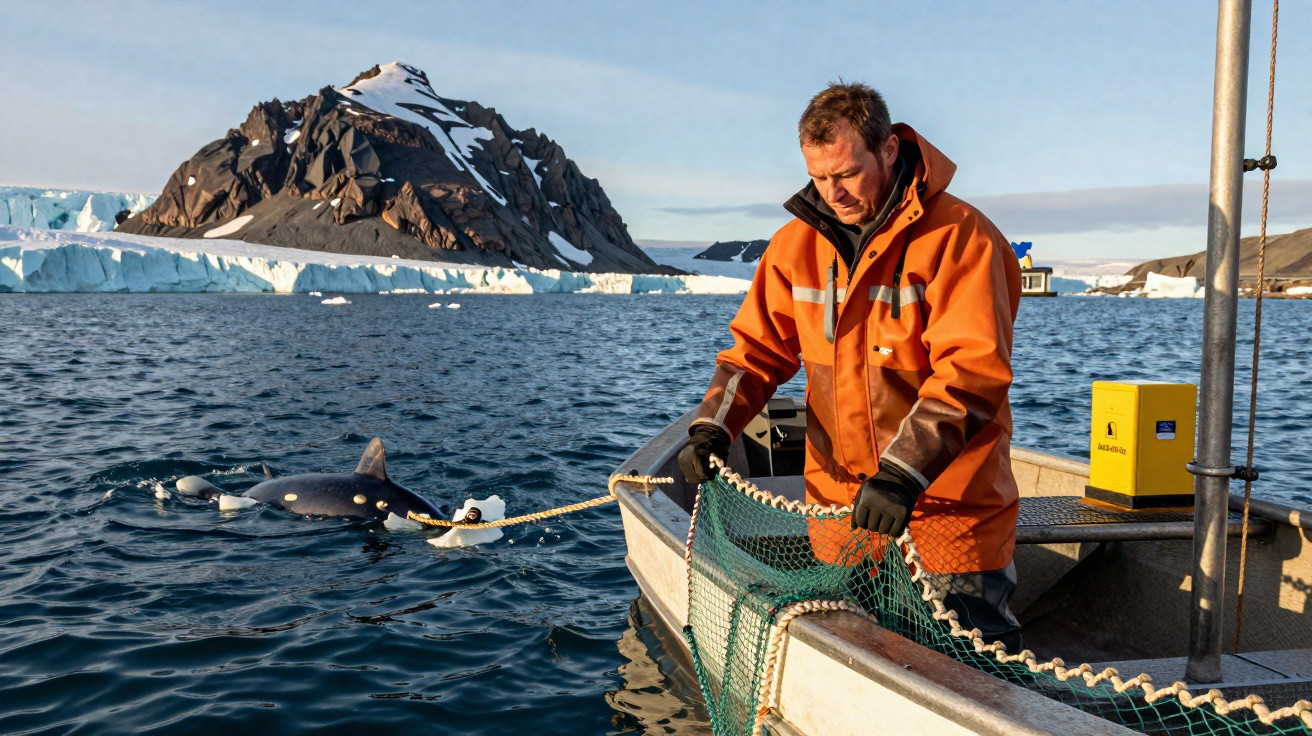
The morning the whales arrived, Nuuk harbour fell still in a way that was not really about quiet. Engines hummed at idle, chats stopped halfway through, and people left coffee cups on the dock as they bent over the railings. Just a few hundred metres from the ice-streaked coast, the black-and-white backs of orcas moved through the steel-blue sea like a chain of drifting buoys.
Someone whispered, “They’re too close.” Someone else said, “They’re late.” Overhead, mountains once wrapped in a narrow white band of sea ice revealed broad, exposed scars of stone. The ice had given way early.
By midday, government telephones across Greenland were ringing constantly. By evening, “emergency” had become the word on everybody’s lips.
Greenland’s sudden crisis: more orcas, less ice, and a nation on edge
On Wednesday, Greenland’s parliament took a step it very rarely takes: it announced a national state of emergency at sea. The trigger was not a storm or a wrecked vessel, but whales, ice and what appeared to be the start of a fresh kind of gold rush. Reports came in all along the west coast, from Nuuk to smaller fishing communities including Maniitsoq and Paamiut, of unprecedented numbers of orcas moving nearer to land than many elders could recall.
Satellite imagery revealed another development at precisely the same time. The coastal ice sheet had split unusually early, creating a tangled field of floes and broad open-water channels. To fishers looking out from the harbour, it was as though a curtain had suddenly been pulled aside.
At a stony quay in Qaqortoq, 46-year-old fisher Karl “Karlu” Jensen rested against a pile of nets, smiling at the dark fins passing by. “They’re eating our fish,” he said, “but they’re also showing us where the fish are.” His small trawler, which normally just gets by on cod, returned last week carrying twice as much as it had at this point last year.
Harbour authorities recorded a 38% rise in small-boat landings over only ten days, as crews hurried out after the tightly packed shoals of herring and mackerel escaping the orcas. The town’s sole ice factory operated overnight, while one local retailer sold out of heavy-duty cool boxes. Over coffee, residents spoke of “the orca bonus”, partly in jest and partly in earnest.
Scientists described the situation with a very different sense of alarm. A joint Danish–Greenlandic research team in Nuuk issued preliminary findings connecting the influx of orcas directly to the breakdown of near-shore ice formations, which normally function as a cold barrier. With that barrier gone, warmer open sea reached further north, bringing predators that had previously stayed around the margins.
The orcas represented more than an unusual sight; they were an indicator of wider change. Seals altered their movements where the whales travelled, fish dispersed and longstanding hunting routes became uncertain. One researcher called it “an ecosystem being redrawn live on a shaky screen.” Policymakers identified the prospect of a short-term windfall, while climate campaigners saw something more like a last warning.
Between boom and blackout: a new Arctic “gold rush” meets a wall of protest
Greenland’s fishing cooperatives convened emergency meetings within hours of the declaration. Many skippers delivered a straightforward message: if the sea is suddenly full of fish, do not prevent us from working. Deckhands previously worried about redundancy began negotiating for overtime, and several crews brought old boats back into service after they had sat in the snow, repairing hulls with whatever materials were available to join the rush.
Unofficial WhatsApp groups remained active late into the night, with members exchanging GPS locations for “crazy” shoals and posting blurry footage of orcas driving frightened herring against pieces of ice. The conversations carried an intense, almost rebellious energy. For households dependent on one strong season to settle winter debts, this was not perceived as an emergency. It felt like an opening.
At sea, the urgency of the chase had a physical force. A Sisimiut crew described pursuing a thick, glittering concentration of mackerel, flashing beneath the surface like spilled mercury, directly behind a hunting pod of orcas. Their sonar display was filled completely with fish. They hauled for hours, their arms trembling, until the nets drooped with their catch. The skipper radioed shore to say they had found “three seasons in a single day.”
The account travelled quickly. Small lenders began receiving requests for rapid loans to cover fuel and equipment. Some younger fishers called it “our crypto moment on water” – unstable, dangerous and impossible to overlook. No one wanted to be the person left ashore.
Climate activists and many researchers followed these events with deep unease. In the government declaration, they heard not permission to take more from the sea, but a flashing warning that demanded a pause. Organisations such as Greenpeace Nordic and local youth movements called for a complete fishing moratorium in the most severely affected areas, maintaining that predators, prey and ice were all under shock simultaneously.
Their case was uncompromising: the ice collapse creating this boom had also left the ecosystem more vulnerable than anyone properly understands. There is simply not enough evidence to determine how much fishing this altered balance can withstand. Greenland’s cabinet now faces two equally pressing demands-meeting today’s bills or preserving the sea for the next generation.
How Greenland navigates this storm: emergency rules, quiet workarounds, fragile hope
The emergency order, pushed through late at night, set out a patchwork of temporary measures intended to accommodate every side, yet leaving almost everyone dissatisfied. Fishing around major orca hunting corridors was limited, while areas with rapidly shrinking ice were redesignated as “sensitive”, subject to strict catch caps and real-time surveillance. Patrol vessels were instructed to record both catches and whale observations, effectively making every voyage a floating survey.
Officials described the measures as “breathing space” for the ecosystem rather than a complete shutdown. Their aim was straightforward: slow the surge long enough to understand what was happening in the sea, without closing off earnings altogether. The approach looked balanced on paper. Conditions offshore proved far less orderly.
Fishers on the docks contrasted “paper seas” with “real seas”. One skipper privately acknowledged moving his route to just beyond the new restricted boundaries, exploiting the lines on the chart while maintaining that he was complying with the law. Another spoke of passing up a highly profitable catch after a pod of exhausted-looking orcas appeared in the same channel.
Many know that point at which survival and conscience pull in opposing directions. For numerous Greenlandic families, this is not an abstract discussion about climate modelling. It determines whether the oil tank is filled before the next blizzard. Nobody wants to be the villain feeding on a dying ocean, but nobody wants their kids cold, either.
In Nuuk, a young campaigner stood in a cramped meeting room, still carrying the faint smell of coffee and wet wool, before a semicircle of older trawler owners. She attempted to reduce the fate of the planet to a few unsteady sentences.
“Every extra net you throw this season is like spending from a savings account that’s already past empty,” she said. “The orcas aren’t a gift. They’re a siren. If we treat this like a gold rush, we’re going to wake up broke in ways that money can’t fix.”
Her remarks remained in the room, balanced somewhere between a prediction and an accusation. Beyond the meeting, officials sketched rough compromises on whiteboards and sticky notes, including:
- Rotating closures of the most fragile fishing grounds
- Shorter, more tightly monitored fishing windows
- Subsidies for crews who agree to stay in port on peak orca days
Nothing about the proposals seemed neat. Every part of them seemed pressing.
A fragile frontier that belongs to all of us
To stand on a Greenlandic quay today is to witness more than a local conflict involving whales, ice and nets. It is to see the leading edge of a warming world being redrawn as it happens. Neither the orcas, the fishers nor the young people chaining themselves to ministry doors in Nuuk are the villains here. Each is responding to the same crumbling assumption: that seasons will continue to behave as they once did.
This Greenland moment offers an unsettling reflection. When the wreckage of the climate crisis produces a sudden opportunity, should it be seized with both hands, or should people step back, however painful that may be, and discover how to live differently with less? The straightforward reality is that no one has a flawless plan.
The decisions made next-in cabinet rooms, at ballot boxes and during quiet family discussions over dinner-will reveal much about how the wider world responds to its own “orca moments” as ice, whether literal or otherwise, begins to give way.
| Key point | Detail | Value for the reader |
|---|---|---|
| Greenland’s state of emergency | Declared as orca numbers surge and coastal ice collapses ahead of schedule | Helps you grasp how fast climate shifts can flip a region into crisis mode |
| “Gold rush” fishing pressure | Fishermen chase record shoals of fish clustered around orca hunts | Shows how economic survival instincts collide with ecological limits |
| Calls for a fishing moratorium | Activists and scientists push for temporary bans in fragile areas | Invites you to weigh short-term gain against long-term ocean health |
FAQ:
- Question 1 Why did Greenland declare a state of emergency over orcas and ice?
- Question 2 Are orcas actually responsible for collapsing fish stocks in the area?
- Question 3 What exactly are activists asking for with a fishing moratorium?
- Question 4 How are local fishermen reacting to the new emergency rules?
- Question 5 Could this Greenland crisis be a preview of what other coastal regions will face?






Comments
No comments yet. Be the first to comment!
Leave a Comment