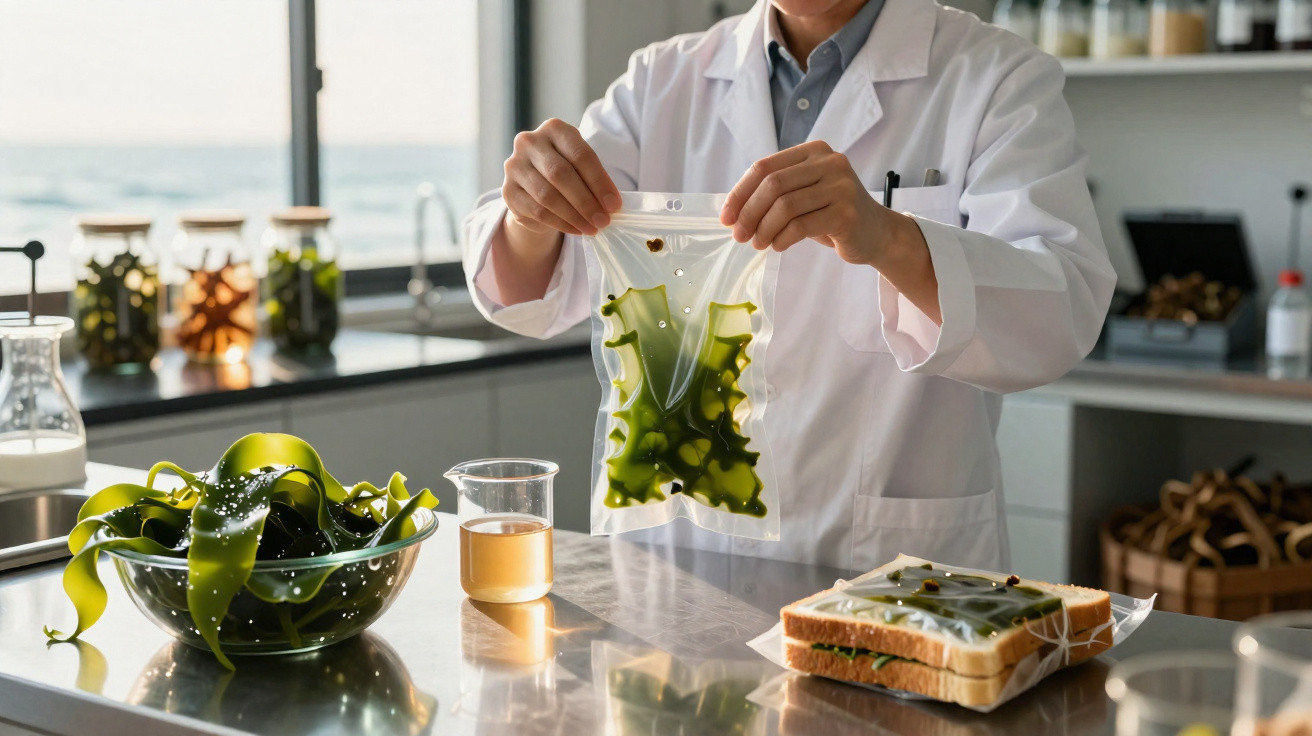
Plastic packaging is so inexpensive and ubiquitous that it seems woven into everyday life. Supermarket apples come wrapped in plastic, parcels arrive swathed in layers, and takeaway containers rustle beneath crinkly lids. A marine scientist believes seaweed could undo that dependence-not in some far-off future, but within five years.
Dr Lea Marin takes a fine amber sheet from a drying rack and raises it towards the light. It resembles cellophane, with a glossy, fragile appearance, yet it originates from a plant that moves with the tides. She breaks off a corner; it crackles before melting softly on her tongue. On the dock, a box of oats is packed in a bag made from a comparable film, while a postal worker presses a mailing pouch that disappears in warm water. It is simultaneously familiar and entirely new. Then she eats the wrapper.
From tide to table: the rise of seaweed packaging
Seaweed needs neither freshwater, farmland nor fertiliser: it feeds from the sea and grows rapidly. This makes it an unusual climate-friendly resource and a feedstock that could scale for films, foams and gels. In Dr Marin’s laboratory, rolls of translucent material unspool like adhesive tape, although they are formed from alginates and carrageenans, the natural polymers found in kelp and red algae. Held in her hands, the move from laboratory bench to supermarket shelf seems remarkably close.
Practical trials continue to mount. Notpla’s edible pods provided hydration to thousands of London Marathon runners before disappearing in a single gulp. US start-ups are sending out fashion mailers made from kelp-derived resins, while Indonesian teams are forming seaweed starch into sachets for spices and soap. One figure stands out: packaging represents about 36% of total plastic demand, with single-use products making up most of it. Shifting even a small proportion to seaweed could create a substantial effect.
Why five years? The issue is scale rather than science. The chemistry is proven; supply and processing capacity are the limiting factors. In suitable conditions, giant kelp can grow by up to half a metre per day, and brown-algae farms are expanding from Brittany to Busan. Extrusion equipment used for fossil-plastic products can be adapted for bio-based blends through retrofits and improved drying. Policy pressures also support the change: plastic taxes, restrictions on selected single-use products and extended producer requirements are prompting brands to respond. The market is moving, and seaweed lies at the meeting point of practicality and speed.
How seaweed packaging works and what to do next
Dr Marin outlines the core process on a notepad marked with salt stains. First, mature kelp is harvested, rinsed and chopped. Alginate or carrageenan is then extracted through a straightforward alkaline soak, followed by filtering and precipitation to produce a clean polymer. It is combined with water and a plasticiser such as glycerol, cast as a fine film and dried at controlled humidity. A coating of plant wax or chitosan can provide a moisture barrier before the material is embossed and cut. The result is film for sachets, liners or wraps that can be composted or, in some cases, dissolved.
Everyone has experienced a “green” package that looks convincing but performs poorly in the kitchen. Water is the main adversary: seaweed films readily absorb moisture, which gives them both their appeal and their limitations. The format must suit the task-dry foods, powder sachets and soup pods intended to dissolve in hot water. Brands frequently choose an unsuitable algae type or add too many additives in an effort to reproduce conventional plastic. Keep the material cool and dry, add secondary paper when necessary, and explain clearly whether it should be discarded or dissolved. Realistically, hardly anyone follows those instructions every day.
There is a pattern to making it work properly. Brown algae, including kelp, is best where strength and transparency are required; red algae is the better option where gel behaviour is important. Use pale pigments to improve compatibility with paper-recycling streams, and consider whole systems rather than relying on one apparent miracle. It is not a silver bullet, but it is a genuine tool.
“Plastic solved the last century’s logistics. Seaweed can solve the next,” Dr. Marin says, peeling a strip that looks like tape. “We’re not trying to be plastic. We’re trying to be enough.”
- Best suited to: dry snacks, cereals, spice sachets, garment bags and mailer liners
- Time to biodegrade: weeks to a few months in home compost, or hours when designed to dissolve
- Avoid: high-grease, high-heat uses unless co-extruded with a barrier layer
- Label clearly: “compost”, “dissolvable”, or “paper-recyclable with liner removed”
- Minimum pilot run: 5,000–50,000 units to refine sealing, thickness and moisture performance
What five years could look like
Enter a plastic-free aisle and it may not seem austere; it may simply feel ordinary. Oats could come in crisp paper lined with seaweed. Coffee pods might dissolve in a cafetière. Bubble mailers could use kelp-based foam padding that becomes soil. Council compost bins could accept these formats, while kerbside collections include disposal guidance printed directly on the pack. Fishing communities might lease lines during winter for kelp cultivation, generating dependable income outside the main season. In laboratories, films would become modestly more capable: barriers would improve slightly, inks would move to algae pigments and lower-temperature sealing would reduce energy use. The familiar plastic crinkle would remain for demanding applications, but it would no longer be everywhere. The five-year window is not so much a deadline as an opening.
| Key point | Detail | Why it matters to readers |
|---|---|---|
| Seaweed scales quickly | Kelp grows without land or freshwater, with harvests possible within months | Indicates practical potential beyond the hype |
| Right job, right format | Dry goods, dissolvable pods and liners are the first strong applications | Helps identify uses that already work today |
| Policy tailwinds | Plastic taxes and bans encourage brands to switch | Makes change more likely within a short timescale |












Comments
No comments yet. Be the first to comment!
Leave a Comment