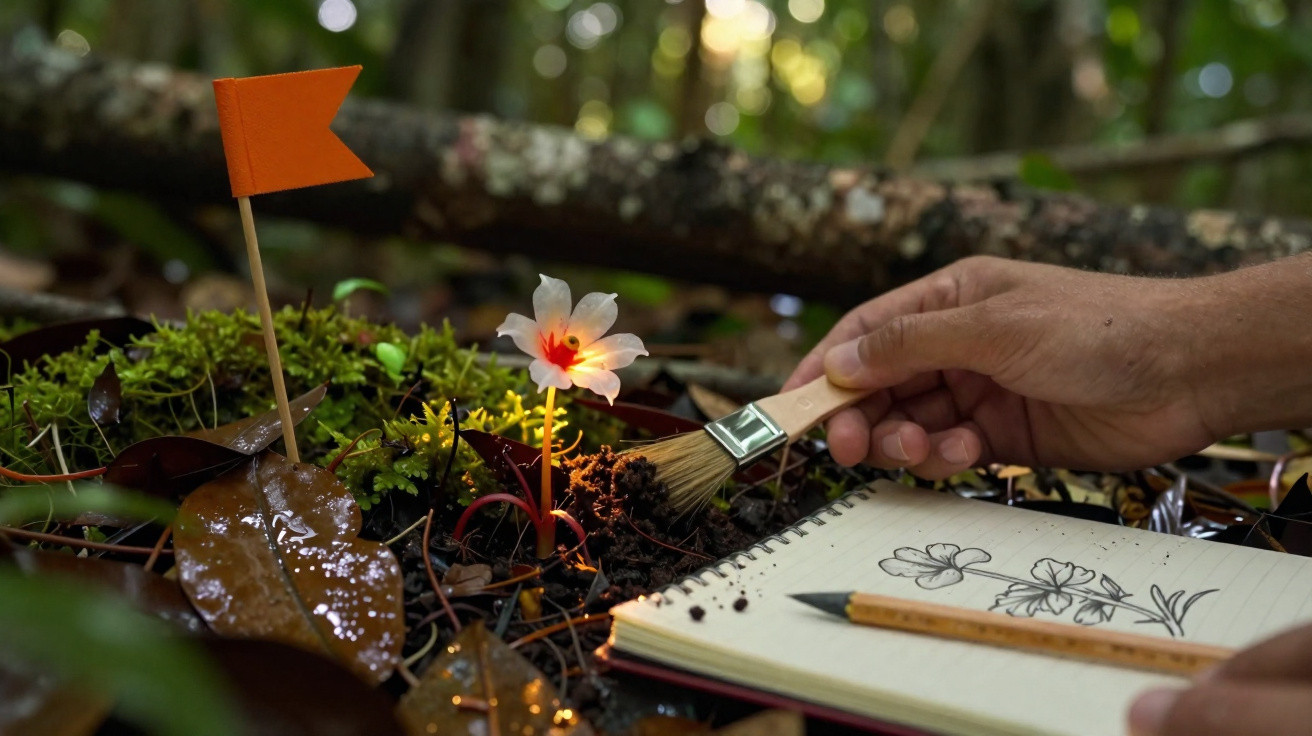
Most plants grow towards the Sun. Light provides them with food, energy and life.
Yet a minute plant found on the shaded forest floor in Thailand seems to defy that fundamental principle.
Picture yourself walking through woodland when you spot a small, nearly black flower emerging from the leaf litter beneath your feet.
Three elongated, horn-like projections extend from its top, and reddish-orange markings give the impression of glowing eyes. Even more remarkably, it lives without sunlight.
Although it looks like something from a horror film, the plant is entirely real.
Scientists have named the newly identified species to match its striking appearance: Thismia daemona, the “devil flower”.
Researchers at Chulalongkorn University and Prince of Songkla University described the species in a study published in PhytoKeys.
Thismia daemona and its underground fungal network
Its sinister-looking flower is not the only unusual feature of T. daemona. The species also disregards one of the best-known rules of plant biology.
Most plants have chlorophyll, the green pigment that captures energy from light. They use this energy in photosynthesis to make their own food.
T. daemona, however, contains no chlorophyll. It is unable to draw energy from sunlight or produce food through photosynthesis.
How, then, does it prevent itself from starving?
The solution is beneath the ground: fungi.
The plant receives the carbon and other nutrients it requires from fungi in the soil. Scientists refer to this lifestyle as mycoheterotrophy.
In simple terms, rather than facing the Sun, the devil flower connects to an underground fungal network.
This relationship enables it to exist on the dark forest floor. It remains concealed under fallen leaves for most of its life, emerging above ground only briefly to flower and set fruit.
Discovery of the devil flower in western Thailand
The researchers found the species in May 2025 at Thong Pha Phum National Park in western Thailand. The specimens grew amid leaf litter and small bamboo at elevations of about 930 to 970 metres.
The site was unexpected because Thismia species are usually linked with permanently humid, lower-elevation rainforests.
"Finding Thismia daemona was indeed a major surprise," says Sahut Chantanaorrapint, a botanist at Prince of Songkla University.
The population’s presence in a seasonal mountain forest almost 1,000 metres above sea level indicates that these plants might withstand a broader range of habitats than scientists had previously understood.
Including the flower, T. daemona grows to roughly 12.5 centimetres tall. Its pale-brown, hairy roots look like fragments of coral. The almost black flower features fleshy reddish-orange parts, translucent blue stamens and three fine ‘horns’ above a dome-shaped structure.
Chantanaorrapint says the name reflects the plant’s "hidden, subterranean, and mysterious lifestyle" and its "devil-like essence".
The new species is part of the genus Thismia, a collection of distinctive plants sometimes called fairy lanterns. Scientists currently recognise around 120 species in this genus.
To establish that the plant was a previously unknown species, researchers studied its physical characteristics using microscopy and high-resolution photographs. They also examined five regions of its nuclear and mitochondrial DNA and compared them with those of other Thismia species.
Its nearest known relative seems to be Thismia betung-kerihunensis, which occurs in Borneo. However, the finding matters for more than simply adding another remarkable plant to the known species list.
T. daemona is assigned to a smaller group known as Geomitra. Prior to this discovery, species in that group had been documented only in Peninsular Malaysia, Borneo and Sumatra.
The western Thailand record pushes the group’s recognised range farther north. It also increases Thailand’s known total of Thismia species from 15 to 16.
Why Thismia daemona is Critically Endangered
However, the devil flower raised concerns almost immediately after being introduced to science.
Just one population is known, with fewer than 50 plants. It occupies an area of less than 0.05 square kilometres.
While the location is inside a protected national park, it receives regular tourist visits. Visitors might inadvertently tread on the plants or disrupt the fragile forest floor on which they and their fungal partners rely.
The researchers have consequently given the species a provisional Critically Endangered assessment under International Union for Conservation of Nature criteria. This does not indicate that it has officially been added to the IUCN Red List; the study presents the status as an initial assessment.
"Inspiring local people to take pride in their natural heritage not only safeguards the microhabitat, but also supports sustainable, community-led ecotourism," Chantanaorrapint says.
The devil flower demonstrates that even protected places with frequent visitors may still harbour species that science has not yet identified.
A newly discovered species is not always concealed in a wilderness so remote that it is almost impossible to reach. It can be hidden in the leaves right beneath our feet.
The study was published in PhytoKeys.
This article was fact-checked by Rebecca Dyer and edited by Rebecca Dyer. Although we take pride in our process, we are only human. If you notice an error, please let us know.












Comments
No comments yet. Be the first to comment!
Leave a Comment