One woman in a modest British courtyard rejected that assumption - and discovered an unexpected breeding approach that kept her roses flowering through winter.
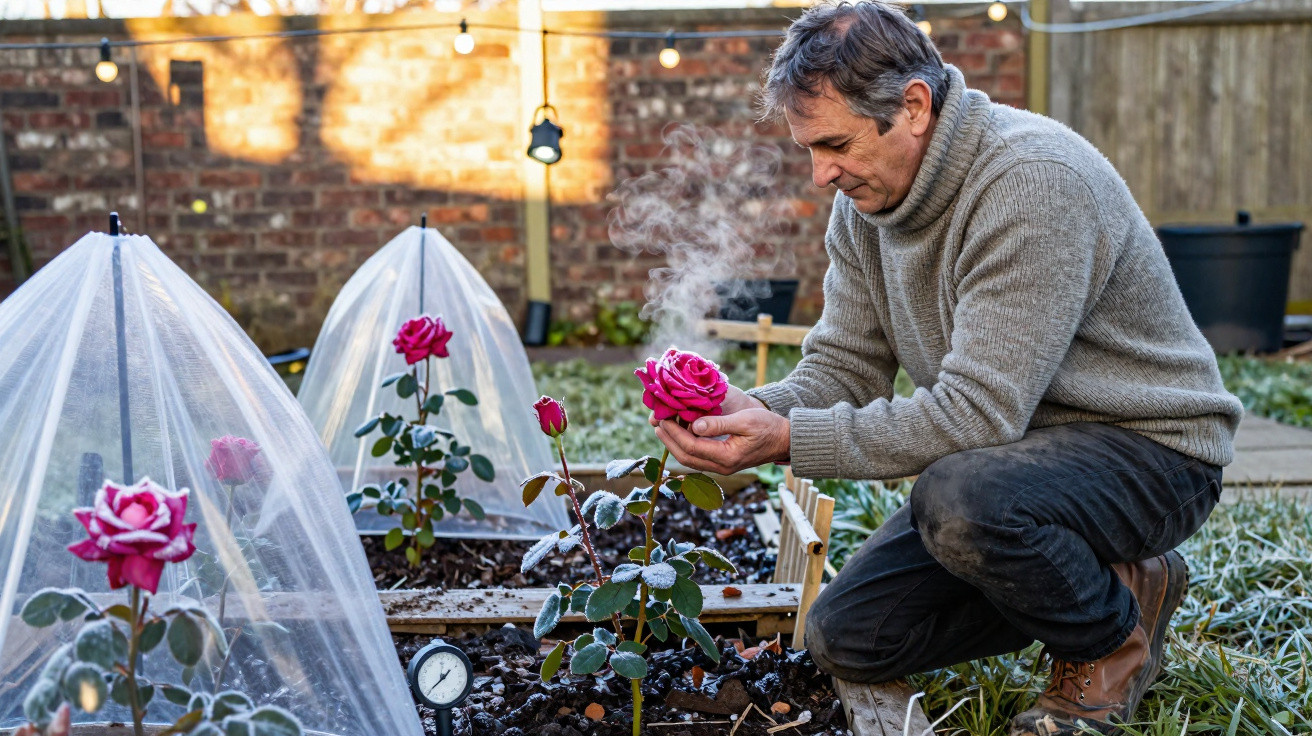
At 6.15am on a crisp December morning in York, a robin darted from a fence post while Hannah West walked into her courtyard wearing woollen socks and a borrowed coat. A fine veil of frost sparkled across the paving. Yet instead of the bare stems and quiet she anticipated, blush-pink roses were lifting their heads into the steam of her breath. She placed her mug beside a terracotta pot and brushed a petal with her thumb, partly astonished and partly out of habit. Fairy lights threaded across the trellis glimmered - neither wholly festive nor especially functional, but a hint that something unusual was happening. She had persuaded the seasons to shift.
The winter rose and the unusual method behind it
Hannah’s roses are not tucked away in a heated greenhouse. They grow in a walled courtyard that holds a calm pocket of air, while the city’s retained warmth eases the sharpest frost. There is no miracle involved. It is a gardener’s technique borrowed from commercial floriculture, paired with patient breeding. Those warm LED strings visible in December are not Christmas decorations: they are what prevents the plants from settling into dormancy.
Seven winters earlier, she started crossing tough, salt-tolerant Rosa rugosa with modern repeat-flowering shrubs. It was part kitchen-table project, part cold-frame experiment, and entirely improvised. In her first year, she sowed 620 seeds, grew 402 seedlings and set 180 in 5-litre pots against the brickwork. By January, most had retreated into dormancy. Eleven, however, continued forming buds despite the cold. She marked them with masking tape, recorded observations on a battered index card, and crossed the strongest plants again. The figures were not impressive, but the pattern was clear.
The key technique is an old-fashioned one that is easily overlooked: night-break lighting. A gentle burst of light in the middle of the night disrupts the long period of darkness that signals many plants to sleep. Roses are not classic long-day plants, but their growth cycle still responds to the duration of uninterrupted night. A two-hour “blink” prevents dormancy chemistry from accumulating, encourages the meristems to remain active, and allows repeat-blooming genetics to work even when the air is biting. It cannot overcome a severe freeze, but it can shift the odds on a mild British winter night.
How to use night-break lighting at home without making your garden look like Blackpool
You do not need laboratory equipment. Begin with varieties bred to flower repeatedly - remontant genetics found in modern shrub roses, certain floribundas and a handful of compact climbers. Arrange a low-intensity warm-white LED string along the canes, from knee to shoulder height, and use an inexpensive timer. Set a “night break” for 23:00 to 01:00, or from 00:30 to 02:30. Leave the crown above the mulch, keep the soil moist rather than wet, and apply a balanced but light feed in autumn. A gentle prune in August can encourage an autumn flush that carries on if the nights remain mild.
Avoid drenching the plants in floodlight. They require a prompt, not noon in the middle of the night. Two to five watts per square metre is sufficient; one string of 100 warm LEDs will often cover a small bed. Maintain good airflow to reduce mildew. Slightly tighter pots can also help: roots that are a little confined often move into flower sooner than those given a broad expanse of compost. We have all over-cared for a plant only to find that it sulks. Ease off and let its rhythm develop. It is not magic, only timing.
Realistically, no one gets it right every day. You will forget to switch on the timer, or water during a cold snap and regret it when the ground turns slushy. Winter roses are a compromise rather than a prize. Aim for “occasional flowers in December and January”, rather than a June-style bouquet in a snow globe. The essential point is recurrent selection in short, cold days. Even without hybridising, you can identify, retain and propagate plants that make buds while others pause. Give them a modest boost with light and shelter, then see the calendar begin to wobble.
“I wasn’t trying to beat winter,” Hannah told me, blowing steam off a mug. “I was just trying to find the ones that don’t mind getting up early.”
- Toolbox: warm-white LED fairy lights, an outdoor-rated timer, two bricks to form a wind baffle, and mulch.
- Timing: 60–120 minutes of light in the middle of the night from late October until late February.
- Genetics: choose repeat-flowering shrubs and trial rugosa hybrids for toughness.
- Microclimate: use walls, hedges or a south-facing fence to preserve still air.
- Care: prune lightly in August, use a low-nitrogen autumn feed, and water sparingly during cold weeks.
Why winter rose lighting works - and its limits
Think of dormancy as a slow hormonal tide. Long nights and persistent cold increase ABA and other signals instructing buds to close tightly and wait out the season. A night break disrupts that communication. You are not using heat to force flowers; you are simply asking the plant to remain alert for a little longer. Repeating this process selects plants predisposed to bud in shorter days and cooler nights. Across several seasons, the bed gradually moves towards winter tolerance without any fuss.
There are boundaries to what it can achieve. If your garden is a frost pocket that regularly falls below –5°C, a pulse of light cannot override biology. The purpose is to make the most of the UK’s present-day winter, which often swings between a cold snap, a mild week, drizzle and a bright day. Light keeps buds ready for those gentler intervals. Waterlogged soil makes roots sulk and buds abort, while excessive nitrogen produces foliage instead of flowers. The answer lies in the smaller details - shelter, drainage and timing.
There is a quiet ethical side to the method, too. You are not consuming kilowatts of energy, but using the faintest amount of electricity to work with a plant’s natural rhythm. You are also creating local strains suited to your own patch, one winter at a time. After three or four seasons, your records become more useful than a catalogue. That is how Hannah’s eleven keepers became twenty-two, then a reliable small group that blooms in January like confetti after a hesitant speech. It feels homemade because it genuinely is.
What to remember on a cold morning in muddy boots
A winter rose is not about defeating the season; it is about understanding its gaps and edges. Carefully used light can steer a plant away from sleep without forcing it into submission. Breeding, even on a kitchen-table scale, is largely about observation: noticing which plants dismiss sleet and which continue producing little fists of colour. In a warmer, less predictable climate, these small adjustments offer a modest sense of control that is both useful and considerate.
It demands patience as well. Winter blooms are the outcome of decisions made in August, cables fixed in October, and tea drunk in January while you inspect bud scales with cold fingers. Celebrate the successes, laugh at the failures and keep the timers inexpensive. The roses will not behave as they do in June, and that is fine. When a flower opens against frost, it resembles a handwritten note slipped beneath a door you had assumed was locked.
| Key point | Detail | Benefit for the reader |
|---|---|---|
| Night-break lighting | 1–2 hours of low-intensity light around midnight | A straightforward, low-cost way to postpone dormancy and maintain buds |
| Choose and keep | Repeat-flowering varieties; select those that bud during cold spells | Develop your own winter-tolerant strain over successive seasons |
| Microclimate matters | Walls, drainage, restrained feeding and a light August prune | Improve the odds without a greenhouse or high bills |












Comments
No comments yet. Be the first to comment!
Leave a Comment