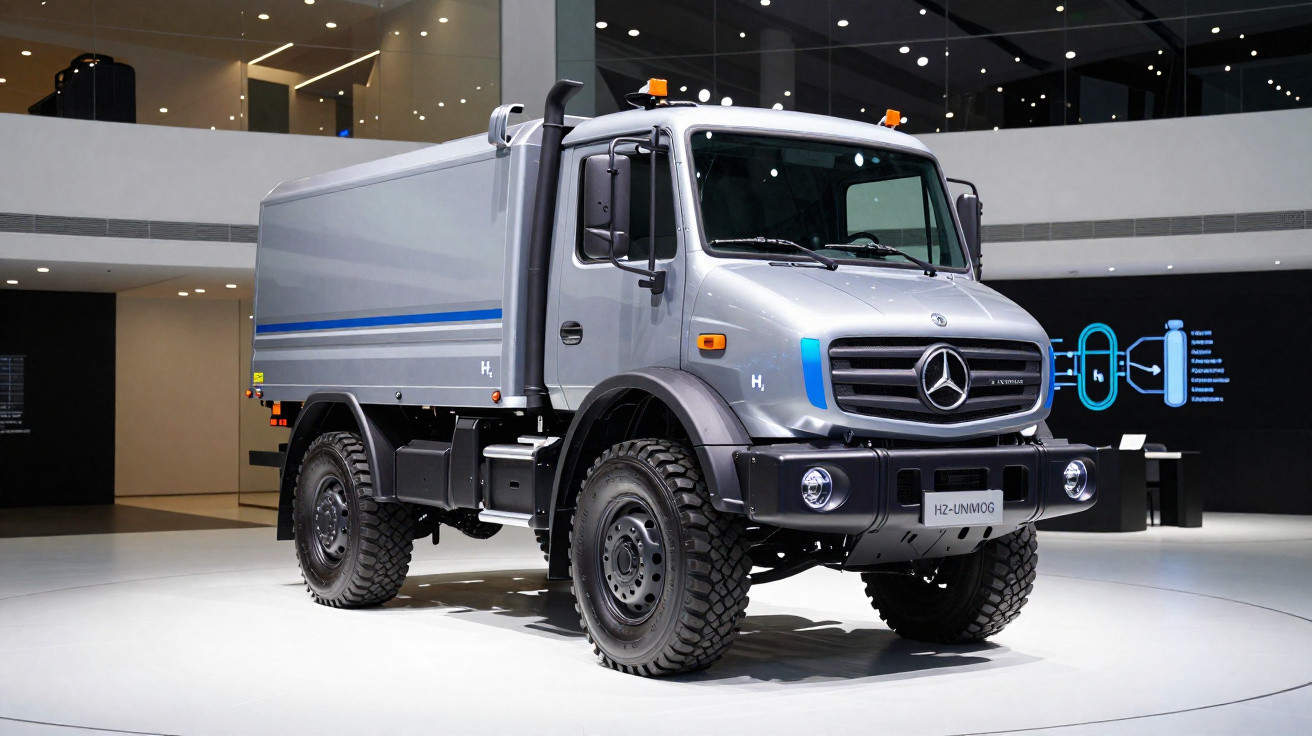
The Unimog stands as one of the most adaptable and capable off-road vehicles money can buy - a German “Swiss Army knife”. Since Mercedes-Benz acquired it in 1950, it has continued to evolve without pause.
Having now earned iconic status within the Stuttgart-based marque, the Unimog is looking ahead and is already undergoing trials with a hydrogen combustion engine.
Mercedes-Benz has a straightforward aim: to assess whether this technology is viable and, in time, create a hydrogen-powered Unimog that can match the abilities of today’s Diesel-engined Unimog.
Testing is already under way
The vehicle currently being evaluated by Mercedes-Benz is a Unimog U 430, fitted with a substantial 7.7-litre inline six-cylinder Diesel engine producing 299 hp and 1200 Nm of maximum torque.
Its figures are slightly less eye-catching when it runs on hydrogen: 290 hp and 1000 Nm. However, according to the German manufacturer, the reduction in power and torque is offset by quieter operation.
“The engine delivers around 290 hp and 1000 Nm and is noticeably quieter than its Diesel equivalent,” states Mercedes-Benz Special Trucks.
14 kg hydrogen capacity
The system is based around four tanks capable of holding approximately 14 kg of hydrogen at a pressure of 700 bar. They are arranged in pairs, with each pair able to operate independently through a control unit.
Hydrogen combustion produces no CO₂ (carbon dioxide) emissions, although it does generate NOₓ (nitrogen oxide) emissions, which are harmful to human health and linked to respiratory problems. These emissions can be managed using existing equipment - SCR systems, or selective catalytic reduction catalysts - already used on Diesel engines.
This is why such a solution is being considered for freight vehicles that operate away from urban centres.
What comes next for the Unimog?
Alongside Toyota, Stellantis and Renault, Mercedes-Benz has been one of the main driving forces behind hydrogen research and testing.
The German manufacturer regards hydrogen as a “complementary” solution and believes it has a role in specialised applications, such as the Unimog.
For now, though, the technology still has certain limitations. The next stage is therefore to increase the onboard hydrogen storage capacity, allowing the Unimog to complete a full day’s work without stopping to refuel.
















Comments
No comments yet. Be the first to comment!
Leave a Comment