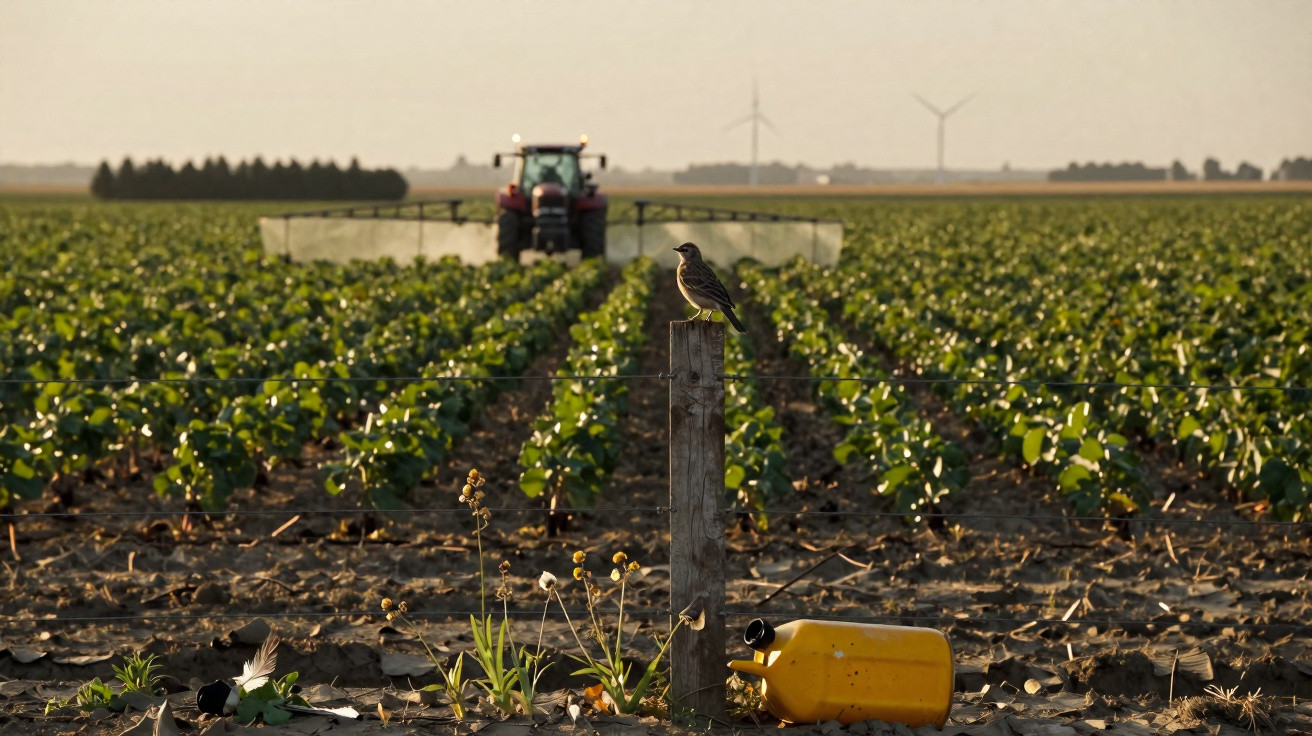
North America’s birdlife is declining - and at a faster rate than many specialists had feared. A study published in the scientific journal Science now identifies where losses are most rapid: in areas where farms rely heavily on pesticides, fertilisers and vast expanses of arable land. The findings also strike close to home for Europe, as the patterns are remarkably similar.
Bird counts over decades: Nearly half of species are declining
The research team assessed data on 261 bird species in North America, covering the period from 1987 to 2021. To do so, the researchers used extensive monitoring schemes and radar data that reveal migratory movements and population trends.
“On average, populations of the bird species studied fell by around 15 per cent over just more than three decades, while 47 per cent of species show a clear downward trend.”
However, the study did not stop at this conventional picture of population change. Rather than simply measuring how many birds have disappeared, the researchers examined the pace at which declines are progressing. This is where the most alarming findings emerge:
- 261 bird species studied (North America)
- Period: 1987 to 2021
- Average decline across all species: approximately 15 per cent
- 47 per cent of species with clearly falling populations
- 24 per cent of species with an accelerating annual decline
For almost a quarter of the species, numbers were not merely falling from year to year - the rate of loss was increasing too. These decline “hotspots” are especially common in areas dominated by intensively farmed agricultural land.
Where arable land begins, birds disappear faster
The researchers overlaid bird population data with maps of land use and agricultural chemical use. The result revealed a distinct pattern: the sharpest declines occurred in regions with particularly high pesticide and fertiliser use, as well as a large proportion of arable farmland.
“The more intensive agriculture is in a region, the faster bird populations collapse there.”
Specialists had raised warnings even before this study. The International Union for Conservation of Nature (IUCN) recently concluded that populations are falling in 61 per cent of all bird species worldwide. Here, too, the expansion and intensification of agriculture is considered one of the leading causes.
How industrial agriculture destroys habitats
A central issue is the conversion of natural habitats into crop fields and livestock farms. When woodland, hedgerows, wetlands or species-rich grasslands disappear, birds lose nesting sites, shelter and food sources.
Typical interventions associated with industrial agriculture include:
- clearing trees and hedgerows to create larger fields
- levelling and draining wetlands
- removing strips of scrub and fallow land
- building tracks, access roads and irrigation infrastructure that fragment habitats
These interventions have long-lasting effects. Even where fields are left fallow for a time, complex habitats do not simply return. Species dependent on particular landscape features are especially vulnerable - including skylarks, meadow pipits and woodland birds that require stands of trees.
The silent killer: Chemicals in the field
Just as serious is the widespread application of fertilisers, herbicides and insecticides. These substances are standard across many farming systems, with consequences extending far beyond the field itself.
“It is not direct poisoning that takes centre stage, but the gradual loss of food for insect-eating and seed-eating birds.”
Insecticides affect the insects that are vital to many bird species. During the breeding season in particular, adult birds feed their chicks protein-rich larvae. When spraying destroys insects across large areas, nests are suddenly left without sufficient food.
How fertilisers and herbicides cause indirect harm
Herbicides are intended to eliminate wild plants regarded as unwanted. Yet these plants provide seeds, flowers and cover - and therefore food and habitat for insects and small vertebrates. Fertilisers alter nutrient balances in the soil and favour a small number of fast-growing species. Diversity declines.
| Substance group | Primary effect on plants/insects | Consequences for birds |
|---|---|---|
| Insecticides | Destroy insects, including many non-pest species | Less food, especially for young birds |
| Herbicides | Remove wild plants and flowering plants | Fewer seeds, fewer flower-visiting insects, less cover |
| Mineral fertilisers | Encourage a small number of rapidly growing crop species | Impoverished plant communities, monocultures, fewer niches |
Such “cascade effects” are rarely noticeable overnight. They develop gradually, but eventually affect entire landscapes. This is precisely the dynamic captured by the new study: where agricultural chemicals have the strongest impact, bird populations decline more quickly.
Climate heating intensifies the pressure on species
The researchers considered not only agriculture, but also rising temperatures. Their analysis produced a twofold picture: warmer regions generally have lower bird numbers, while intensive farming adds further momentum to the decline.
“Agriculture and global heating act like two vices, squeezing bird populations from both sides.”
Notably, the effect of intensive agricultural land use on bird populations was even more pronounced in areas that have warmed particularly strongly over recent decades. There are several reasons for this:
- Arable fields provide less shade and moisture than woodland and hedgerows.
- Cleared land retains more heat and dries out more rapidly.
- Fewer trees also mean less CO₂ storage, further intensifying global heating.
For birds, this brings heat stress, altered insect development, shifted flowering periods and more extreme weather. Populations already under pressure therefore slip into decline even faster.
What more bird-friendly farming can achieve
Despite the alarming figures, the results also show that agriculture does not inevitably have to create a birdless landscape. Specialists point to alternative cultivation systems, such as regenerative or organic farming, which use fewer chemicals and support greater diversity.
Key measures include:
- substantially reducing the use of pesticides and herbicides
- retaining and creating hedgerows, field copses and flower strips
- avoiding vast monocultures in favour of smaller fields and crop rotations
- providing fallow land and wetlands as refuges
Pilot projects in Central European agricultural landscapes have long shown that yields and nature conservation are not mutually exclusive. Farmers who establish flower-rich areas, reduce pesticide use or mow later often report stable, or even increasing, populations of typical farmland birds.
What the study means for Germany and Central Europe
While the new data come from North America, the underlying mechanisms are similar around the world. In Germany, too, northern lapwings, grey partridges, skylarks and whinchats survive in many places only in remnant populations, while intensively cultivated arable land dominates the landscape.
For agricultural policy, the study sends a clear message: it is not enough to look only at overall bird population figures. What matters is identifying early those regions and species in which the collapse is accelerating. It is in these places that support schemes, protected areas or restrictions on pesticide use can have the quickest effect.
Another aspect is that many of the terms involved can seem abstract. In practical terms, “intensification” means, for example, more harvests each year, higher quantities of fertiliser, tighter crop rotations and larger machinery. For birds, this translates into fewer undisturbed periods, more disruption and a uniform landscape without places of refuge.
Anyone walking through farming areas with their eyes open can immediately see the developments described: immense, featureless fields, hardly any hedgerows, few trees and very little blossom from spring to autumn. The study suggests that these are precisely the places where birdsong disappears from the landscape most quickly.








Comments
No comments yet. Be the first to comment!
Leave a Comment