Many home gardeners put their tools away when the first frost arrives, assuming there is nothing more to do until April. For hydrangeas, however-particularly large mophead varieties-the care given during cold weather can determine whether a shrub is laden with flowers or produces hardly any blooms.
January makes or breaks next summer’s hydrangeas
By the middle of January, the harshest weather is often still ahead. A hydrangea may appear to be nothing more than a cluster of grey stems, but it remains very much alive. Those stems contain the flower buds for next summer, which developed towards the end of the previous season.
Although resilient, these buds are not indestructible. Severe frost can damage them, particularly where the soil is exposed and the shrub has no protection. When the buds have been lost, neither spring fertiliser nor pruning can restore that season’s flowers.
The real decision about your hydrangea display is taken in the heart of winter, not in May at the garden centre.
Garden designers and professional landscapers understand this. While many of us stay indoors following the weather forecast, they tend to their hydrangeas. The key is not an expensive product or specialist feed, but one straightforward winter practice.
The mistake to avoid: pruning at the wrong time
As soon as branches are bare, many gardeners instinctively reach for the secateurs, believing that everything should be pruned in winter. In the case of hydrangeas, that habit can mean losing the flowers.
On traditional Hydrangea macrophylla varieties, including mopheads and lacecaps, the flower buds form close to the ends of the previous year’s growth. Pruning at this point removes those buds and leaves new cuts exposed to frost.
In midwinter, the smartest thing you can do with your pruning shears is put them back in the shed.
Keep the spent flower heads in place. They provide a small umbrella-like cover for the buds beneath, protecting them from wind and cold. The network of stems also shelters the centre of the shrub. Save reshaping and removing old wood until early spring, after the worst frosts are over and it is clear which stems are genuinely dead.
The real secret is at ground level
While attention often centres on the parts above the soil, professionals concentrate on the base of the plant. Frost affects more than buds: it can penetrate the ground and harm the shallow root system on which hydrangeas depend.
If deep frost damages the crown and upper roots, the shrub may survive but spend the following season recovering rather than flowering. The result is plenty of foliage but very few blooms.
The key winter gesture is not cutting; it is insulating the soil at the foot of the hydrangea.
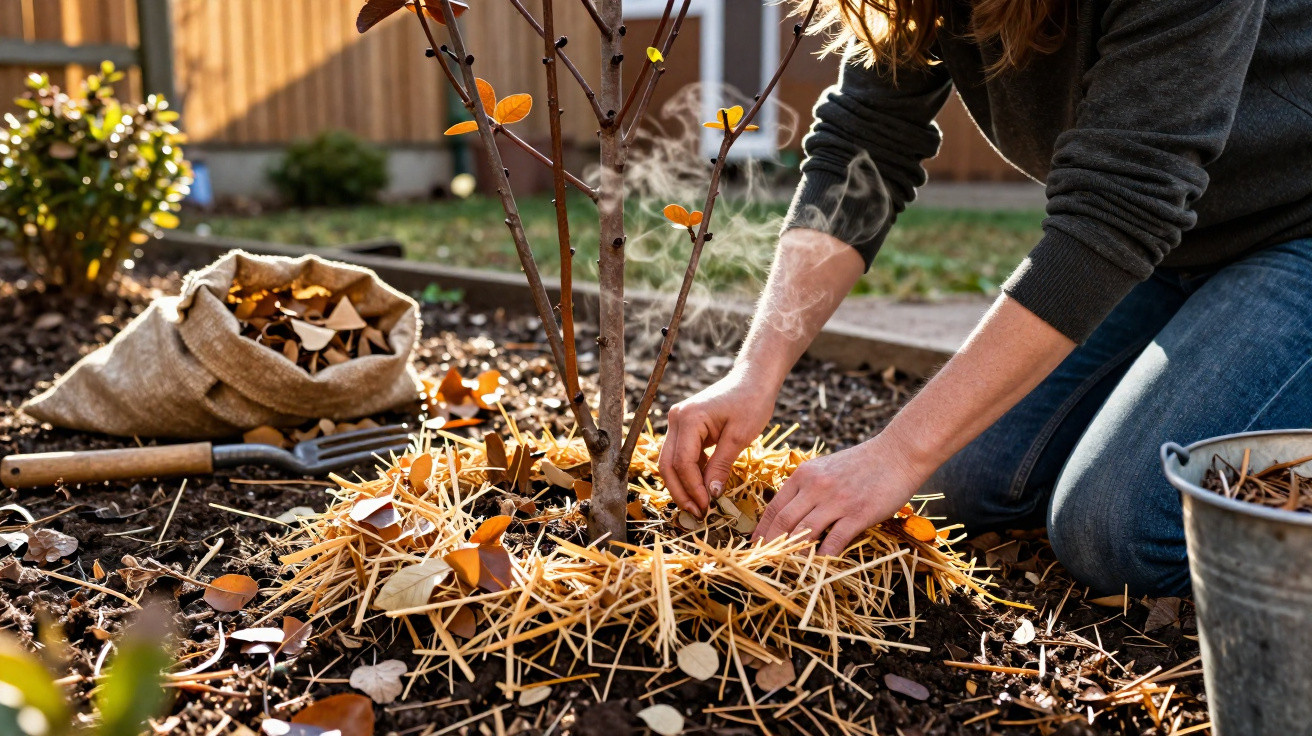
The objective is to form an insulating layer around the base of the shrub. It holds pockets of air, reduces sudden changes in temperature and keeps the root area more even. When applied properly, it also becomes valuable organic matter by spring.
Free materials that make a winter “armour”
There is no need for costly fleece coverings or plastic protection. In many gardens, fallen material from surrounding trees will provide all that is required.
- Dead leaves: Oak and beech leaves work particularly well. They decompose slowly, offer good insulation and are free.
- Pine bark: Bark chips can help maintain slightly acidic soil, which is useful for blue hydrangeas where conditions are suitable.
- Straw or hemp: Both insulate effectively because air is held between their stems.
- Dry fern fronds: Popular with gardeners in wooded locations, these repel water and persist through the winter.
Using a combination is often most effective. Leaves occupy the spaces, straw keeps the mulch airy, and bark weighs down the surface so that it is not carried off by the wind.
How thick should the protection be?
Aim for the equivalent of a proper winter coat rather than a T-shirt. A light sprinkling of leaves offers little defence against a severe freeze.
| Type of winter | Recommended mulch thickness |
|---|---|
| Mild, coastal or urban | 8–10 cm |
| Typical temperate frost | 10–15 cm |
| Cold inland, regular hard freezes | 15–20 cm |
This may seem like a substantial layer, but it is the depth needed to slow frost before it reaches the plant’s crown.
Step-by-step: building a winter blanket without smothering the shrub
Allow 15–20 minutes on a dry day that is not too frozen. The soil may be cold and firm, but it should still be possible to shift the upper few centimetres if necessary.
- Light clean-up: Carefully remove any visible weeds around the base. Avoid deep digging or raking because hydrangea roots are close to the surface.
- Mark the crown: Identify the point where the stems emerge from the soil. This prevents material from being heaped directly against it.
- Apply mulch: Spread the chosen material around the shrub in a broad circle, extending from the base to at least the width of the branches.
- Reach the right height: Increase the layer to around 10–15 cm. Your hand or a trowel can serve as an approximate guide.
- Leave a breathing gap: Maintain a slim 1–2 cm ring of exposed soil immediately around the stems to limit the chance of rot.
The mulch should feel like a loose duvet, not a compacted mat. Trapped air is what insulates.
Pressing the material down hard is a frequent error. It may appear neat, but it removes the air spaces that make mulch insulating. Pat the surface only lightly to secure it, especially in exposed or windy gardens.
From winter shield to spring booster
After late frosts have ended and buds begin to swell in spring, the winter mulch delivers another benefit. Rainfall and soil organisms slowly draw fragments of leaves, bark and straw down into the ground.
This produces humus: the dark, crumbly substance that nourishes soil life and improves soil structure. Hydrangeas thrive in fertile, moist and well-structured ground, and this gradual supply of nutrients suits them well.
Your winter mulch acts first as a blanket, then as a long-term fertiliser factory at the roots of the plant.
There is an additional advantage once summer heat arrives. The same organic layer that protected against frost also reduces evaporation. The soil remains cooler and damp for longer, cutting the need for watering and reducing stress during hot periods. Reduced stress generally means improved flower size and colour.
Colour, chemistry and a detail many gardeners miss
For gardeners focused on achieving a precise flower shade, this winter routine also has a subtle effect. Hydrangea colour-especially blue tones-is closely connected to soil pH and the availability of aluminium in the soil solution.
Over time, pine bark and some leaf types gradually encourage more acidic conditions, which may help retain or intensify blue colouring where the conditions permit. By contrast, heavy use of alkaline mulches, including crushed shells, or nearby concrete rubble can shift flowers towards pink.
The effect is not immediate, but following the same winter routine year after year gently alters the soil conditions surrounding the shrub.
What happens if you skip this step?
Imagine two neighbouring gardens after a severe winter. In one, the hydrangeas received no protection. Frost blackened the upper buds, the crown was chilled repeatedly, and spring growth begins late from lower buds that do not flower.
Next door, the shrubs were covered by a 15 cm ring of leaves and bark. Their buds remained undamaged, the roots scarcely registered the cold, and the protected stems begin growing from their tips as temperatures rise. By early July, the contrast may be striking: one shrub is leafy but carries sparse blooms, while the other appears almost covered in flowers.
Often, that difference is the result of a quarter of an hour spent working during the greyest part of winter.
Extra benefits and small risks to manage
This modest routine can also benefit the wider garden ecosystem. A dense organic mulch provides cover for ground beetles, spiders and other useful predators that eat slugs and pests. Birds commonly search around the edges, dispersing seeds and helping to control insect numbers.
There are, however, a few points to monitor. Very deep, wet mulch heaped against stems can promote fungal disease and rot around the base. In sheltered corners, rodents may occasionally nest in straw layers and gnaw at roots or bark. A brief check during winter, along with the narrow gap around the stems, prevents most of these issues.
When used with care, this small winter task forms part of a broader low-input gardening approach: less poorly timed pruning, fewer chemical feeds, and greater attention to soil life and seasonal patterns. Hydrangeas respond strongly to this method, rewarding a few cold-weather minutes with months of colour once the garden comes back to life.









Comments
No comments yet. Be the first to comment!
Leave a Comment