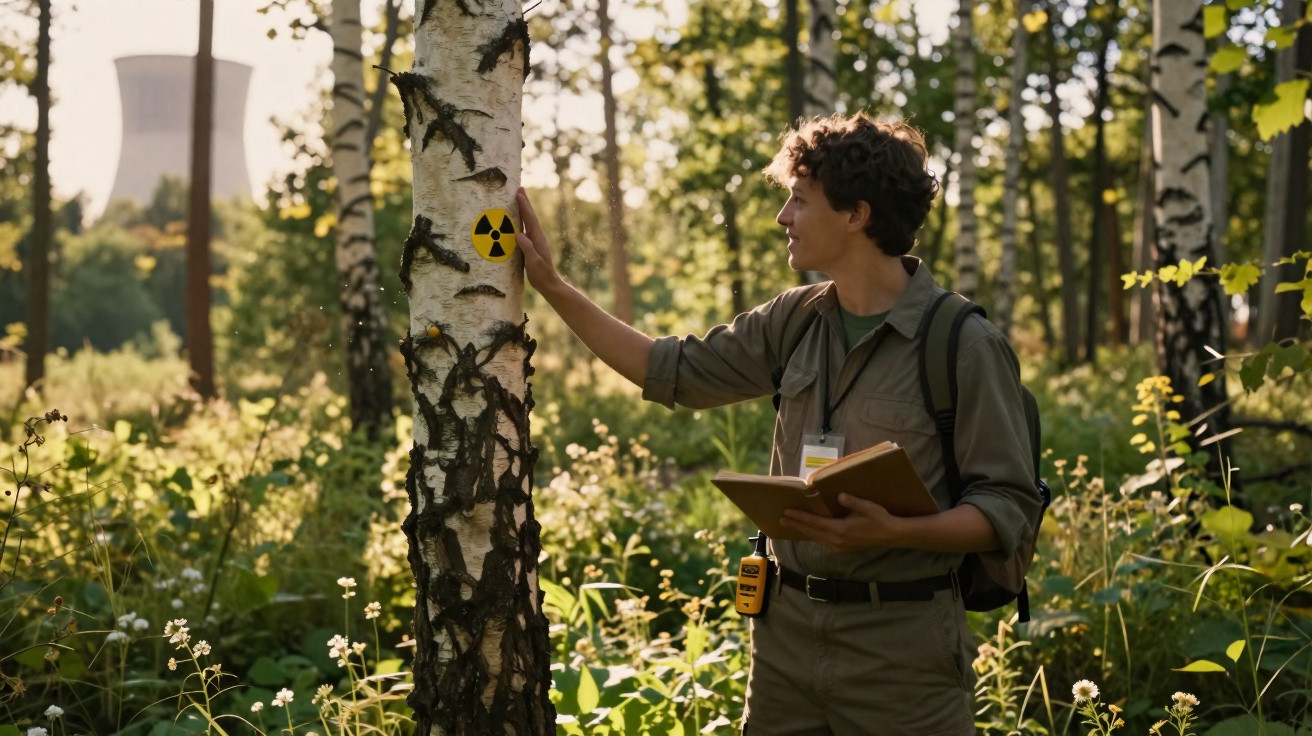
Barbed wire droops beneath the weight of ivy. In the stillness, a woodpecker taps at a pine tree that, by any reasonable measure, should not exist here.
These are places once coloured red on maps and marked “uninhabitable”. In the aftermath of Chernobyl and Fukushima, and around underground test sites in Kazakhstan and Nevada, experts talked in centuries rather than decades. The soil was poisoned, the water was haunted, and forests were written off as though they were casualties of war.
Yet saplings began to emerge among fractured concrete and skeletal power cables. At first, they formed a blur of green. Then they became a strip of shade. Eventually, they created woodland so dense that it softens the sound of every footstep.
What followed is more unusual than any disaster film – and considerably more real.
When the “dead zone” begins to breathe again
Enter the Chernobyl exclusion zone in early autumn and fear is not the first sensation. Smell is. Wet leaves, resin and fungi quietly at work beneath your boots. Birch and Scots pine spill across deserted roads, throwing fractured shadows over faded white lines.
Birdsong carries between trunks rooted in earth that was once considered untouchable. Wild boar and red deer appear in open spaces, along with the occasional wolf. There are no cars, chainsaws or weekend walkers. Instead, there is woodland thick enough to engulf whole villages, with only a roofline or leaning bus shelter suggesting that people once lived busy lives here.
Satellite imagery tells an unexpected story in the “forbidden” areas surrounding nuclear sites. The broad grey patches visible in the late 1980s have become dark green. Across Ukraine, Belarus, Japan and parts of Russia, tree cover has increased sharply in land abandoned after nuclear disasters or weapons-testing programmes.
Ecologists studying the Chernobyl Exclusion Zone have recorded woodland expansion of tens of thousands of hectares since 1986. Fields once used for wheat and potatoes have become naturally seeded forests, while replanting projects and firebreaks have connected isolated fragments into an unbroken canopy.
At Fukushima, forestry workers and local volunteers have planted broadleaf saplings beside rivers and along ridgelines, using them to stabilise contaminated ground and act as living filters. At Kazakhstan’s Semipalatinsk test site, planned belts of pine and birch have been established to retain dust and limit wind erosion across a damaged steppe where hundreds of nuclear devices were detonated.
This is not an overnight miracle. It is a gradual, purposeful and occasionally awkward effort to restore woodland one tree at a time, even as nature forces its way back more quickly than planners anticipated. The figures continue to grow.
Why are forests returning to places our grandparents were told to abandon? One part of the explanation is harshly straightforward: people left. Remove logging, agriculture, hunting, road construction and weekend barbecues on a vast scale, and the pressure on an ecosystem falls suddenly.
Species that fare badly amid continual human disruption can recover. Plants reclaim open soil. Young trees are no longer cut back or grazed away. Prey returns, followed by predators. Within only a few decades, the absence of people can matter more than radiation damage for many kinds of life.
Radiation still defines these environments, of course. Some areas remain so “hot” that timber cannot safely be harvested, mushrooms contain worrying levels of cesium, and certain animals have increased rates of cataracts or tumours. Recovery is uneven and untidy, with major gaps in available data.
But viewed from a distance, a clear pattern appears: when we make room, forests are remarkably capable of rewriting a story we had already labelled “permanently lost”.
How people discreetly help forests reclaim nuclear fallout
Rewilding attracts attention, but much of the practical work is almost mundane. It may involve a forester in a pickup coated with dust, deciding which saplings belong on a slope where a Geiger counter still clicks. Or it may be a Fukushima village meeting, where residents debate which hills should be reforested and which should remain open for potential farming if that time comes.
In many contaminated areas, the workable approach is to choose the right tree for the least unsuitable site. Deep-rooted species can hold soil in place that might otherwise carry radioactive particles into rivers. Fast-growing conifers catch dust in their needles and serve as living filters – although they can also lock radiation into timber that should not be burned.
For that reason, teams combine species: pine and larch for rapid canopy cover; oak and chestnut for slower-growing, more resilient woodland; and willow and alder beside streams to absorb water-borne contaminants. They map “hot spots” in detail, avoid sites where roots could reach buried waste, and lay fallen branches and brush to limit erosion. It is not glamorous work. It is patient, repetitive and quietly heroic.
Let us be honest: nobody carries out this work every day with the cinematic drama shown in documentaries. Much of it involves spreadsheets, soil samples and exhausted people in rubber boots.
Radiation is not the only silent threat in nuclear landscapes. Fire is another. Forests reclaiming abandoned farmland can become crowded, dry and full of deadwood. At Chernobyl, a large wildfire can send radioactive particles back into the air and disperse them well beyond the perimeter fences.
That is why many reclaimed forests are not entirely left to themselves. Firebreaks are created. In targeted strips, older pines that readily catch and spread flames are thinned. Near Fukushima, officials carry out controlled burns in selected seasons under strict supervision, reducing fuel loads without causing a spike in radiation.
Scientists and local residents exchange advice that can sound almost household-like. Do not leave cut branches in long, unbroken heaps: they make ideal fire ladders. Maintain thinly vegetated areas beside old roads as emergency buffers. Avoid heavy equipment on certain soils, as it can disturb contaminated layers.
There is also a more human error that repeatedly occurs: seeing these forests either as cursed wastelands or as miraculous sanctuaries. The truth lies uncomfortably between the two.
“We talk about the ‘return of nature’ as if the disaster never happened,” says a Ukrainian ecologist who has worked in Chernobyl for two decades. “But the trees remember. The soil remembers. Recovery and damage exist in the same square metre.”
That contradiction appears in scientific papers and local discussions alike. Some former residents regard the new woodland as evidence that people may one day return. Others experience it as a betrayal, watching thick greenery spread across homes they were compelled to leave.
- Look beyond the simple story: a green forest is not automatically a healthy landscape.
- Recognise the quiet helpers: ranger teams, volunteer planters and local guides who know every “hot” ditch and safe route.
- Think about your own forests: patience, species diversity and respect for risk matter far beyond any nuclear perimeter.
What reclaimed nuclear forests reveal about us
Stand on a decaying bridge in the Chernobyl zone at dusk and the feeling is difficult to define. Light reaches the tops of poplars that began life as seedlings in radioactive dust. A group of wild horses moves without sound along the riverbank. Power lines buzz over a valley that remains, officially, a disaster site.
On a map, it is a contaminated polygon. For the forest, it is simply space in which to grow.
Forests growing from nuclear fallout reveal a truth we seldom voice: we are both responsible for the problem and involved in the solution. Reactor failures, weapons tests and sudden evacuations scarred the land and emptied villages. Then, over time, some of the same human hands began planting, measuring, fencing and, at times, stepping away long enough for saplings to establish themselves.
Most of us know the moment of walking through woods and realising that they were once something else: a quarry, a landfill or an old farmyard. Once you see what came before the green, the air seems different. Nuclear forests intensify that sensation to its fullest extent.
They show that harm may endure for centuries, while change can still start within a human lifetime. These places will not revert to an imagined “pristine” condition. They are producing a different form of wildness, marked by cesium, shaped by fire danger and bounded by exclusion fences, yet undeniably alive.
That leaves difficult but hopeful questions. If nature can reclaim ground even here, what might happen in places we have not abandoned so completely?
| Key point | Detail | Why it matters to the reader |
|---|---|---|
| Forests returned after people left | Exclusion zones such as Chernobyl and Fukushima have experienced rapid growth in tree cover without human activity. | It helps you understand how strongly human presence shapes – and can sometimes restrict – natural recovery. |
| Restoration is partly planned and partly wild | Targeted planting, fire management and mapping work alongside natural regrowth from seeds and roots. | It demonstrates that repairing damaged land is neither solely “rewilding” nor solely engineering, but a combination of both. |
| These forests are damaged and flourishing at once | Radiation remains in the soil and timber, while ecosystems continue to become complex and rich in wildlife. | It encourages you to reconsider simple ideas of “destroyed” versus “saved” nature, including closer to home. |










Comments
No comments yet. Be the first to comment!
Leave a Comment