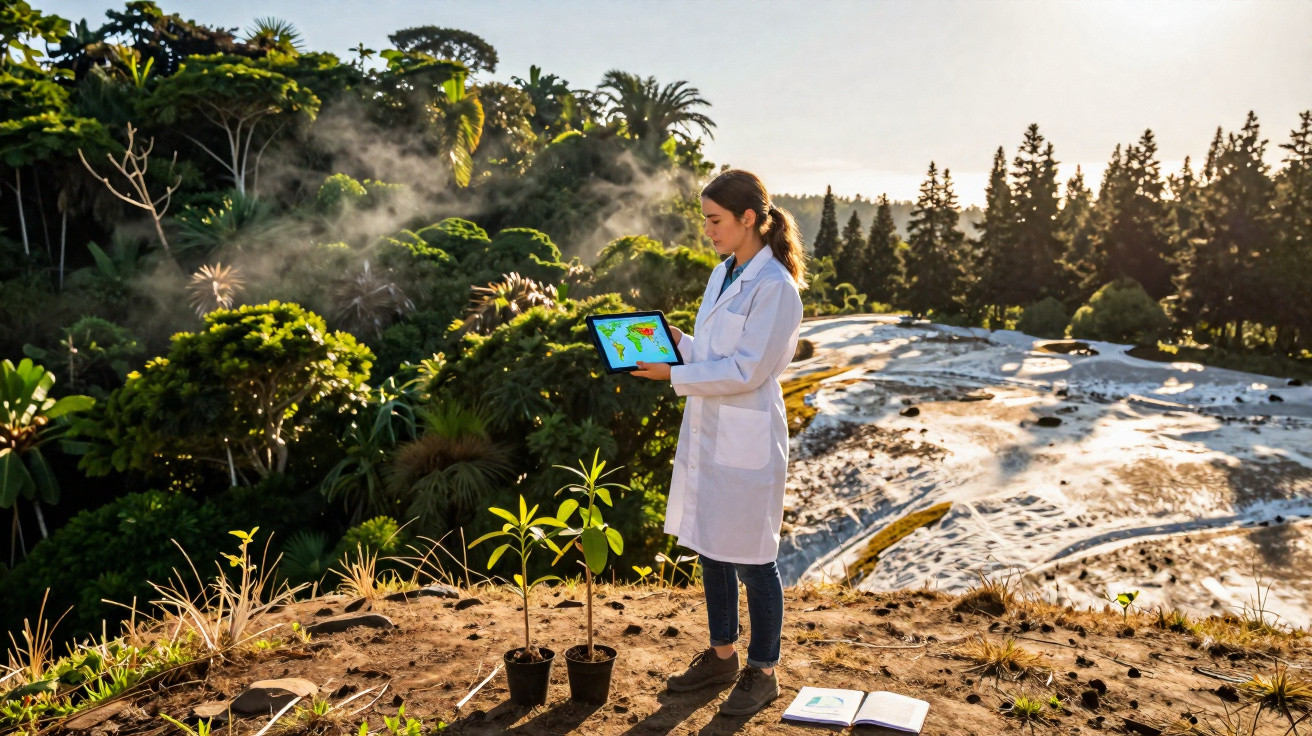
Governments, companies and foundations are currently competing with promises to plant billions of trees. It sounds like a straightforward response to the climate crisis. However, a recent study makes clear that the crucial issue is not how many saplings are put into the ground, but precisely where they grow. Some regions cool the planet substantially, while others can paradoxically make it warmer.
Why trees do not protect the climate equally well everywhere
At first glance, the calculation appears simple: trees remove carbon dioxide from the air and store carbon in their wood, soil and vegetation. More forest, less CO₂ – problem solved. The new research corrects this overly simple view.
The researchers show that forests affect the climate through several physical and biological mechanisms, which can either reinforce or cancel one another out. Three factors are particularly important: carbon storage, the reflectivity of the Earth’s surface and evaporation.
Afforestation can cool the Earth – or warm it. The difference depends heavily on the location and the type of landscape converted into forest.
CO₂ storage: the familiar climate effect of forests
Through photosynthesis, trees absorb carbon dioxide and use it to build biomass. Some of that carbon is stored in trunks, roots and leaf litter, while another share ends up in the soil. This storage process slows further warming, provided that the land is not cleared or burned again.
Trees grow especially rapidly in tropical areas and produce large amounts of biomass. The CO₂ balance is particularly favourable there: high uptake, comparatively limited seasonal variation and stable stores – at least as long as large-scale fires, deforestation and soil degradation are avoided.
Albedo: dark forests and bright land surfaces
The effect known as albedo is less widely understood. It describes the proportion of sunlight that a surface reflects back into space. Bright surfaces, such as snow, ice or pale dry soils, reflect a great deal of radiation. Dark surfaces – including coniferous forests and damp soils – absorb more energy and warm up more strongly.
When a dark forest develops on a bright snow-covered surface, its reflectivity declines markedly. The ground absorbs more heat and local air temperatures rise. This warming effect can partly, or even completely, offset the beneficial CO₂ effect.
Evaporation: the landscape’s natural air conditioning
The third component is evaporation, referred to technically as evapotranspiration. Trees draw water from the soil and release it back into the air through their leaves. This process consumes energy and therefore cools the surrounding area, much like sweat cooling the skin.
In tropical and humid regions, this natural “air conditioning” is particularly powerful: dense forests transfer enormous quantities of water into the atmosphere, lowering temperatures locally and across wider regions. In very dry areas, the effect is weaker simply because too little water is available.
Why tropical forests provide a climate benefit – and boreal forests do not always
The study assesses measurement data and model simulations from different climate zones, revealing a clear pattern: the impact of afforestation depends strongly on geographical location.
Tropics: low risk and a major cooling effect
In tropical regions such as the Amazon, Central Africa and South-East Asia, the positive effects clearly outweigh the negatives. All three mechanisms operate in the same direction there:
- high CO₂ uptake resulting from rapid growth
- strong evaporation, and therefore considerable cooling
- a comparatively small loss of albedo because the ground is already relatively dark
Restoring forest cover on degraded land in these areas delivers an especially large climate benefit per hectare. The researchers show that the same cooling effect can be achieved with around half the forest area if land is specifically selected in these high-potential regions.
High latitudes: afforestation can backfire
The situation is very different at northern latitudes, including Canada, Scandinavia and Siberia. During winter, the ground is often covered with snow, which reflects a great deal of sunlight. When forests grow on this land, their dark canopy conceals the bright blanket beneath. The region absorbs more energy and the surroundings become warmer.
In some scenarios, the climate benefit is even reversed: afforestation makes a net contribution to warming despite the trees storing CO₂. Large-scale programmes located in snow-rich zones are particularly exposed to this risk.
Distant effects: forests influence weather far beyond their location
Forests do not act only at a local level. They alter wind patterns, moisture exchange between land and the atmosphere, and consequently rainfall and temperature patterns in distant regions. A large afforestation project can therefore change the weather hundreds or thousands of kilometres away – either positively or negatively.
For example, additional forest in the tropical belt can affect moisture supply to other continents, alter monsoon systems, or reduce or intensify heatwaves. Climate policy focused solely on local effects overlooks these distant consequences and therefore fails to reflect reality.
Why climate policy must move beyond simply “counting trees”
For a long time, afforestation programmes were viewed as an uncomplicated climate tool. A country commits to planting billions of trees, companies offset flights through forest projects, and many climate plans make generous allowances for future CO₂ sinks. The new analysis gives this logic a poor assessment.
It is not the sheer number of saplings that determines the climate benefit, but the combination of location, forest type and long-term stability.
Targeted land instead of symbolic policy
The researchers argue that afforestation needs to be managed far more carefully. Priority should go to regions with strong cooling potential – especially tropical, humid and degraded land that was previously forested. New monocultures on land with high albedo or limited water availability perform substantially worse by comparison.
For governments and businesses, this means that reporting afforestation by the hectare is not enough. What matters is whether projects are located where forests genuinely have a net effect on global temperature.
Monocultures: cheaper, but risky
The study also criticises uniform plantations containing one, or only a few, tree species. Although they often grow more quickly and can be managed industrially, they bring serious risks:
- high vulnerability to pests and disease
- greater fire risk from uniform stands that are often easily flammable
- lower plant and animal biodiversity
- generally shallower and less stable soil carbon stores
Instead, experts recommend mixed forests adapted to the relevant region. They may grow more slowly, but they cope better with disruption and store carbon more robustly over the long term.
The limits of afforestation – without an emissions stop, the effect fades away
The study also tempers exaggerated expectations. Even in optimistic scenarios, where enormous areas worldwide are restored to forest deliberately and appropriately, model calculations suggest that the global average temperature will fall by only around 0.25 degrees by 2100. This is noticeable, but it is not a miracle solution.
Meanwhile, emissions from coal, oil and gas, industry and transport continue to grow. Unless these sources decline rapidly and substantially, no amount of afforestation worldwide can offset the additional warming.
What projects can do better now in practice
The findings provide clear guidance for future programmes. Anyone intending to use afforestation as a climate tool should follow several basic principles:
- Assess the location: Before a project begins, analyse precisely how albedo, evaporation and CO₂ storage will behave, including snow cover and soil moisture.
- Prioritise tropical and subtropical regions: The same hectare generally produces more cooling there than at high latitudes.
- Restore previously forested land: Reforesting damaged ecosystems delivers more than planting sensitive natural areas for the first time.
- Plant mixed forests: Diversity strengthens resilience, reduces fire risks and stabilises carbon stores.
- Plan for long timescales: Forests work over decades. Projects need long-term funding, protection against clearance and monitoring.
Although such standards reduce the number of projects that can be marketed quickly, they greatly increase the real climate impact per pound invested. For companies promoting climate commitments, it will therefore become harder to generate “green” certificates with minimal effort.
Terms worth knowing – and what they mean in practice
Anyone assessing afforestation projects will repeatedly encounter technical terms. Three are central:
- Albedo: A measure of how strongly a surface reflects sunlight. High albedo (snow, light-coloured desert) cools, while low albedo (forest, water) warms.
- Evapotranspiration: The combination of water evaporating from soils and plants. It cools the surrounding air and creates more pleasant temperatures in humid areas.
- Carbon sink: A system that permanently absorbs more CO₂ than it releases. Intact forests, peatlands and oceans are considered key sinks.
In practical terms, a “good” afforestation project supports all three factors in a sensible balance: it establishes a robust carbon sink, improves local evaporation and reduces albedo as little as possible.
For public debate, the study represents a change of direction. The image of the tree as a universal climate saviour is too simplistic. Forests remain an important ally in the fight against warming, but only when they are established in the right places, with suitable species and within policies that consistently reduce fossil emissions. Anyone decorating climate promises with large planting figures without seriously examining location is pursuing public relations rather than climate protection.











Comments
No comments yet. Be the first to comment!
Leave a Comment