Leaves are drooping, flower edges have turned brown, and stems are slumped as though they have abandoned the whole idea of garden glory. She scrolls through phone tips: scratch tests, sugar water, ice cubes and aspirin in the vase. Her finger stops at a video claiming it can deliver a “miracle revival in 24 hours”. She looks at the plant, then the hose and the unopened compost bag. With a sigh, she says, “Alright, sugar water, don’t fail me now.” It is an oddly recognisable scene.
Why the Famous Hydrangea “Revival Hacks” Won’t Save Your Dying Shrubs
Garden forums thrive on the promise of instant solutions, and hydrangeas make ideal victims. Every summer brings the same supposedly magical phrases: “scratch test”, “sugar water trick” and “instant revival”. It can sound like a late-night advert aimed at gardeners in despair.
But visit real gardens and the lush, almost smug-looking hydrangeas tend to share one feature: they never needed rescuing. They were given the right conditions from the beginning. It may not be as exciting as a viral trick, but it is much nearer the truth.
The scratch test is the old favourite. You use a fingernail to scrape the bark and check for green beneath it. Green is taken to mean the stem is “alive” and therefore savable. Online, people scratch their way across half a shrub before declaring success. What is rarely shown is the disappointment a fortnight later, when those apparently green stems still have not produced leaves. A stem can remain technically alive while being unable to recover during that growing season. Hydrangeas can be stubborn in that way.
Next comes the sugar water trick, perhaps the one that makes experts roll their eyes most. Its logic seems persuasive: give the plant sugar as “energy” and it will spring back. Yet roots do not take in sweetness as an exhausted runner takes a sports drink. They require oxygen, healthy soil and genuine nutrients, not a dessert. Adding sugar to soil can also promote fungal problems and attract insects that a stressed plant does not need. It is like treating burnout with sweets rather than rest and a nourishing meal: appealing, perhaps, but not effective.
The Real Hydrangea Revival: What Actually Brings a Plant Back From the Brink
While the internet argues over sugar-water recipes, professional gardeners tend to rely on deep rehydration and attention to the roots. There is no sparkle or shortcut involved, only slow and focused care.
First, remove every genuinely dead, brittle stem at its base. Avoid agonising over every tiny choice: if a stem breaks cleanly and feels dry, cut it away. Next, water thoroughly around the root zone rather than spraying the leaves, allowing moisture to soak in from below. A gentle trickle for 20–30 minutes achieves more than ten hurried sprays. Let’s be honest: hardly anyone does that every day. Still, doing it correctly a few times has more value than light daily watering.
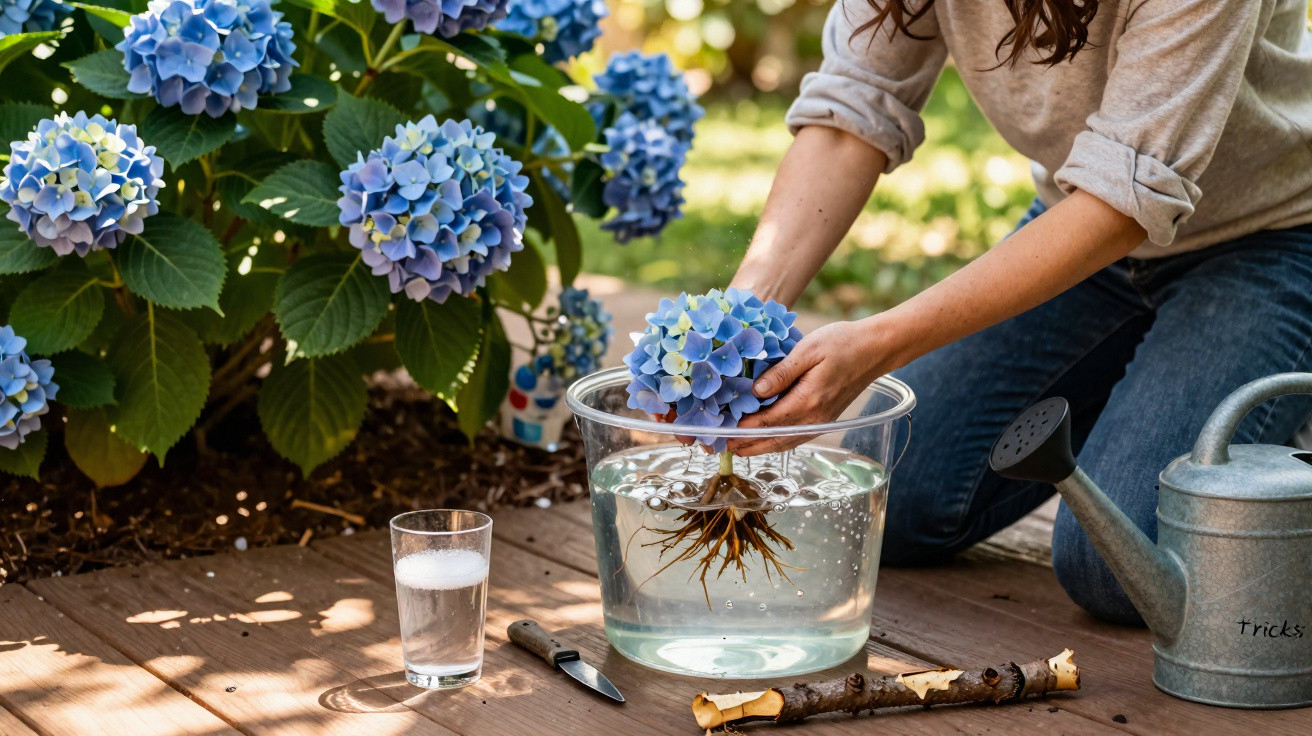
For a potted plant, pick up the container. Does it feel feather-light? The root ball is likely completely dry inside, even where the surface appears damp. Place the entire pot in a tub or bucket for 30–40 minutes, until bubbles no longer rise. Those bubbles are trapped air escaping.
Allow the pot to drain completely afterwards. Do not put it straight back into a water-filled saucer: hydrangeas dislike waterlogged roots almost as much as drought. Once it has been soaked and allowed to rest, spread a light mulch around the base. Keep it away from the stems; its role is simply to help maintain even moisture.
Shrubs planted outdoors often benefit more from environmental adjustments than from any magical treatment. Provide afternoon shade where full sun is scorching them. Shift potted hydrangeas from heat-reflecting patios to cooler ground. Find out whether the soil is dense clay that stays wet for days or sandy soil that dries within hours. The genuine “revival hack” is identifying a mismatch between the plant and its position, then calmly putting it right. That is when you move beyond firefighting and begin gardening.
Why Experts Call the Sugar Water Trick “Pure Nonsense”
When horticulturists dismiss the sugar water trend, it is not because they are being snobbish. It comes down to basic plant biology. Roots do not draw in sugar like a straw in fizzy drink; they absorb water and minerals. Hydrangeas produce their own sugars in their leaves through photosynthesis, using light as their power source. Sugar poured around the roots does not “feed” them. At best, it has no effect. At worst, it disrupts the balance of soil microbes and attracts pests.
The plant is not struggling because it needs sugar. It is struggling because it needs stable conditions.
Experts have a somewhat different objection to the scratch test. It is not entirely without use, but it creates misplaced certainty. Green tissue beneath the bark only shows that a stem is not completely dead. It does not reveal whether the stem has enough stored energy to produce leaves, whether frost has killed its buds, or whether the roots can still support it. Gardeners hold on to the idea that “green means hope”, then blame themselves when nothing happens. Repeated scratching can also create small wounds and add stress to an already vulnerable plant.
As one landscape gardener told me while standing beside a row of partly bare hydrangeas:
“People want a yes-or-no answer from a living thing that only speaks in maybes.”
The frustration is understandable on both sides. Quick tests and miracle tips are the plant equivalent of fortune cookies: broad, reassuring and seldom conclusive. Meaningful recovery relies on less glamorous actions:
- Testing soil moisture with your fingers rather than an app.
- Pruning more firmly than feels comfortable when wood is truly dead.
- Recognising that some stems will not return this year, and that this is not a personal failure.
How to Give Your Hydrangeas a Future, Not Just a Quick Fix
The understated truth that many plant influencers leave out is that hydrangea revival begins months before a shrub appears half-dead. Think of it as building a reserve of strength. Water deeply but less frequently, encouraging roots to grow down instead of remaining close to the surface. Add compost once or twice yearly rather than relying on continual miracle feeds. With some varieties, leave spent flowers in place through winter to shield buds from frost. These habits give the plant reserves when a heatwave or late frost arrives.
On a difficult day, however, immediate practical steps still help. Shade netting, or even an old bedsheet placed over a plant in fierce sunshine, can prevent it tipping into genuine damage. A deep morning watering before predicted extreme heat is far more useful than an anxious evening spray once the leaves have already wilted. When a cold snap is forecast, mulch around the base and drape horticultural fleece over the shrub to protect next season’s flowers. On a human level, that modest protective act can feel surprisingly grounding.
Most of us have stared at a plant and wondered: is it me, or you?
The better you understand the difference between nonsense and genuine care, the less likely you are to blame yourself. Instead of pursuing hacks, you begin to spot patterns. You learn how leaves droop when roots are dry compared with when they are scorched. You notice the difference between healthy new growth and growth that is short of nutrients. Gradually, hydrangeas become less like fragile ornaments and more like old friends, capable of getting through a bad week without fuss. That is the real “revival hack” experts actually believe in.
| Key point | Detail | Why it matters to the reader |
|---|---|---|
| Sugar water = myth | Roots absorb water and minerals, not sugar as a direct source of energy | Prevents wasted time and further harm to the soil |
| Scratch test is limited | Green cambium indicates life, not a real ability to regrow | Reduces false hope and harsh treatment of the wood |
| The genuine “hack” | Deep watering, suitable soil, partial shade and targeted pruning of dead stems | Provides a practical, lasting way to save hydrangeas |






Comments
No comments yet. Be the first to comment!
Leave a Comment