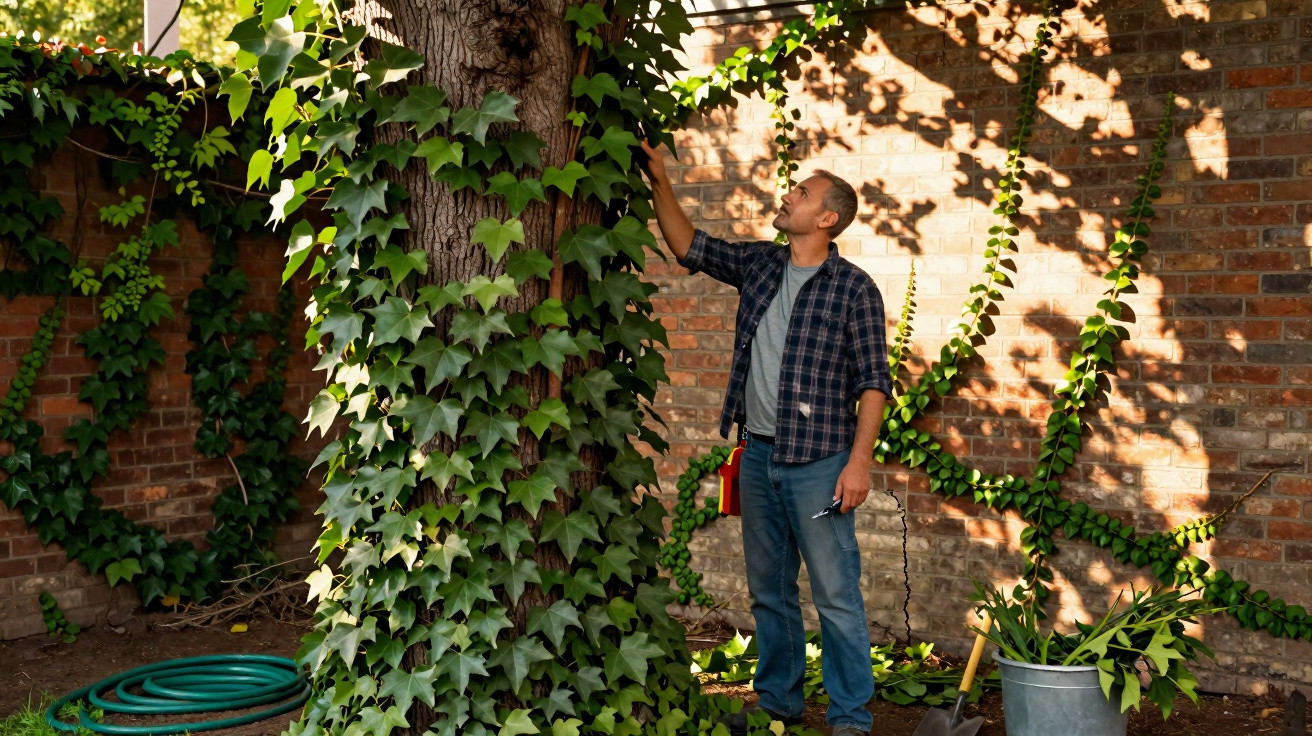
People are often quick to tear down ivy, whether it is covering a suburban fence or a stone wall that has stood for centuries, in the name of “good maintenance”. However, an increasing number of arborists, ecologists and building experts warn that this automatic response can be counterproductive, harming trees, speeding up erosion and even reducing a home's resilience.
Ivy is not the parasite many think it is
The main misconception begins underground. Common ivy (Hedera helix) is not parasitic in the way that mistletoe is. It neither takes sap from a tree trunk nor removes nutrients from a wall.
Its actual roots remain in the ground, absorbing minerals and water from the soil. The parts that climb are small aerial holdfasts: tiny anchor-like structures that attach themselves to bark or masonry. They secure the plant without drawing anything from the surface.
When a tree is vigorous and structurally sound, research shows ivy does not reduce its vitality or “strangle” it.
This difference is crucial. On a healthy tree or structurally sound façade, ivy acts more like a protective covering than a leech. Taking it away “just in case” may remove a natural shield that has taken years to establish.
On trees, ivy can be a living shield
Gardeners commonly worry when substantial ivy stems wind around a tree trunk. Their first reaction may be to sever it at ground level and pull away the remaining growth. On a strong, healthy trunk, though, this green covering can offer several less obvious benefits.
A microclimate for bark and wildlife
Its thick leaves provide insulation, moderating heat and cold extremes that would otherwise affect the bark directly. During summer, the foliage protects the trunk from intense sunshine. In winter, it lessens wind chill and may reduce freeze-thaw stress in the outer wood.
Ivy also holds a light layer of moisture around the bark. This can limit rapid drying and help prevent surface splits in exposed locations. Along the ground, its trailing stems create a dense cover that holds soil in place, reduces erosion and slows moisture loss.
Ivy thickets can shelter nesting birds, small mammals and well over a hundred species of insects, all inside a single mature clump.
In urban areas, where mature trees and hedgerows may be limited, a well-established ivy column can serve as a miniature block of flats for wildlife.
When ivy becomes a real problem for trees
Problems tend to arise when the tree supporting it is already vulnerable. A very old or diseased tree with decayed heartwood or fragile branches may be less able to cope with the additional weight and wind resistance created by ivy in its canopy.
Young trees, particularly fruit trees, present another issue. Their fine branches require plenty of light to develop strongly and bear fruit. Heavy ivy can shade new growth, conceal evidence of disease and form damp areas that encourage fungal growth.
In stormy weather, an evergreen canopy packed with ivy behaves like a sail. Its extra surface increases wind loading. For a weakened tree, this could be the factor that determines whether it remains standing or snaps or is uprooted.
- Healthy, well-rooted mature tree: ivy generally safe, with light, regular trimming.
- Very old, hollow or structurally damaged tree: ivy can increase risk of failure.
- Young trees and fruit trees: ivy should be kept low or removed from the crown.
Experts therefore recommend a measured approach: reduce ivy in the upper canopy of at-risk trees instead of stripping every stem away and leaving bare bark.
On walls, ivy can protect rather than destroy
Ivy perhaps has its poorest reputation around buildings. Homeowners often blame it for cracked stonework or peeling render. Yet building surveys frequently point to another sequence of events: the damage was usually present first, and ivy followed it.
How ivy behaves on a sound façade
Where a wall is stable and its mortar and render are intact, ivy holdfasts usually stay at the surface. They adhere to the wall but seldom penetrate deeply into the material.
The resulting green cover can operate as a form of natural cladding. It reduces the direct impact of wind-driven rain, limiting the water reaching the wall itself. Its foliage also moderates changes in temperature, making masonry cooler during heatwaves and marginally warmer in cold weather.
Well-managed ivy on a solid wall can cut surface temperature peaks and shield bricks from repeated wetting and drying cycles.
As air moves past, the leaves capture dust and certain pollutants, potentially offering a small improvement in local street-level air quality. This is relevant for properties beside busy roads.
Where cracks exist, ivy exploits them
The situation is different if the wall has existing defects. Weak mortar, neglected pointing and fine cracks create small spaces into which ivy's clinging roots can settle.
When stems grow thicker and move in the wind, they place repeated mechanical strain on these weak points. Water remains in the openings, increasing frost damage and salt crystallisation. Over time, joints may spread, fragile bricks can work loose and water penetration may become more severe.
Older stone properties that have not been restored are particularly at risk. Dense ivy may also block gutters and downpipes, directing water to places where it should not collect. For these buildings, specialists advise a straightforward order: inspect the masonry, repair the faults and then decide whether ivy should be allowed to grow back.
| Wall condition | What ivy tends to do | Recommended approach |
|---|---|---|
| Sound brick or stone, good mortar | Clings to surface, adds shade and rain protection | Keep, but prune around windows, gutters and roofline |
| Hairline cracks, slightly soft joints | Roots can lodge and slowly widen gaps | Cut ivy, repair joints, then reassess |
| Severely degraded masonry | Can conceal and aggravate serious moisture problems | Remove in stages, carry out full repairs |
How to manage ivy without harming trees or buildings
Experts recommend beginning with a basic assessment of the structure supporting the plant before taking action. For trees, check trunk stability, the root flare, branch arrangement and signs of decay. For walls, examine mortar, render and any damp areas already visible.
On a sturdy tree, ivy can normally remain in place. Gentle pruning every two to three years prevents it from taking over the canopy. The objective is to retain a green column on the trunk while avoiding dense growth at the top, where wind loading is most significant.
A leaning or damaged tree needs a more cautious approach. Arborists will often cut through a ring of ivy stems at the base and allow the growth above to die back on its own. This prevents bark being torn away, which could create lengthy wounds and leave the tree open to infection.
Brutal tearing of ivy from trunks or façades often causes more damage than the plant ever did on its own.
Gardeners can take a similarly gradual approach with walls. Severing ivy at the base and allowing it to dry out makes later removal simpler. After it has died, the stems release more cleanly from the surface, lowering the chance of pulling away sections of mortar or render.
Practical scenarios for homeowners and gardeners
If your garden tree is wrapped in ivy
Consider a mature oak or maple carrying a substantial column of ivy. If the tree appears sturdy, has a full crown of its own foliage and shows no clear dieback, the ivy can remain as a wildlife habitat and a climatic buffer. Simply thin it near the crown and stop it spreading across the main branches, where it could conceal early symptoms of disease.
Now consider a different example: a hollow, leaning trunk that has suffered storm damage and is also covered in ivy. In this instance, internal weakness combined with external weight increases the risk. Paying for a professional inspection is worthwhile, while reducing or removing crown ivy should form part of a wider safety plan.
If your house wall is covered in green
Imagine a well-pointed brick wall from the 1990s with no visible cracking. Ivy has grown up one side and reached the eaves. Here, it is less a villain than an unpaid assistant. You may still choose to remove it from gutters, roof tiles and window frames, but the central section can remain as a natural screen providing shade.
Consider instead a 19th-century stone cottage with deteriorating joints and indoor signs of damp. A thick layer of ivy over the façade could be concealing significant faults. The first priority is to remove the plant safely, let the wall dry, then repair the masonry and resolve drainage problems. Allowing the ivy to return is sensible only after the building is structurally stable.
Key terms and side effects worth knowing
Two technical concepts explain ivy's mixed reputation. The first is the “sail effect”: a dense volume of leaves catching the wind in the manner of a boat sail. On trees, this added drag increases the forces acting on trunks and roots. On walls, heavy stems moving in the wind can place strain on weak joints.
The second concept is the “microclimate”. Ivy forms its own small climatic layer around brick or bark. Slightly increased humidity and reduced temperature variation can benefit living wood and certain types of masonry, while posing a risk to walls that are already damp and lack ventilation.
There is also a trade-off for people. Ivy contributes to urban biodiversity, captures a small quantity of air pollution and softens the appearance of hard landscapes. Conversely, its flowers can cause allergies in sensitive individuals, while thick growth can give rodents or wasps a sheltered place to hide close to a building.
With some understanding, ivy becomes a managed ally rather than a threat. The deciding factor is usually not the plant, but the condition of the surface or tree it is attached to - and how readily we reach for the pruning saw.














Comments
No comments yet. Be the first to comment!
Leave a Comment