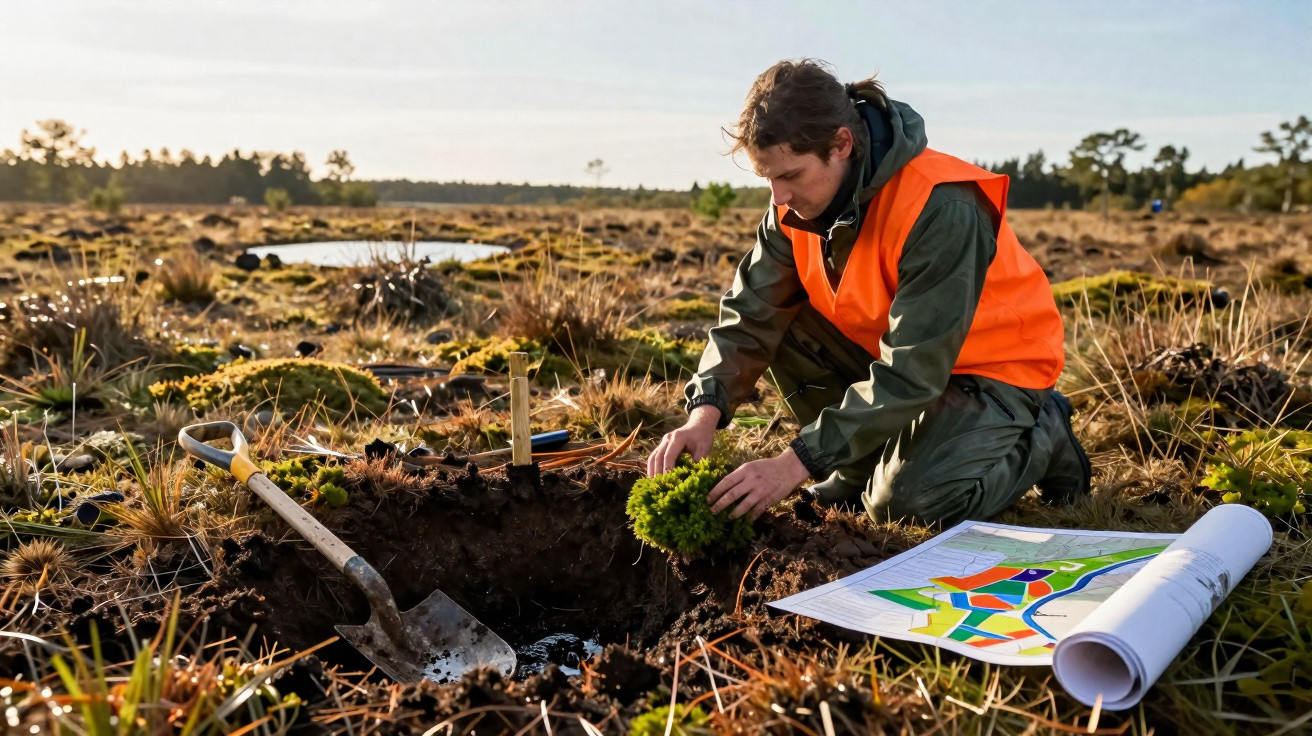
Beneath the moss and black water, however, something enormous is quietly stirring once more. For decades, drained peatlands have released ancient carbon into the atmosphere, one unseen breath at a time. In isolated places around the globe, people are now entering these waterlogged, neglected landscapes with spades, plugging ditches, holding back water and attempting to stop the loss. There are no vast machines or gleaming technologies involved. There is only mud, patience and a race against the clock. Their approach rests on a straightforward belief: make peatlands wet again, and the damaged carbon lock may finally close.
What occurs when a landscape relearns how to safeguard a secret it has kept for millennia?
When the ground starts breathing differently again
The noise is what strikes you first. On a restored peatland, boots do not land on solid earth; they press down into the surface with a drawn-out sigh, as though the ground itself were breathing out. Former drainage channels have been packed with branches and blocks of peat, slowing the water enough for it to spread sideways through the moss. The air carries the distinctive smell of waterlogged soil: rich, sharp and faintly smoky.
For a long time, these landscapes were dismissed as wasteland or converted into supposedly “improved” farmland and forestry. They were drained, planted, ploughed and burned. Carbon that had remained sealed in saturated soil for thousands of years then began to escape. Today, researchers cross these sites carrying handheld sensors, tracking how the readings alter as the land becomes wet again. Areas that were once carbon sources are gradually moving back towards becoming carbon sinks.
In the Flow Country in northern Scotland, among the world’s largest peatland complexes, the history is almost visible from above. Old commercial forestry plantations slice through the bog like scars, with their rigid outlines and unnatural darkness. Between them, pale-green bands of sphagnum moss are returning where drains have been closed. Local teams have spent years turning this landscape back, one hectare at a time.
The evidence emerging from these locations is increasingly promising. As water tables rise, greenhouse gas emissions fall substantially, even where the peat does not immediately return to net carbon storage. In certain trial plots, carbon losses have dropped by more than half over only a few seasons. This is no miracle solution; it is a brake lever, pulled firmly.
The process beneath the surface is both remarkably uncomplicated and quietly extraordinary. Peat consists largely of dead plant matter that did not fully break down because it remained flooded and deprived of oxygen. Once a bog is drained, microbes can feast on this ancient material, releasing carbon dioxide and nitrous oxide into the atmosphere. Bring back the water and that activity slows to almost nothing.
Meanwhile, mosses and other wetland plants start building fresh organic material above the older layers. Each year adds millimetres of new matter. That may appear insignificant, but over centuries it becomes metres of dense, carbon-rich peat. Peatland restoration is not solely about plugging today’s leak. It also restarts a natural system that stored carbon quietly long before our species had a term for it.
How people are coaxing bogs back to life
The central action in peatland restoration is strikingly simple: close the drains. Teams follow the routes of old ditches, constructing small dams every few metres from peat, timber or plastic piling. Water levels can rise within days, and shallow pools form where straight channels once carried water rapidly downhill.
The next stage takes longer. Where sites have been severely damaged, restoration workers may reintroduce sphagnum moss or scatter shredded pieces of it over the wet ground as a living mulch. Some schemes are testing “paludiculture” – the cultivation of wetland crops such as cattails or reeds – enabling farmers to retain an income without drying the soil. The aim is to stop battling water and begin working alongside it. The work is neither glamorous nor immediate, but it can be remarkably effective.
It may seem logical that governments and landowners would be eager to do this everywhere. In practice, the situation is more complicated. Many areas rich in peat are working farms, forestry plantations or proposed housing developments. People understandably worry about losing productive land or seeing machinery sink into fields made wet again. Others are concerned that rewetting will produce more methane than the carbon savings justify. Methane science is complicated, and it can lead to difficult conversations in muddy fields.
Let us be honest: hardly anyone thinks about this every day. Most people do not wake up wondering, “How’s the water table in that bog 300 kilometres away?” They are thinking about rent, children and deadlines. For this reason, restoration teams are increasingly discussing more than grams of CO₂, focusing instead on tangible outcomes: lower wildfire risk, cleaner drinking water and new rural employment. When a drained peatland catches fire, it may burn below ground for weeks and release enormous quantities of carbon. Keeping it wet is therefore both a climate precaution and a form of local self-preservation.
Behind the practical work, scientists and policymakers are also undergoing a quieter change in perspective. Peatlands are shifting from a conservation issue considered merely desirable to a central part of climate strategy. They account for only about 3% of the Earth’s land surface, yet hold roughly twice as much carbon as all the world’s forests combined. Damage that store and we trigger a slow-motion disaster; restore it and we gain time.
“Restoring peatlands is like fixing a broken safety deposit box,” says one researcher in Finland. “You don’t see the value on the surface, but what’s protected inside could change your whole future.”
For anyone asking what this looks like in practical terms, several themes recur across project after project:
- Wet land is not useless land: it can shield nearby homes from flooding.
- Closing only a handful of crucial drains can alter the water balance of an entire landscape.
- Local expertise – from farmers, hunters and Indigenous communities – often identifies issues well before satellite imagery does.
- Monitoring need not be sophisticated: basic water-level records and photographs can provide compelling evidence.
Where this leaves us – and what it asks from us
At dusk, standing beside a rewetted bog produces a strange combination of stillness and profound motion. Dragonflies dart across recently formed pools, while cottongrass bends in the wind. Below the surface, biochemistry is changing as molecules follow slightly different routes from those they took the previous year. The land is learning again how to retain what is valuable.
We live at a time when climate solutions can sound like science fiction: direct air capture facilities, massive mirrors in space and speculative geoengineering projects. Against this setting, a waterlogged field gradually filling with rain can seem almost embarrassingly mundane. Yet that ordinariness is precisely why it merits attention. Peatland restoration is not a silver bullet, but it is a practical, modest measure that already works and can be scaled if we allow it to be.
At a human level, restoring peatlands also touches on something familiar. We have all had moments when it feels as though matters have gone too far, the damage cannot be reversed and there is no point trying. Walking through a landscape that was once stripped bare and is now recovering slowly challenges that belief. It offers no promise of a happy ending, but it demonstrates that damaged systems can begin again. The old carbon locks closing into place make no sound. Choosing to help them do so does.
| Key point | Detail | Why it matters to the reader |
|---|---|---|
| Peatlands as carbon giants | 3% of land area, roughly twice the carbon of all forests | Demonstrates why these “boring bogs” matter far more than they appear to |
| Drainage vs. rewetting | Draining turns peat from a carbon sink into a source; blocking drains can reverse much of this | Explains how a straightforward change in water management can reshape emissions |
| Co-benefits of restoration | Lower wildfire risk, cleaner water, new rural jobs, biodiversity gains | Connects climate action with everyday life and local communities |










Comments
No comments yet. Be the first to comment!
Leave a Comment