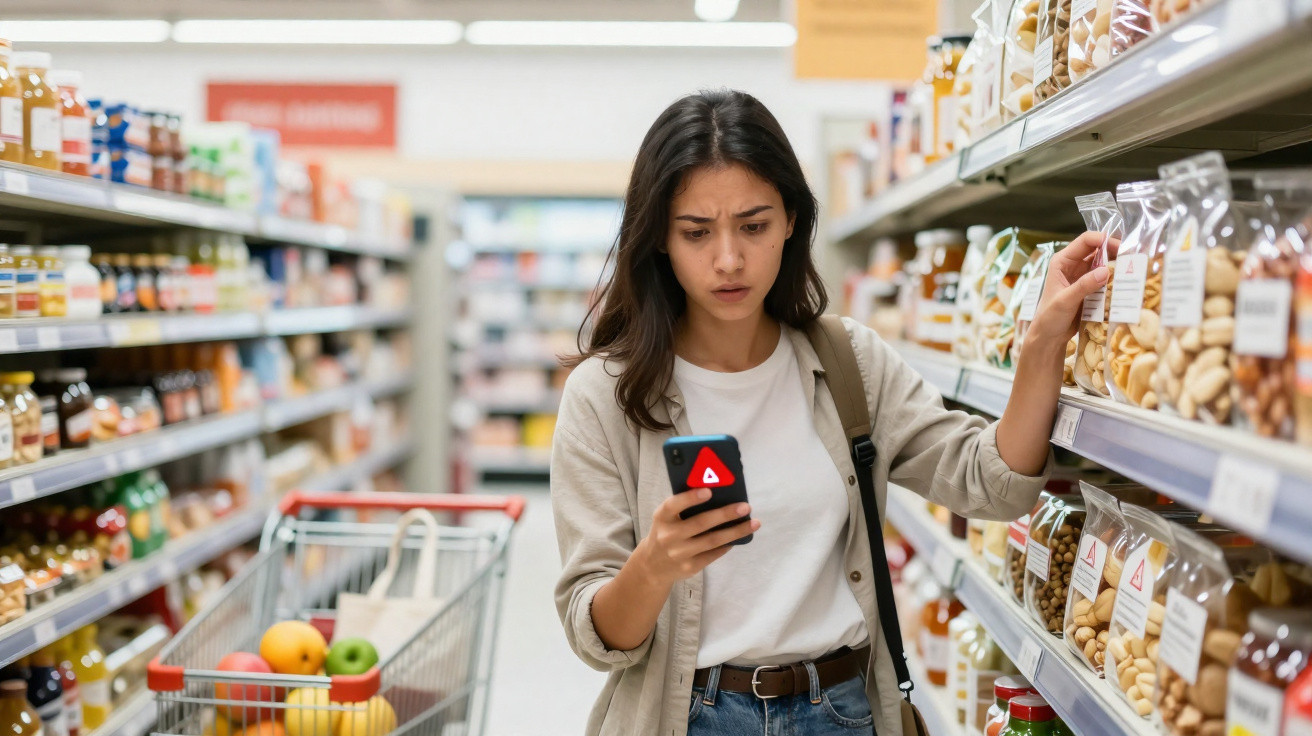
The woman ahead of me in the supermarket seemed completely still, her forehead creased as she studied a bag of ready-made salad. With one hand, she flicked through her phone; with the other, she held the packet beneath the bright strip lighting, trying to find a tiny code close to the seal. The late-afternoon crowd continued around her as though nothing was different. Trolleys clattered, children asked for biscuits and the self-service checkout called out its prompts.
She alone appeared to be caught in a different sort of time.
Her screen showed a food recall alert posted in the neighbourhood WhatsApp group. The packet carried the same brand and the same use-by date. When she eventually matched the numbers, I saw her shoulders sink.
That is the moment a recall stops being a news headline and becomes something you may already have eaten.
From a quiet shelf to an urgent food recall alert
Food recalls rarely begin with alarm. More often, they start in a laboratory, when a technician notices a test result that is not quite right. It may be a single batch, one concerning reading or an email arriving in the quality control manager’s inbox.
Gradually, it develops into a story affecting thousands of refrigerators.
This week’s alert relates to a packaged food available through several leading supermarket chains. It was removed from sale after routine testing identified a potential contamination risk. There is nothing visibly unusual about the product: no odd smell and no strange colour. It is simply the sort of item you pick up after work when you are tired and need a quick dinner.
The recall announcement first appeared quietly on official websites, phrased in the rather dry wording that can feel more like a legal notice than a warning for people. Within a few hours, it was circulating in Facebook groups and Instagram stories: images of barcodes marked with red circles, screenshots of supermarket emails and anxious posts asking, “Has anyone else bought this?”
One mother said she had already given the product to her children on two consecutive nights. She described mentally replaying the week: who had seemed slightly unwell, who had mentioned a sore stomach and who had left food on their plate. That is the force of a recall: it does not merely take food off shelves; it sends you back through the previous few days, examining every moment frame by frame.
Away from public view, the response follows a carefully managed sequence. Laboratories identify concerning results. Brands notify supermarkets. Internal systems retrieve product codes and automatically block affected items at checkouts. Employees move through the aisles with print-outs, removing particular batches from shelves.
Shoppers only see the final stage: signs by the entrance, notifications in supermarket apps and brief entries on government recall pages.
The difference between the activity behind the scenes and our experience as customers is vast. Anxiety takes hold in that space. When a recall hits, we’re suddenly asked to act like experts with nothing but a blurry photo and a batch number to go on.
How to act quickly when a recall happens
The most straightforward approach is to screenshot first and check afterwards. If you spot a recall alert for food you may have at home, save the post, email or webpage. Enlarge the image and check the brand, product name, weight, use-by dates and those long, irritating lot numbers that hardly anybody normally reads.
Next, go to the kitchen and take out every item in that product category at once. Gather all the yoghurts, every salad bag or all the frozen pizzas. Arrange them on the worktop as a small inspection line.
Check the details methodically. Do not simply look at the logo and make an assumption.
Most people react differently. We notice the recall, feel a brief surge of concern, look in the fridge, vaguely inspect one packet and decide it “should be fine”. Afterwards, we cannot remember which codes we checked and which we did not.
Honestly, nobody manages this perfectly every day.
The useful thing is to make recall checking a small, repeatable task rather than a major investigation. Use the same spot on the worktop, line products up in the same way and photograph the label whenever you are uncertain, so it can be compared with the official notice.
You are not aiming to become paranoid. You are simply creating fewer “Did I…?” moments for your future self.
“People think recalls mean they’ve failed as shoppers,” explains a food safety consultant who advises several major retailers. “In reality, a recall means the system picked up a problem and is trying to keep you safe. The real risk is ignoring those boring little details on the label.”
- Check the exact product name
Brands frequently sell closely related products. A recall generally applies to one specific version. - Look at the date and lot code
Those pale strings of digits close to the seal or on the rear panel are where the recall details are found. - Follow the official action
Most recalls allow you to receive a refund or replacement, even if you do not have a receipt. Some provide a helpline as well. - Do not taste “just to see”
Where a recall refers to bacteria, undeclared allergens or foreign objects, the item should go in the bin or be returned to the shop. - Take a photo before you throw it away
If you dispose of the packaging, a quick image of its label and codes may still allow you to claim a refund later.
Living with food recall alerts without losing your mind
Modern food shopping comes with an unusual tension. Shelves have never been subject to more monitoring, regulation or traceability. Yet our phones continue to buzz with a stream of alerts: one batch recalled, a brand under investigation, another item withdrawn “as a precaution”.
You could keep scrolling until you feel unable to choose anything. Or you could shrug and eat whichever item is nearest. Most of us move between these two positions, depending on the day and how much sleep we had the night before.
That is why the middle ground is important: staying informed and attentive while still being able to enjoy dinner without a knot in your stomach.
| Key point | Detail | Value for the reader |
|---|---|---|
| Know what is being recalled | Focus on the precise product name, date and lot codes rather than the brand alone | Limits unnecessary concern about safe items in your fridge |
| Create a quick-check routine | Screenshot the alert, lay out products, compare them carefully and take photos | Makes responding to recalls straightforward, quick and more dependable |
| Use official channels | Consult supermarket websites, government recall pages and shop posters | Provides clear guidance on refunds, risks and what to do next |
FAQ:
- Question 1 What should I do if I’ve already eaten a recalled product?
- Question 2 Do I always need to see a doctor after a food recall?
- Question 3 Can I get a refund without the receipt or empty packaging?
- Question 4 How do I keep up with recalls without checking the news all day?
- Question 5 Are recalls a sign that food is becoming less safe overall?















Comments
No comments yet. Be the first to comment!
Leave a Comment