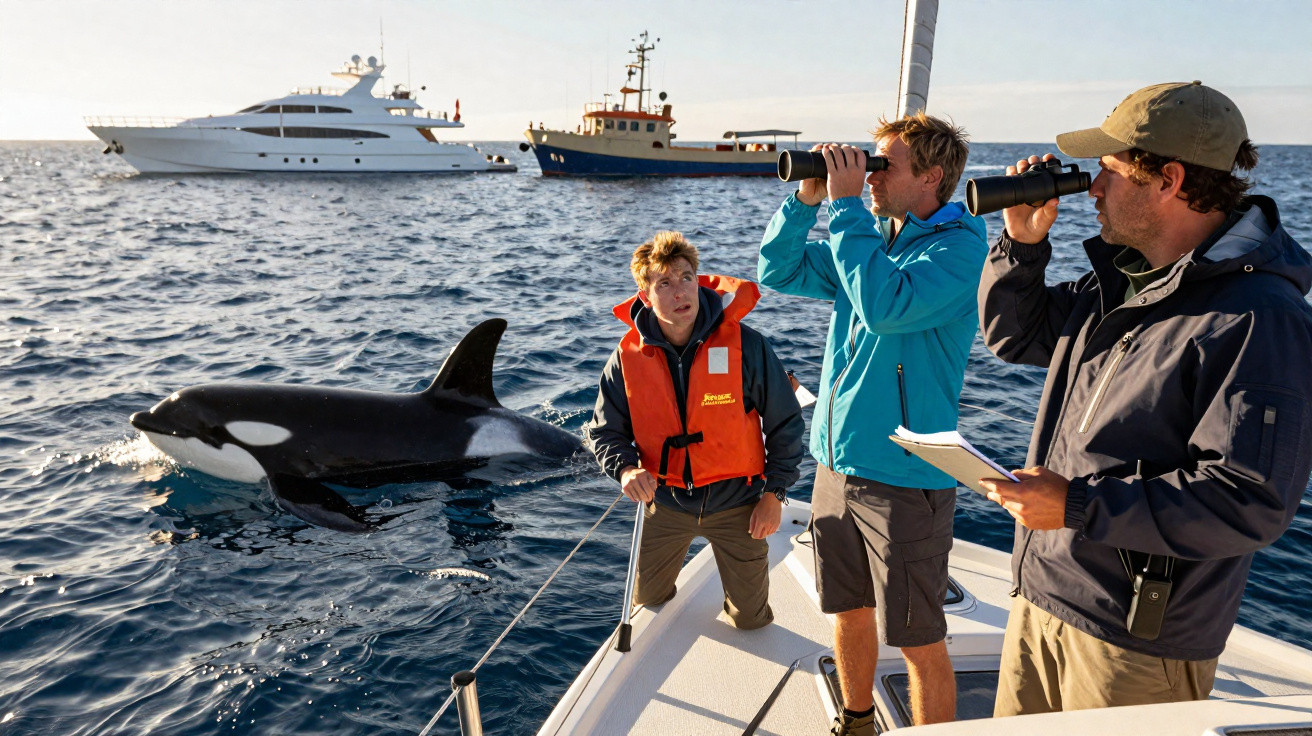
The yacht jolted before anything else happened: a slight vibration the tourists initially dismissed as the swell. Moments later, the stern lurched to one side, as though an unseen force had seized it. Beneath the blue hull off Galicia, a black-and-white form turned in the water and a door-high fin broke the surface. A nervous laugh went up, people reached for their phones, and a crew member yelled for the engine to be stopped. The laughter disappeared when the rudder broke with a dull crack.
A small fishing boat sat 100 metres away, watching without a word. To its crew, this was no TikTok spectacle. It meant damaged equipment, days lost at sea, and a predator that had abruptly shifted from folklore to a budget expense.
Over the radio, the coastguard remained composed, almost offhand: “Keep distance. Report the interaction.”
In these waters, the instruction can feel like speaking softly in the middle of a storm.
Orcas are changing the rules. People are still pretending it’s a game.
Across the heavily travelled sea routes off Spain and Portugal, orcas have begun behaving in a way that appears uncomfortably strategic. They focus on the rudders of sailing boats and, at times, small fishing vessels, striking in rapid, accurate bursts. Boats lose their steering, rotate helplessly and issue distress calls. Then the whales disappear, seemingly finished with the encounter.
Marine authorities on land publish carefully phrased advice about “unusual interactions” and “keeping safe distances.” At sea, however, such wording can seem muted and almost unreal. Crews describe “attacks.” Boat owners speak of “war.” Tour guides call it “the revolution of the sea.”
The same videos are being watched by everyone, yet they are not being interpreted in the same way.
Speak to any skipper in the so-called “orca alley” around the Iberian Peninsula and there will be a story. A charter captain from Cádiz can show the marks along his hull, the destroyed rudder and recall the night spent adrift while orcas patrolled around the boat like guards. A Galician fisherman remembers sacrificing half a day’s catch after making a sharp turn to avoid a pod, leaving nets tangled and torn in the confusion.
Online, footage of orcas pushing against boats attracts millions of views, often paired with cheerful music and captions claiming “they’re just curious”. In that same week, local rescue teams may receive repeated calls from damaged yachts. A Spanish sailing association recorded dozens of incidents in one season, a figure that would have sounded ridiculous ten years earlier.
Somewhere between viral videos and insurance claims sits an uneasy reality: the sea is rewriting its agreement with people.
Scientists favour the term “interaction” over “attack.” They discuss learned behaviour, cultural transmission between orca pods and the possibility that one traumatised female started the pattern after colliding with a boat. Under that theory, she began hitting rudders, younger orcas copied the behaviour, and the practice moved through the pod like a habit.
For biologists, this is a remarkable real-time study of animal culture. For owners of private yachts, it can mean a repair bill running into six figures. For small-scale fishermen, it is another unforeseeable setback added to quotas, fuel prices and warming seas.
A wide divide separates the measured language of academic papers from the immediate reality of sitting aboard a vessel that can no longer be steered. It is in that divide that frustration - and activism - begins to take root.
The new front line: tourists, activists, and fishermen staring at the same fin
At sea, official guidance sounds straightforward: reduce speed when orcas are nearby, do not approach them, avoid abrupt manoeuvres and contact the coastguard if damage occurs. Crews are advised to stop their engines where it is safe to do so, remain calm and wait for the encounter to pass. That may sound reassuring on paper. When a 6-ton whale is striking your rudder, it can feel like being told to “just breathe” during an earthquake.
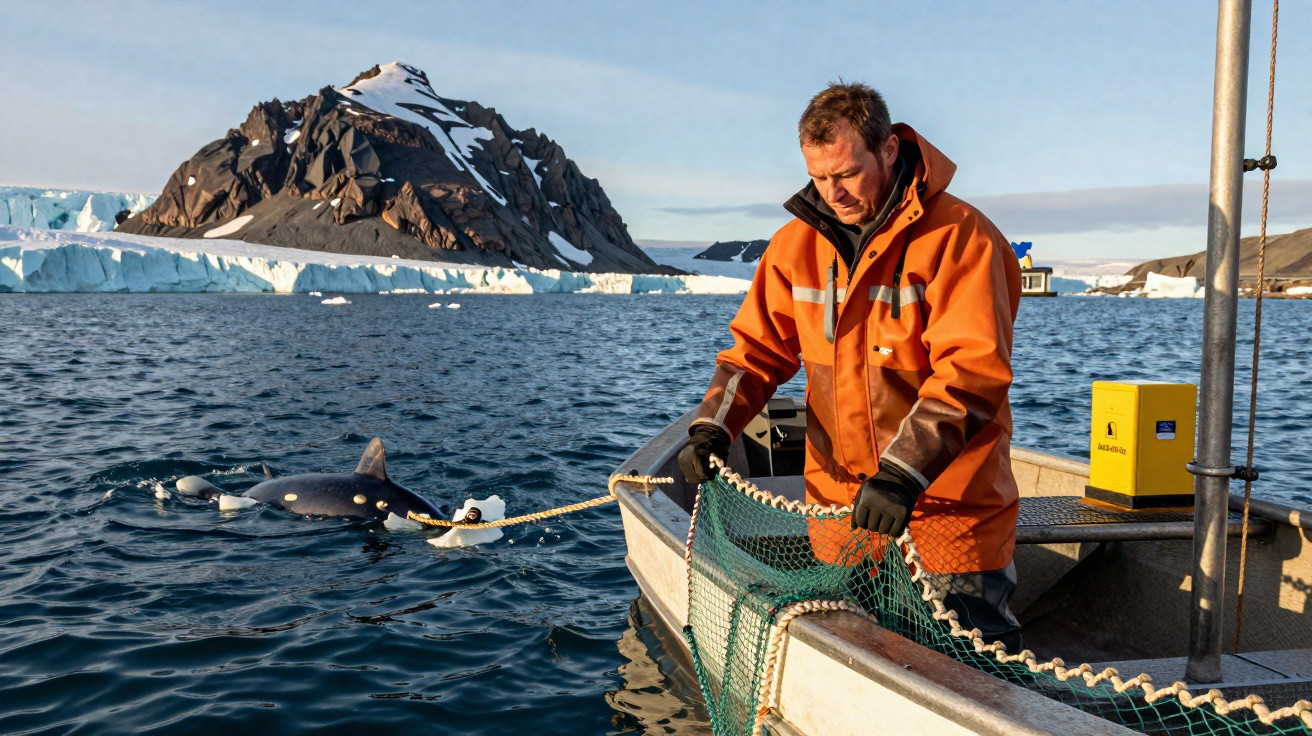
Fishing skippers have developed their own routines. Some throw old nets into the water as a barrier, hoping to confuse the whales without causing harm. Others abandon established routes, accept longer working days and take chances on unfamiliar fishing grounds. Whale-watching guides operating under permits keep a greater distance, hoping their tourists will not insist on getting “just a little closer” to capture the ideal image.
Everyone is making it up as they go. The sea does not consult guidance notes.
The dispute becomes sharper on shore. Tourism businesses understand that visitors arrive for tales such as: “We saw orcas, right next to the hull, it was incredible.” Their livelihood depends on that sense of wonder. Yet they are also the first to face criticism when footage shows vessels heading towards pods or when a close encounter ends badly. Fishermen see those same boats as symbols of money and leisure afloat above their own precarious incomes. For them, an orca that ruins fishing gear is not an emblem of untamed freedom; it is another month of invoices.
We have all experienced the point at which it becomes clear that two people looking at the same scene are, in fact, living entirely different stories. On one quay, activists raise banners calling for strict protection of orcas and tougher restrictions on boat traffic. On the next, a crew grumbles that, if the authorities will not protect them, they will “solve” the problem themselves.
That is how conflicts at sea begin: not with artillery, but with bitterness.
“From my desk, it’s a ‘risk management issue’,” admits a regional maritime official who asked not to be named. “From the deck of a damaged fishing boat, it looks like abandonment. And from the orca’s point of view? We honestly don’t know. We’re guessing.”
- Soft warnings, hard consequences
Official alerts rely on restrained language intended to prevent panic, but that restraint may sound like denial to people whose vessels are at risk. - Clashing narratives at sea
Tourists, activists and fishermen witness the same orcas, yet regard them as a marvel, a symbol or a danger. Those perspectives are not easily reconciled. - The plain truth: nobody out here feels fully heard
Maritime authorities must balance conservation legislation, financial pressure and political appearances, while those working on the water experience the danger directly.
Between restrained bureaucracy and the harsh reality of salt water, the room for measured discussion is narrowing more quickly than anyone acknowledges.
The orcas are forcing a bigger question than “who pays for the rudder?”
This story taps into a deeper anxiety. We have built an ocean economy on the assumption that the sea is scenery: a setting for tourism, industry, romantic sunsets and fishing excursions. Now, a species with names, families and clear preferences is responding in a way that cannot simply be labelled an “accident.” When a pod appears to coordinate strikes on one particular part of a vessel, it seems personal, even where science identifies learned behaviour rather than revenge.
People impose their deepest fears on that black-and-white silhouette. For some, it represents nature finally striking back. For others, it is another indication that their work, equipment and way of life are under pressure from forces they cannot foresee or control.
Let us be frank: almost nobody studies marine advisories every day before setting out. Most people only pay attention after something has been damaged - a boat, a daily routine or an assumption about who controls the sea.
| Key point | Detail | Value for the reader |
|---|---|---|
| Orca “interactions” are rising | Increasing rudder strikes and close encounters occur along busy coastlines from Spain to the Pacific | Explains why these stories continue appearing in your feed |
| Warnings feel too soft at sea | Official wording remains neutral even as damage and fear increase on the water | Provides context for the strain between authorities and people aboard boats |
| A cultural clash, not just an animal story | Tourists, activists and fishermen understand the same events through conflicting emotional perspectives | Encourages you to consider your own instinctive “side” in this emerging sea war |















Comments
No comments yet. Be the first to comment!
Leave a Comment