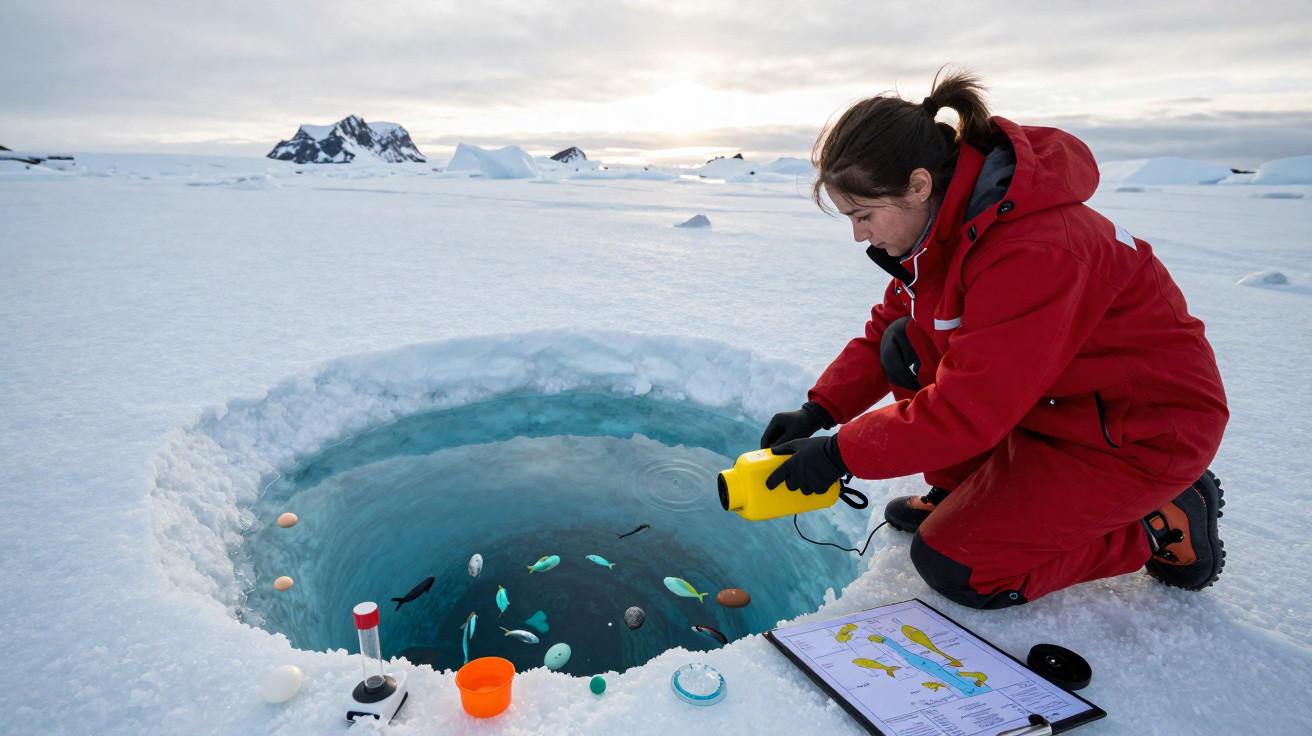
The camera sinks through black water like a lift with no bottom, passing floating ice crystals and the slow pulse of a jellyfish. On deck, the ship is hushed. A handful of scientists lean towards their monitors, their faces washed in spectral blue light. Then circles cover the display: immaculate, repeating circles, hundreds upon hundreds. One person mutters an expletive. Another starts to laugh. Suddenly, the ship seems impossibly small.
On the floor of the Weddell Sea, under a roof of Antarctic ice, there is a vast city of fish nests extending beyond the camera’s view. There are not tens or hundreds, but an estimated 60 million. Every hula-hoop-sized nest is watched over by one pale fish with large, dark eyes, tending its eggs as a parent might rock a cradle.
Far above this frigid, silent nursery, a different storm is gathering in fluorescent meeting rooms. Fishing nations, polar researchers and diplomats wearing strained smiles are facing one another. To some, this concealed metropolis is a wonder that must be safeguarded. To others, it is a chart pointing towards future revenue. The ice may be thick, but patience is wearing thin.
Beneath the ice: an unexpected city of nests
The find was made almost accidentally in early 2021 aboard the German research icebreaker RV Polarstern. As the vessel made its way slowly through sea ice, a towed camera rig roughly the size of a small car began transmitting images of those unsettling circles on the seabed. Initially, researchers assumed they had found an unusual geological formation. Then a fish entered the shot.
It was the icefish Neopagetopsis ionah, a ghostly species found nowhere else. Each nest contained roughly 1,500 eggs and was protected by a single adult. The camera continued filming, and nest after nest came into view. The pattern on the monitor resembled a planned housing estate rather than wilderness, except that every home belonged to a fish and parental care was the rent.
Once the ship had completed its transects, the team had charted an estimated 240 square kilometres of breeding habitat. That is approximately the area of a major city, devoted entirely to one phase of life for one Antarctic species. Such a concentration is a prize for food webs, and for fisheries as well. A nursery on this scale could function as a protein conveyor belt. Once something so valuable has been identified and mapped, politics tends to follow almost automatically.
Weddell Sea icefish nests: from marvel to political tug-of-war
Antarctica is administered through a web of treaties intended to reserve the continent for “peace and science.” Its surrounding ocean, however, is considerably more complicated. The Southern Ocean falls under the authority of an organisation with a lengthy name and an even longer abbreviation: CCAMLR, the Commission for the Conservation of Antarctic Marine Living Resources. Its role is meant to balance conservation with fishing.
Several member states, led by the EU and countries including Germany, soon called for the icefish nesting ground to be closed off as part of a vast marine protected area in the Weddell Sea. They say a breeding site this exceptional is like a library of life: you do not begin tearing out pages before you have read them. In their view, the nest field is scientific gold, a living laboratory for observing how a polar ecosystem reacts to rising temperatures, thinning sea ice and altered currents.
Other countries at the CCAMLR table, especially Russia and China, have opposed broad protections. They note that the treaty also permits “rational use” of resources. In simpler terms, that means fishing rights. Toothfish and krill from the Southern Ocean already generate major business, supplying global markets ranging from sushi bars to salmon farms. To some, a huge icefish breeding area appears to be a future fishery awaiting approval. Because decisions must be unanimous, one “no” can turn optimism into stalemate.
When exploitation takes priority over protection
Fishing that might endanger this nursery need not resemble a Hollywood trawler ripping across the seabed. Longlines and nets deployed in the wrong place at the wrong time could entangle adults defending their nests or disrupt the eggs. Vessels attracted by more lucrative fishing grounds nearby could drift sufficiently close for “bycatch” to become a quiet, unrecorded loss of parents from the colony.
There is a cascading effect, too. Icefish are not merely background species within this ecosystem. Seals, whales and larger fish feed on them. Remove or place pressure on an icefish generation and its predators begin to suffer. Their own prey then changes in turn. Those effects travel through the food web in directions we can never predict completely. The same pattern has been seen before with North Atlantic cod and anchovies off Peru. Once an important stock collapses, recovery may take decades, if it happens at all.
In truth, few people regard every piece of deep-ocean seabed as irreplaceable. It appears blank on radar, which makes it seem disposable. But this nest field is not an anonymous stretch of mud. It is closer to the world’s largest maternity ward for a single species. If it is disturbed before we understand its cycles, the consequences could be locked in, beyond repair by a policy reversal ten years later.
Protecting a place that most people will never witness
Among the strongest measures being considered is the proposed Weddell Sea Marine Protected Area, an initiative discussed for years. Including the nest field within a strictly protected zone would establish an unambiguous legal boundary. There would be no commercial fishing and only limited research access: effectively an underwater national park without a visitor centre or gift shop.
Establishing protection involves more than marking boundaries on a chart. It requires satellites and patrols to track ships, electronic monitoring of licensed fishing vessels, and information-sharing between countries that do not always trust each other. It also requires money. Surveillance aircraft and icebreaking vessels are expensive, while budgets are limited, particularly when emergencies closer to home make more noise than silent nests beneath the ice.
A softer but still potent instrument is the creation of norms. When scientific teams publish their research in open-access journals, and documentaries reveal this hidden nest city to millions, it becomes more difficult for a nation to quietly regard the site as open territory. Public pressure does not draft treaties, but it influences what delegations believe they can afford to obstruct in a meeting room in Hobart or Brussels. Once a place captures the collective imagination, it starts to gain a kind of informal citizenship in our shared moral map of the planet.
The uncomfortable complication: climate
Even if every fishing nation agreed tomorrow to leave the nest field untouched, a slower threat is already under way. The Southern Ocean is warming. The change is neither uniform nor identical everywhere, but it is sufficient for sea ice to form later, melt sooner and vary in thickness. For icefish that evolved to breed within a precise band of temperature and oxygen conditions, seemingly minor physical shifts can have major consequences.
The nesting field relies on a precise combination of factors: cold, oxygen-rich water moving through the Weddell Gyre; stable ice cover that reduces wave activity; and enough productivity in surface waters for food to descend through the water column. Warmer currents, acidifying water or changing winds could upset that balance. Eggs could develop in different ways. Predators might find access easier. Diseases that struggle in intense cold could suddenly establish themselves.
There is a further issue quietly troubling the negotiations. Any protections adopted now are, in effect, bets on a target that is moving. If nesting grounds shift as conditions change, or the population breaks up, today’s sanctuary may become tomorrow’s ghost town. Policymakers are uncomfortable with that uncertainty. They favour reliable maps and stable baselines. Increasingly, Antarctica provides neither.
Behind closed doors: Antarctica’s chess game
Within CCAMLR and Antarctic Treaty meetings, the vocabulary is diplomatic but the interests are stark. Nations that fund polar logistics, icebreakers and research stations often expect influence over how the region’s resources are used. They refer to “presence” and “engagement.” Beneath those terms lies a longer-term concern: future access to minerals, strategic routes and living resources as more accessible parts of the world become depleted or politically unstable.
Against this background, the icefish nest field is a test. Can the international community see a living treasure and collectively agree to keep its distance? Or will the site be labelled a “potential opportunity” and left in a grey area where regulations are weak and enforcement weaker still? Proposals for large Southern Ocean marine protected areas have repeatedly been diluted, postponed or prevented by only a small number of states.
We all recognise the moment when an obvious short-term reward overwhelms the faint inner warning: “You’ll regret this later.” Multiply that situation by twenty-seven member states with competing priorities, and the present impasse becomes clear. Fishing quotas are renewed. Proposed compromises are raised, then disappear. For now, the nests remain in the darkness, untouched by the speeches taking place above them.
What the hidden Weddell Sea nursery asks of us
The Weddell Sea’s icefish nests are unlikely ever to appear on anyone’s holiday itinerary or Instagram feed. They are too isolated, too cold and too unfamiliar. Yet their future reveals something recognisable about human behaviour: how we treat unseen wealth, particularly when no one is watching. A billion eggs, laid out of sight and protected by parents likely to die before the next breeding season, offer neither slogans nor votes. They simply exist.
One straightforward truth sits beneath all the legal and scientific terminology: some places are worth leaving alone, even if we never see them with our own eyes. The discovery of this underwater city makes that reality harder to avoid. It becomes more difficult to plead ignorance when the proof swims across the camera frame, nest after nest after nest.
While negotiations continue to drag on, the response available to the rest of us is oddly simple. We can decide to care about a place so remote that it might as well be on another planet. We can discuss it and put uncomfortable questions to governments that fly flags over ice on which they will never personally stand. We can also keep in mind this unglamorous, profoundly patient image: millions of pale fish beneath an icy ceiling, quietly keeping their eggs alive as we debate the value of their world.
| Key point | Detail | Value for the reader |
|---|---|---|
| Hidden mega-nursery | Discovery of ~60 million icefish nests over 240 km² in the Weddell Sea | Understand the scale and singular nature of this Antarctic ecosystem |
| Political deadlock | Disputes within CCAMLR between states backing strict protection and those prioritising future fishing | Understand why ambitious conservation commitments stall in reality |
| Double threat | Combined pressure from potential fishing and accelerating climate change on a finely balanced habitat | See how distant environmental decisions are linked to global climate choices |











Comments
No comments yet. Be the first to comment!
Leave a Comment