A microbiologist working in some of the world’s most unforgiving deserts believes that our most useful allies may be organisms we scarcely register beneath our feet. The aim is not to subdue a planet; it is to help the ground behave as though it is alive.
At sunrise in the Mojave, I met her as the wind pulled at her field notebook and dust roughened its edges. She knelt beside a patch that appeared to be ordinary sand, then swept a gloved finger across it to expose a dark, knobbly surface: a living crust that keeps deserts intact. Microbes quietly bind the ground together, giving life something to cling to. A portable CO2 sensor hummed beneath the buzz of a fly, while the air carried a faintly metallic scent of hot pennies and sagebrush. It seemed like a rehearsal for Mars.
She explained that bacteria had written the story of this soil, and that its script could be reworked, scene by scene, for the Red Planet. When I asked what would come first-oxygen, water, machinery or microbes-her eyes lit up. “None,” she said. “We start with patience.” She smiled, and the brief silence that followed felt like a challenge.
The desert’s living crust and the Martian bet
Follow a desert path at first light and you may spot low mounds that slow the wind and retain moisture: desert biocrusts. Cyanobacteria, fungi and other organisms form a fine living layer that converts loose grit into a connected surface. They capture carbon, retain a modest amount of nitrogen and produce sticky exopolymers that bind particles in place. This is not the rapid growth of a forest; it is soil being born gradually. That is the Martian bet: a process that is neither swift nor spectacular, but rooted in methods that already work where life survives by the narrowest margin.
A ranger in Utah once stopped me with a kind request: “Don’t bust the crust.” Even light footsteps can destroy years of quiet building work, while restoration can take decades. These dull black carpets are easily overlooked, yet they cover a substantial share of Earth: roughly 12% of land surface hosts some form of biocrust. The figure matters because it demonstrates scale: tiny organisms can have a cumulative effect. Mars, with an atmosphere composed mostly of CO2 and ground that resembles a chemistry experiment more than soil, would demand the same equation of patience and repetition-small successes accumulating over time.
Desert bacteria are not superheroes but specialists. They endure lengthy dry periods, high UV exposure and salt, while making miniature fortresses from slime and dust. Some can neutralise harmful oxidants, others fix limited quantities of nitrogen when it is present, and many tolerate cold nights with little difficulty. On Mars, however, their role would change. They would probably operate in pressurised greenhouses or sealed growing beds rather than on the exposed plains. Supply light, CO2, a little water, trace nutrients and something to anchor to. They will not create a garden overnight, but they can make the dirt feel more like home.
From laboratory tents to agrodomes: a practical route
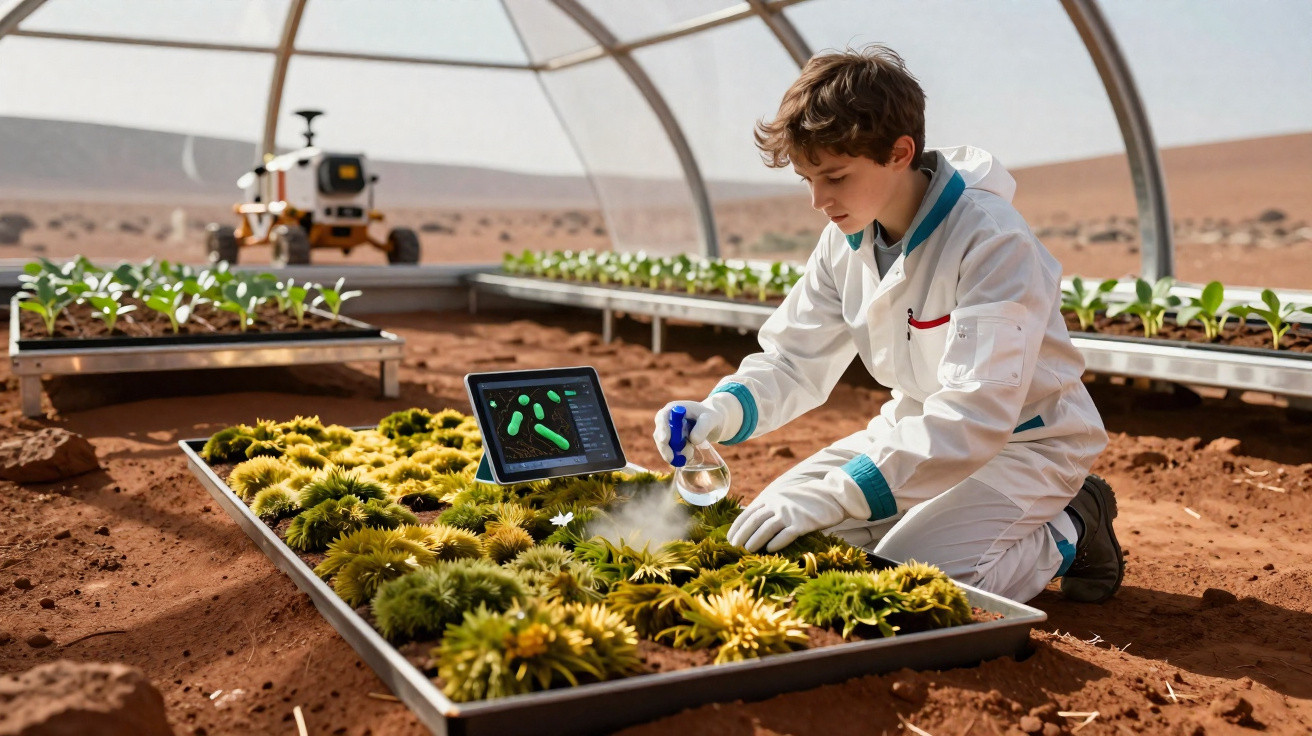
The process should be approached in stages. First, detoxify the regolith by combining perchlorate-munching bacteria with inert scaffolds that hold them close to the harmful salts; bioremediation must happen before seeds. Next, establish “starter crusts” using resilient cyanobacteria that release sticky polymers, capture fine dust and create a thin, stable surface. Then enhance this layer with rock-weathering and nutrient-cycling partners, allowing minerals trapped in the dust to become available to plants. This work would take place in pressurised, sunlit “agrodomes”, where wind is controlled and Mars’ thin atmosphere cannot steal moisture. It is not laboratory magic, merely ecosystem choreography.
The usual errors start with impatience. People expect tomatoes by Tuesday, forgetting that soil is a relationship rather than a substrate. Most of us have watched a houseplant wilt and realised that we had treated its soil as a sponge instead of a living city. Apply that impatience to Mars and water, energy and crew morale are all depleted. Allow microbes to weave their network before planting. Nitrogen should not be overlooked either: Martian nitrates contain some, but accounting for it is a mission in itself, not a footnote. Let’s be honest: nobody does that every day.
Every microbiologist I have encountered expresses the same idea in their own way.
“If you want roots, give microbes a roof,” the scientist told me, tapping the crust. “They build the first address where plants can get mail.”
- Begin in containment: pressurised beds shield microbes from freeze-dry cycles and UV spikes.
- Detoxification precedes dinner: address oxidants before introducing nutrient-cyclers, rather than reversing the order.
- Stability matters more than speed: a thin, sticky crust limits erosion and water loss before additional complexity is added.
- Consider consortia rather than solo performers: cyanobacteria, heterotrophs and mineral-solubilisers function together.
- Account for dust: design surfaces and routines that admit light even during the storm season.
The time horizon that changes everything
Mars encourages both vast timelines and modest routines. Picture a crust becoming thicker across seasons rather than weeks, and beds changing from sterile dust to ground that feels slightly springy under a boot, much as a desert trail softens after rain. There are no miraculous jumps-only steady improvements that establish a new baseline for life. Slow terraforming may sound discouraging until you hold a pinch of living crust and sense it resist the wind. A future colony is not simply a city of domes; it is a collection of places where dirt is less hostile, carrots can survive a bad day, and someone wakes to the smell of green. That is worth debating and worth working towards.
| Key point | Detail | Why it matters to the reader |
|---|---|---|
| Desert biocrusts as a template | Microbes bind particles, add carbon and stabilise surfaces beneath harsh sunlight | Demonstrates a real-world model that already transforms “dirt” into “soil” |
| Three-stage approach | Detoxify oxidants, establish a sticky crust, then enrich it with nutrient-cyclers | Provides a clear framework for how Martian dirt could become suitable for plants |
| Work inside agrodomes | Pressurised, light-rich beds protect microbes and preserve water | Converts broad ideas into conditions that a future colony could genuinely construct |








Comments
No comments yet. Be the first to comment!
Leave a Comment