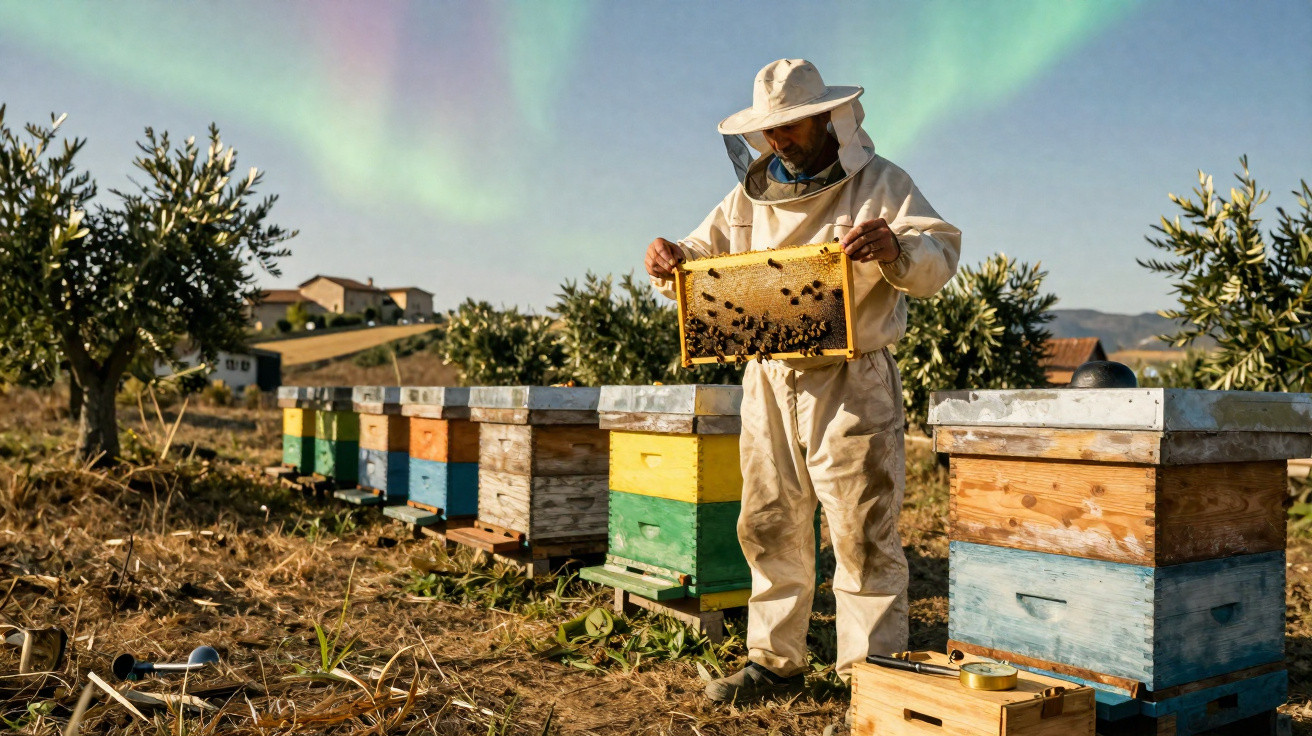
In southern Italy, whole bee colonies disappeared in broad daylight-and did not return. A rare geomagnetic storm illuminated the heavens and, according to beekeepers, robbed the insects of their in-flight compass.
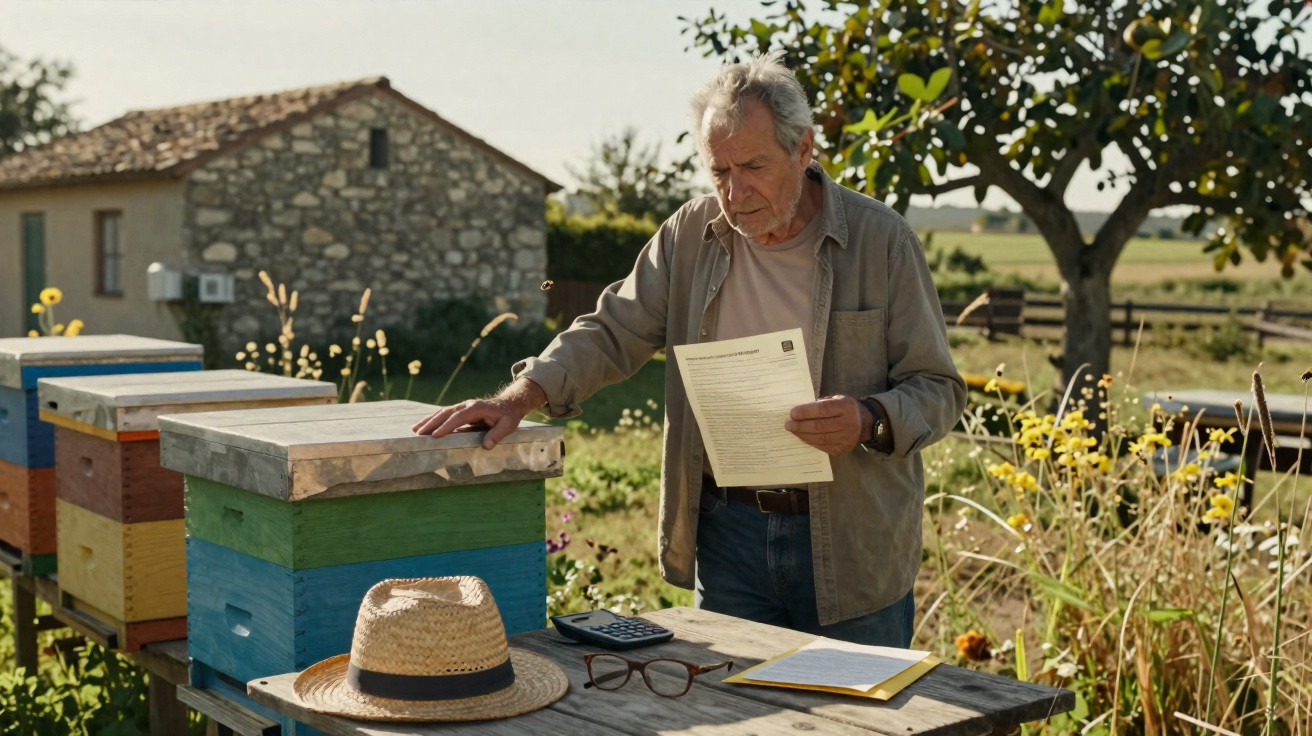
This week, Lucia, a second-generation beekeeper near Lecce, experienced it herself. She raised a frame and waited for the usual surge of foragers coming home. The box seemed unnaturally light. Its landing board remained empty, resembling a station after the final train has departed.
The previous evening, her brother had gestured towards the horizon: a pale green glow, a phenomenon they had only ever seen in photographs from distant northern regions. Radios crackled. The dog barked for no apparent reason. By morning, the wildflowers in the fields were unchanged-yet bees had disappeared somewhere between blossom and hive, between their route and home. The sky had carried an odd greenish mark that night. Then the compass stopped working.
The night the compass went wrong
Throughout Puglia, Basilicata and Calabria, the same account is being shared quietly at farm gates. Hives buzzing fiercely on Sunday had become subdued by Tuesday. They are not entirely silent: queens continue laying, nurse bees keep tending the brood, and drones hover at the margins like bored teenagers.
What has gone missing is the workforce of foragers-the bees that chart the landscape and bring its resources back on their legs. Based on field counts and drops recorded by hive scales, local associations estimate that millions vanished within 48 hours. Millions of bees did not simply stray; the sky knocked them off course.
In the province of Cosenza, Matteo looked at his digital hive monitors in disbelief. At the height of the storm, returning bee traffic had dropped by 62% compared with the previous week. He lost a third of the nectar flow from citrus just as the trees came into bloom. Near Taranto, another beekeeper checked rows of hives that should each contain 50,000 bees; by midweek, half of the foragers had failed to return. This is not an oddity. It is a gap ripped through the normal routine.
For a region dependent on bees to pollinate citrus, almonds, courgettes and tomatoes, the timing is particularly painful. Cooperative packers are already forecasting reduced harvests, particularly in orchards reliant on managed pollination. Lorries carrying honey supers stood unused while beekeepers rang one another with the same questions: Did you see the lights? Did your bees return?
The underlying physics is straightforward. Geomagnetic storms disturb the Earth’s magnetic field after solar eruptions hurl charged particles towards the planet. Bees navigate using a combination of the sun’s position, landmarks, polarised light and, indeed, magnetic signals. Disrupt those signals sufficiently and the “waggle dance” becomes meaningless: a map whose roads have shifted beneath their feet.
Researchers have identified magnetite particles in bees, as well as responses to modified magnetic fields. When the Kp index surges-this week it reached levels Italians seldom encounter-the bees’ internal compass becomes unreliable. Foragers fly for longer, use up their energy, miss the hive by metres, then kilometres, and eventually night falls. Weaker bees collapse in grass that looks no different from any other. A storm two hundred million kilometres away can redirect a thousand tiny choices.
What beekeepers can do in the next 10 days
First, give colonies more time. Offer light syrup in the late afternoon to reduce frantic midday flights, and narrow entrances so guard bees can better protect the colony. Paint or tape prominent symbols onto hive fronts-blue triangles, black circles or stripes-giving returning bees a dependable landmark when their magnetic sense is disrupted.
Use windbreaks or temporary screens to make each hive stand out more clearly against the field. Where possible, move hives a metre apart so that every box appears less identical to the next. A few drops of lemongrass oil by the entrance may reinforce the home scent without making the apiary smell overwhelmingly perfumed. Space weather casts a wide net; the available responses are modest, visual and local.
Avoid overreacting with major relocations. Moving hives to another orchard the day after a storm can add further disorientation to an already confusing situation. Dividing weak colonies at this point can easily turn one problem into two exhausted boxes. Feed to maintain stability rather than trigger rapid growth, and monitor brood patterns for a week before making significant decisions. Give queens and nurse bees time to restore their rhythm.
Keep an unobtrusive eye on the sky. Follow NOAA SWPC or Italian INGV alerts rather than rumours. If checking a phone hourly is not practical, set push notifications for Kp ≥ 6 and spikes in solar wind, then put the phone away and listen to the hive. Realistically, nobody does this every day. One careful check at dawn and another at dusk is enough to gauge the colony’s condition.
“When Kp jumps, the bee’s map loses one of its tools,” says Dr. Elena Ruggieri, an entomologist in Bari. “You can’t fix the sky, but you can sharpen everything else-color, scent, silhouette, timing.”
- Watchlist: Kp ≥ 7, shortwave radio blackouts and auroral sightings south of Rome.
- Tools: NOAA SWPC dashboard, INGV geomagnetism page, and a basic hive scale or entrance counter.
- Quick actions: reduce entrances, add visual markers, move feeding to late afternoon and record returning traffic.
- Field note: contact growers so irrigation and spraying can be timed around periods of bee stress.
- Community: share data with nearby apiaries to identify neighbourhood patterns rather than relying on one yard’s fortune.
Why this story matters beyond the hives
Space weather may sound like science fiction until it affects breakfast. Orange, apple, cucumber and melon yields all depend on pollination rates. Southern Italy is already managing drought, heat stress and pesticide drift. Space weather now joins drought and pesticides on the beekeeper’s list of concerns.
Most people know the feeling of finding their everyday driving route diverted, when suddenly every turn seems unfamiliar. Now imagine that experience for a creature guided by light, magnetic fields and scent. A solar storm does not kill bees outright; it leaves them delayed, lost and short of energy. Farms notice the consequences weeks later, when fewer fruits begin to form.
Policy specialists discuss resilience as though it were a spreadsheet. Here, resilience means a landing board, a painted circle and a phone alert that is actually used. No, this is not a freak headline-it is a systems story. The sun sneezes, the magnetosphere bends, bees lose their rhythm, trees produce fewer seeds, and a family in Brindisi ends up buying imported honey. Small changes in the sky can flow all the way down into kitchens.
Some of this is only new in its scale. Older beekeepers in the south recall strange nights when the air seemed charged and the bees behaved unusually the following morning. What has changed is the availability of data. Hive scales and entrance counters reveal the decline in real time; satellites trace the path of charged particles; and farmers can use both when deciding when to irrigate or spray.
Perhaps the lesson, then, is attention rather than panic. The map contains more layers than previously thought: soil moisture, flowering schedules, freight timetables and solar wind. If those layers communicate with each other, losses can shrink from “millions” to “a bad week.” Bees do not have words for this, but they cast their vote with their wings.
| Key point | Detail | Why it matters to readers |
|---|---|---|
| Geomagnetic storm disrupted bee navigation | Rare southern auroras coincided with Kp spikes and widespread disorientation across Puglia, Basilicata and Calabria | Links a viral sky event to what may appear on your plate in a month |
| Practical steps for hives | Visual markers, scent cues, reduced entrances, later feeding and simple monitoring | Useful actions available today, whether you manage 2 hives or 200 |
| Monitor the sky as you would the weather | Use NOAA/INGV alerts; watch for Kp ≥ 6–7 and shortwave disruption | Turns an alarming headline into a routine alert that can protect colonies and crops |




Comments
No comments yet. Be the first to comment!
Leave a Comment