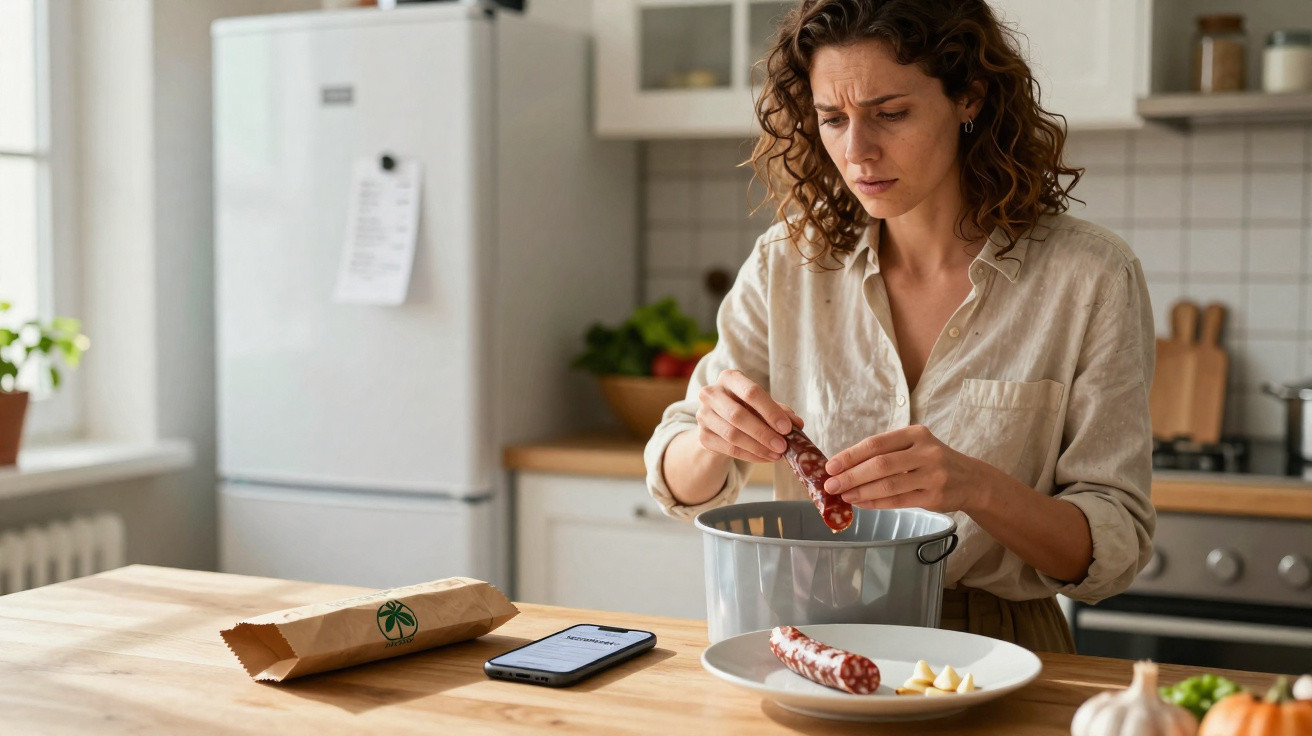
French health authorities have issued a national warning about a batch of organic garlic sausage that was on sale for only a short period but may still be stored in household fridges. The alert follows the discovery of potentially harmful bacteria, with officials seeking to prevent food poisoning cases before they arise.
Recalled organic garlic sausage sold throughout France
The product named in the alert is an unbranded organic garlic sausage carrying the producer identification “Ferme du Doiterneau”. It was supplied vacuum-packed in portions of around 250 g and bore the health mark FR 44138002.
RappelConso, France’s official product-recall platform, gives the following information for the affected batch:
- Product: Organic garlic sausage, unbranded
- Producer reference: “Ferme du Doiterneau”
- Batch number: 040326041002
- Use-by date: 11 March 2026
- Packaging: Vacuum-packed, about 250 g
- Health mark: FR 44138002
- Sales period: 19 to 25 February 2026
- Distribution: Nationwide in France by Ferme Doiterneau
Consumers are asked to stop eating the sausage immediately and return it to the point of sale for a refund.
Although it was sold only between 19 and 25 February 2026, its March use-by date means that a number of households may still have the sausage in a refrigerator or freezer.
Salmonella contamination identified in the sausage
Testing found salmonella in the organic garlic sausage. This group of bacteria can cause salmonellosis, which is among Europe’s most common foodborne infections.
French authorities say the withdrawal is currently a precautionary measure. No confirmed group of illnesses has yet been officially connected with this batch. The producer began the recall voluntarily, rather than following a prefectural enforcement order.
The recall is based on the precautionary principle: act fast once contamination is spotted, even before any confirmed poisoning cases.
Salmonella is a recognised hazard in raw or insufficiently cooked meat, eggs and certain unpasteurised dairy foods. Cured meat products may also become contaminated where hygiene or temperature management breaks down anywhere in the supply chain, from slaughter through to slicing.
Symptoms to look out for after eating the sausage
French health officials provide a defined timeframe for anyone who has consumed the recalled garlic sausage. Symptoms generally develop from 6 to 72 hours after eating contaminated food.
Common symptoms of salmonellosis
The symptoms most often reported are:
- Watery diarrhoea, sometimes severe
- Vomiting and nausea
- Stomach cramps
- Fever
- Headaches and general fatigue
These symptoms commonly continue for several days. Most otherwise healthy adults recover with rest and fluids, without requiring specific treatment. However, the infection can be more serious for people who are vulnerable.
Young children, pregnant women, older adults and people with weakened immune systems face higher risks of complications from salmonella.
People in these groups who have eaten the product and experience unusual digestive symptoms should contact a doctor, making clear that they consumed the recalled sausage. Everyone else should seek medical advice if diarrhoea is particularly severe, a high temperature continues, or dehydration symptoms occur.
Conversely, French authorities consider the risk reassuring if seven complete days have passed since the product was eaten without symptoms. They do not advise routine medical examinations solely because of this exposure.
What consumers in France should do
The recall remains in place until Wednesday 25 March 2026. Shoppers should inspect any organic garlic sausage purchased in late February and match it against the batch information provided.
| Action | What to do |
|---|---|
| If you still have the sausage | Do not eat it. Retain the packaging and return it to the shop for a refund. |
| If you already ate it and feel unwell | Contact your GP, mention the recalled batch and describe your symptoms. |
| If you ate it but feel fine | Keep an eye on your health for 7 days. No routine check is required if you remain symptom-free. |
The producer has provided a dedicated telephone number for recall-related queries: +33 (0)2 33 50 85 86.
Can cooking make the sausage safe?
An important consideration for consumers is the effect of heat on salmonella. The bacteria are destroyed when food is cooked all the way through, including at its centre, to temperatures above 65°C.
Heating food thoroughly to at least 65°C all the way through destroys salmonella bacteria.
Garlic sausage is often eaten cold and sliced directly from the packet, so it does not benefit from the protection that thorough cooking can offer. For foods intended to be served hot, a kitchen thermometer can help confirm that the middle has reached a safe temperature, particularly with thick pieces of meat or large joints.
How food recalls operate in France
France has reinforced its food-monitoring arrangements in recent years, in part after several prominent contamination incidents across Europe. If a producer, laboratory or inspector identifies a possible issue, it may be referred to RappelConso, the national service that brings together recalls and food-safety warnings.
This organic garlic sausage recall reflects the approach used in recent warnings involving charcuterie and cheese. Products are frequently taken off sale before an outbreak has occurred, simply because testing indicates a credible threat.
For consumers, three practices can make a significant difference:
- Reading labels and recording batch numbers when a recall is announced
- Looking at the official recall website or notices in shops when a product seems familiar
- Retaining receipts or payment records that can verify the date of purchase
Why salmonella continues to make headlines
Salmonella is a resilient bacterium that survives effectively in animal intestines and may remain in the surrounding environment. In abattoirs, cutting facilities and small farm premises, shortcomings in cleaning or temperature control can enable it to contaminate meat products.
Its presence does not necessarily change a food’s smell or flavour, making laboratory analysis essential. A sausage may appear entirely normal while carrying sufficient bacteria to make someone ill, particularly a person whose health is already fragile.
At home, straightforward habits can limit the risk from any contaminated item that passes initial controls: wash hands before and after touching raw meat, separate raw foods from cooked foods, and keep refrigerators below 4°C.
Use-by dates and the risk of food poisoning
Shoppers are often unsure about the distinction between use-by and best-before dates. The recalled organic garlic sausage has a use-by date, which is connected to food safety. Eating it after that date may raise the likelihood of bacterial growth, even where the product appears fit to eat.
Best-before dates, by comparison, relate mainly to quality rather than safety. Many cupboard foods and certain long-life products can remain safe after this point, although their texture or flavour may deteriorate. Disregarding a use-by date is much more hazardous with fresh meat and chilled ready-to-eat foods.
Consider a family that purchased the sausage on 24 February, served some sliced as an aperitif and froze the remainder. If contamination was present before it was frozen, freezing would suspend the problem rather than remove it. Once defrosted and eaten cold in March, it could still cause symptoms. Recall warnings are intended to deal with precisely this type of situation.
Food recalls and consumer trust
Although repeated recalls may worry shoppers, public-health specialists often regard them as evidence that the safeguards are functioning. Early detection, clear public information and refunds can support confidence in independent producers as well as major supermarket groups.
For those outside France, this incident is a reminder that organic or farm-produced foods are not exempt from bacterial risks. Terms such as “organic” describe agricultural practices; they do not guarantee that every batch has passed every hygiene control. Once a product enters the home, basic food-safety practices remain the final safeguard.




Comments
No comments yet. Be the first to comment!
Leave a Comment