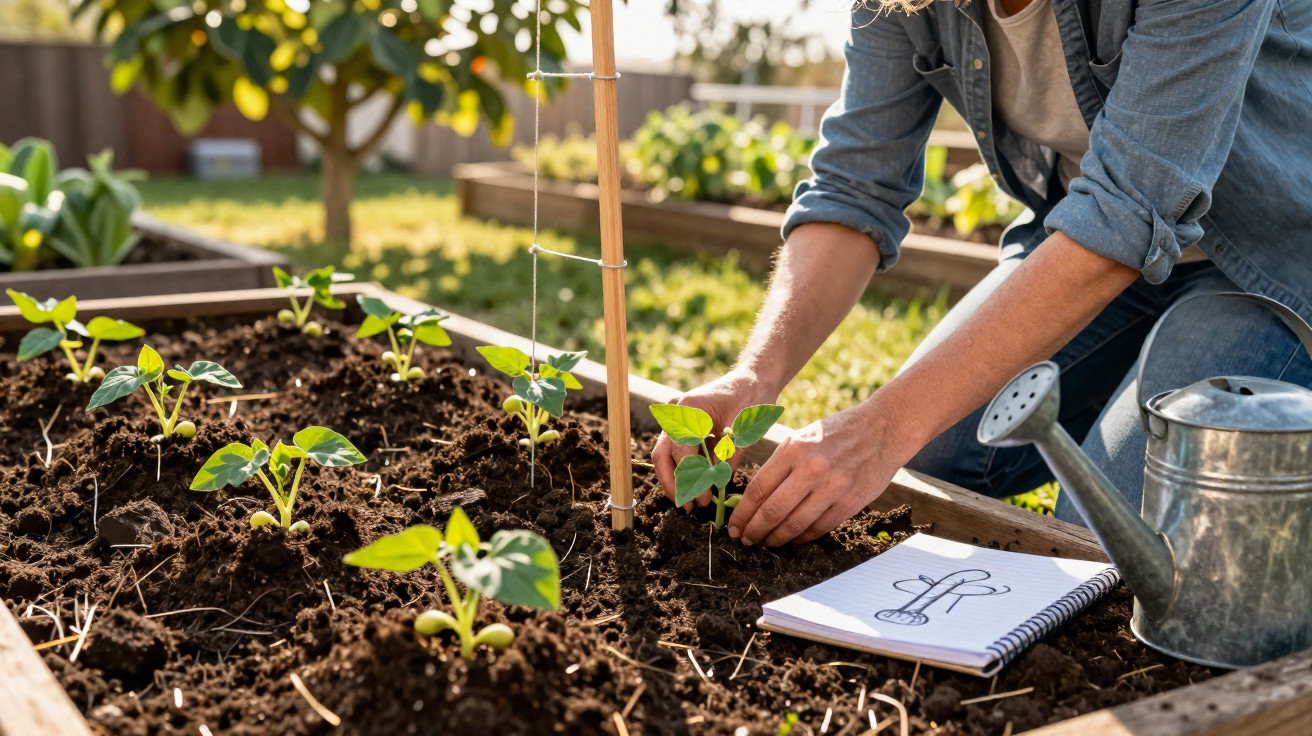
The first sound is bamboo canes clattering in the breeze. In a modest back garden at the edge of town, a weathered A-frame bean teepee has unobtrusively made way for an unexpected arrangement: low, irregular mounds partly blanketed in compost and marked by tiny coloured sticks. A woman in worn overalls bends over and pushes a bean seed sideways into the earth rather than setting it tip-first. She stops briefly, as though waiting to hear something. Then she goes to another patch, avoiding straight lines entirely, almost drawing with seeds.
When someone asks what she is doing, she laughs. “Experimenting,” she says.
The way gardeners sow beans is beginning to change.
From straight rows to living “bean systems”
Visit a community garden this spring and the difference is easy to spot. The immaculate, military-style bean rows grown by previous generations are gradually vanishing. In their place are circles, spirals, groups and curious small green islands. Bean patches are becoming more like living networks than conventional plots.
Gardeners now discuss roots, airflow and mycorrhizae as casually as neighbourhood gossip. Rather than simply putting seeds in the ground, they are planning systems intended to encourage more vigorous plants.
Consider the communal garden behind a small Wisconsin library. Three years ago, its volunteers sowed beans in neat, lengthy lines beside a fence. From the pavement, the crop appeared healthy. Closer inspection revealed leaves turning yellow by midsummer, however, and harvests that were merely “okay”.
Last year, they changed their approach. They made compact bean “stations” at one-metre intervals, each consisting of a small compost-enriched mound, three climbing beans and a circle of dwarf marigolds. The variety and climate were unchanged, but the plants became bushier and darker, while rough estimates suggested the harvest nearly doubled. One volunteer said the greatest surprise was that the plants continued cropping into early autumn, whereas they had previously faded by late August.
This is less a “magic trick” than a response to the way beans naturally grow. Beans are sociable plants with nutrient-hungry roots, and they dislike becoming waterlogged or overheated. Packed into narrow rows where they compete for the same limited band of nourishment, they may survive, but they seldom flourish.
Give them separate clusters on raised pockets of fertile soil, take the edge off the wind and sustain the soil with companion plants, and their response changes. Their roots grow further down, they fix more nitrogen and they cope with pressures such as heatwaves and sudden storms with a quiet toughness that is almost tangible when their stems are touched.
The new way gardeners are planting beans
The change begins as soon as the seed reaches the ground. Instead of cutting long furrows, many gardeners now make micro-mounds. These are simple, shallow domes of friable soil blended with compost or well-rotted leaf mould, each roughly the size of a dinner plate. Into every mound, they press three or four bean seeds in a relaxed triangle, 5–8 cm apart and around one knuckle deep.
There is no need for a ruler or flawless symmetry. The aim is to create modest pockets of especially good soil, positioned to let air circulate and allow roots to travel beneath the surface like unseen bridges.
Most gardeners know the disappointment of pulling up a struggling bean plant only to find that its roots scarcely extended beyond the upper five centimetres of soil. These newer techniques are quietly designed to prevent exactly that. Gardeners are discovering that beans favour deep, loose, gently warmed soil and an incentive to send roots downwards, rather than squeezing sideways against nearby plants.
A frequent error is sowing too closely and too near the surface in ground compacted by winter footfall. Gardeners may fault the seed or blame the weather, when the real issue is that the beans were never able to develop a substantial underground anchor. In truth, hardly anyone double-digs and loosens every centimetre of a bed before sowing.
The approach therefore fits everyday gardening. An urban gardener in Bristol told me that she sows beans in informal mound-top “triads”, then lays shredded cardboard and straw between them. She weeds infrequently and does not water daily. Even so, her beans climb strongly, producing thick stems and dark foliage.
“When I stopped forcing beans into rows and started planting them into little homes, everything changed,” she says. “I think of each mound as a tiny bean village. They seem happier. And when the plants are happier, I relax too.”
- Micro-mounds rather than long furrows
- Three to four loosely spaced seeds in each mound
- Mulch between mounds to keep the roots cool
- Light, deep soil in place of compacted strips
- Greater focus on airflow and spacing, with less concern for perfectly straight lines
Small tweaks, bigger harvests, calmer gardeners
Viewing beans this way changes the feel of the garden. Instead of measuring out metres of rows, you begin to see small communities of life. Beans are no longer growing by themselves: low herbs sit beneath them, flowers attract beneficial insects nearby, and soft mulch keeps their roots comfortable.
The aim gradually moves from “a full row” towards “a strong plant”. Higher yields often come with that shift. The plants that remain can simply perform better, stay healthier and continue cropping for longer through the season.
| Key point | Detail | Value for the reader |
|---|---|---|
| Cluster planting on mounds | 3–4 seeds per raised pocket of rich soil | Stronger roots, better resilience in heat and storms |
| Focus on soil life | Compost, mulch, and less compaction | Healthier plants with fewer disease problems |
| Airflow and spacing | Short “stations” instead of long rows | Less mildew, more productive foliage and pods |
FAQ:
Question 1 Can I still grow beans in straight rows and get good results?
Yes, you can, although spacing and loose soil matter more than the precise layout. Even when using rows, small mounds and wider gaps between plants will generally improve vigour.Question 2 Do these methods work in containers or on balconies?
Yes. Choose deep pots, form mini-mounds within the container and sow in loose groups rather than in a tightly packed ring around the edge.Question 3 How far apart should I space the bean mounds?
For most dwarf beans, 30–40 cm between mounds is sufficient. Give vigorous climbing beans 40–60 cm so they do not shade one another too heavily.Question 4 Do I need special bean varieties for stronger growth with this method?
No. Traditional varieties respond equally well. The difference lies in the planting method-soil structure, spacing and support-not genetics.Question 5 What should I plant with beans to help them grow better?
Low-growing companions such as marigolds, basil or lettuce are suitable. Do not plant beans immediately beside heavy-feeding crops such as sweetcorn unless you allow generous spacing.










Comments
No comments yet. Be the first to comment!
Leave a Comment