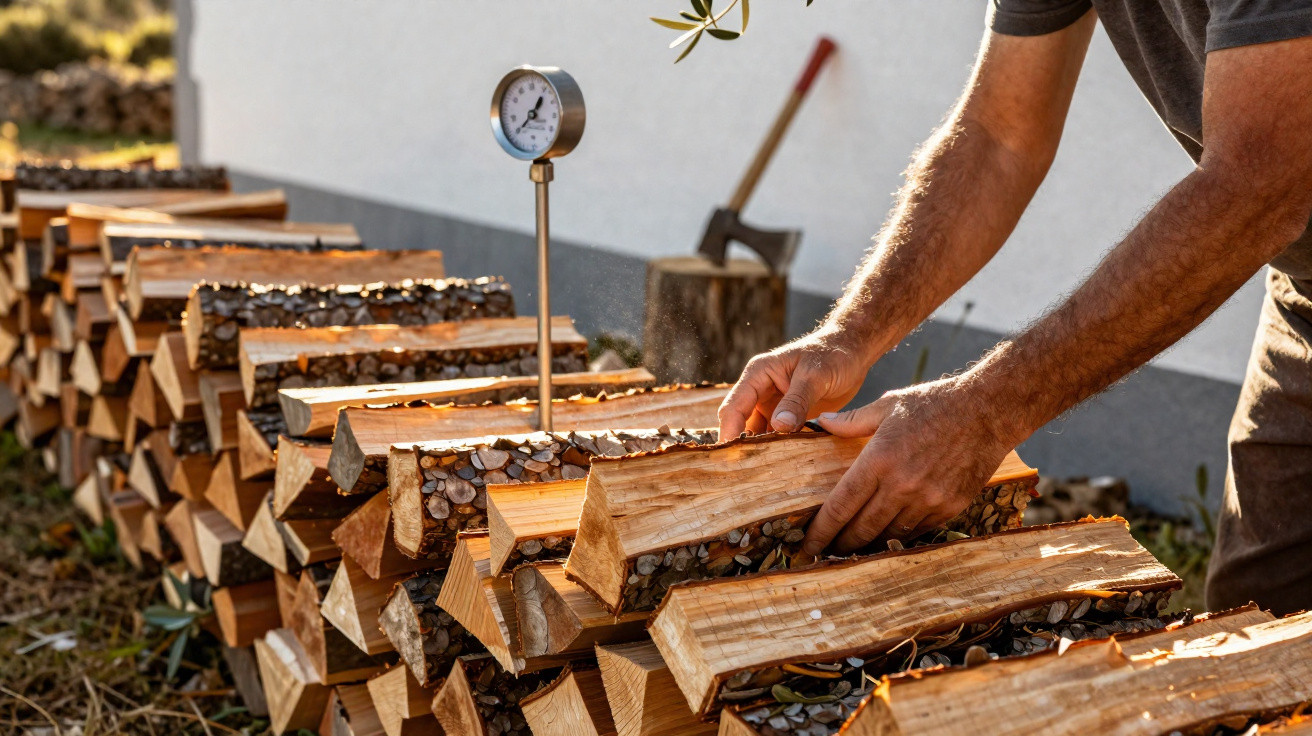
Plenty of households pile up their firewood, light the stove and believe the job is done. However, altering how logs are split and dried can nearly double the heat you can use, reduce smoke and potentially lessen the chance of chimney fires.
Why most firewood stacks are quietly wasting energy
Heating homes with wood has become more popular as gas and electricity costs fluctuate, and many first-time stove owners assume logs are ready when they simply “look dry”. In reality, the moisture locked within each log has a major effect on how it performs.
Recently felled wood commonly contains 40–60% moisture by weight. Before it can warm your sitting room, much of the fire’s energy is spent turning that water into steam.
Drying wood down to around 15–20% moisture can almost double the amount of useful heat released from the same log.
Wet fuel means burning more wood to achieve the same indoor temperature. It also produces a cooler fire, allows soot to accumulate more rapidly and increases emissions. This is why energy bodies throughout Europe repeatedly offer the same understated guidance: the stove’s “hidden fuel” is not only the timber, but also how it is dried and stored.
The technique that changes everything: intensive drying and log preparation
The approach attracting attention on French wood-burning forums does not involve a costly appliance or upgrade. Instead, it is a more rigorous method of splitting, stacking and ventilating logs, enabling them to dry far more quickly and burn at a much higher temperature.
1. Split sooner and make logs smaller
The initial measure may seem obvious, but its impact is substantial: split wood as soon as you can after felling or delivery, using pieces slightly smaller than those you would normally prepare.
More surface area exposes more wood fibres, giving moisture additional routes to escape. Rather than putting large rounds directly onto the stack, regular users of this method generally cut logs to 30–40 cm long and divide them into halves or quarters.
Many homeowners report that since they started splitting each delivery immediately, they’ve seen brighter flames, less smoke and a noticeable jump in heat.
Smaller, shorter pieces are not only quicker to dry over summer. In winter, they catch fire faster too, bringing the stove to its best operating temperature in minutes instead of half an hour.
2. Stack for ventilation rather than appearance
Many people create neat, tightly packed log stacks that look impressive on Instagram. For drying purposes, though, this is counterproductive. The alternative method prioritises spaces, air channels and a somewhat irregular arrangement that encourages air movement.
- Lift the stack at least 10–15 cm above ground level with pallets or spare logs.
- Set one layer north–south and the next east–west to form criss-cross channels.
- Keep roughly a hand’s width between rows, allowing wind to move through the stack.
The aim is straightforward: produce a “wind tunnel” effect around every log. In mild, breezy weather, timber stacked this way can shed moisture at almost double the rate of a dense pile placed on the ground against a wall.
3. Treat sun and wind as free equipment
Experienced rural French stove users often refer to locating “the hot corner” of the garden. Usually, this means a south- or west-facing area that receives sunshine and is open to the prevailing wind.
Positioning stacks there instead of beneath a completely enclosed carport can reduce drying time by months. The essential point is to protect the top of the pile from direct rainfall while leaving its sides entirely open.
A simple rule: cover above, breathe on the sides. A tarp draped to the ground turns your woodpile into a slow mould incubator.
In practical terms, many homes now secure a rigid panel or basic roof above their stack, then pull back any plastic covering on dry days to maximise airflow.
How to know whether your logs are genuinely ready
Relying on appearance alone to assess dryness is unreliable. A log may be grey and weathered on the outside while its centre remains full of sap. Professionals increasingly advise using several simple tests together.
| Check | What you want to see or hear |
|---|---|
| Appearance | Greyish surface, small radial cracks at the ends |
| Weight | Feels surprisingly light for its size |
| Sound | Two logs struck together ring with a clear, sharp “clack” |
| Smell | Almost no resin smell; faint, dry, woody scent |
| Moisture meter | Reading under about 20% in the middle of a freshly split face |
In France, many stove installers now demonstrate the use of an inexpensive handheld moisture meter to customers. Inserted into a newly split face, it can rapidly establish whether the wood is ready to burn straight away or needs another season to dry.
The two-year rule – and how some users safely shorten it
Foresters’ traditional guidance is unambiguous: most hardwoods require about two years of outdoor seasoning to reach the target of below 20% moisture. For oak and beech, this remains a dependable standard.
With this more intensive drying method, however, some users find that softwoods such as pine and spruce reach a suitable burning condition after one properly ventilated summer. The compromise is that these woods burn more rapidly, requiring the stove to be refuelled more often.
A useful middle ground developed by experienced wood-burners is a “mix and rotate” system:
- Burn very dry hardwood, seasoned for 2–3 years, for longer overnight fires.
- Store faster-dried softwood for quick evening bursts of heat.
- Mark stacks by year to ensure the oldest wood is always used first.
Why the wood species matters as much as drying
The tree species from which a log comes affects both its drying period and the heat it supplies per cubic metre. Dense hardwoods including oak, hornbeam and beech contain considerably more energy than poplar or pine.
French energy agencies commonly place firewood into broad groups:
- Hardwoods (oak, beech, ash): slow-drying, long-burning and high-heat, making them well suited to primary winter heating.
- Medium woods (birch, chestnut): dry sooner and burn faster, with attractive flames and easy ignition.
- Softwoods (pine, fir, spruce): quick to dry and useful as kindling or during milder parts of the heating season, although they create more resinous deposits when burned very fresh.
Using different species deliberately lets you “tune” stove behaviour: softwood provides a rapid response, while hardwood maintains consistent background warmth.
Hidden gains: cleaner chimneys and safer homes
This focus on dry wood is also a matter of safety. Logs that have not been properly seasoned burn at lower temperatures, creating more soot and creosote. These sticky residues adhere to the flue interior and can catch fire.
Switching from damp, “green” logs to properly dried ones can dramatically reduce creosote build-up and the need for emergency sweeps.
Across Europe, chimney sweeps consistently associate chimney-fire call-outs with wet wood, neglected flues and stoves operated with the air controls continuously restricted. Clean, hot combustion depends on three factors: dry fuel, sufficient oxygen and proper flue draw.
What “doubling the heat” means in everyday use
With an average efficient modern stove, a cubic metre of quality dry hardwood can provide around twice the useful heat of the same volume burned before it has dried sufficiently. In day-to-day terms, this could mean:
- Two armfuls of dry logs heating a small sitting room comfortably for an evening.
- The same room remaining only lukewarm after four armfuls of damp logs have been burned.
Homes that move to strict moisture management frequently say their winter wood use falls by 30–40%. The warmth is more consistent, the stove glass remains cleaner and less ash collects in the tray.
Key terms every wood-stove owner should know
People using this drying method soon encounter several technical terms:
- Moisture content: the proportion of water contained in wood. For burning, the usual target is below 20%.
- Seasoned wood: timber air-dried outdoors for months or years, typically protected above but exposed at the sides.
- Creosote: a tar-like residue produced by incomplete combustion, which is highly flammable when baked onto a chimney liner.
- Primary/secondary air: adjustable stove vents that regulate air entering the firebox and how completely gases are combusted.
Knowing these terms makes it easier to understand stove instructions, energy-efficiency recommendations and local air-quality rules.
Beyond heating: further benefits of careful wood drying
A more organised approach also has a psychological benefit: the log stack becomes part of an annual routine. People describe the satisfaction of seeing a clearly labelled, well-aired supply that they know will heat their home during the coming cold season.
The environmental aspect is important too. When dry wood burns cleanly in a modern stove, its climate impact may be much lower than when that same fuel is lost as smoke and soot. Less wood is used, more heat is obtained and fewer pollutants drift across neighbouring rooftops.
For anyone depending on logs this winter, following this more exacting system of drying and stacking is more than a minor technical adjustment. It transforms an unplanned timber pile into a carefully managed store of heat that works more efficiently, burns more cleanly and makes every fire more rewarding.









Comments
No comments yet. Be the first to comment!
Leave a Comment