You bring home a fashionable monstera, proudly carrying it like a prize, then give it an adorable pot and an optimistic smile. A fortnight later, one leaf develops a brown tip. Then another gets a yellow patch. Before long, you are quietly thinking, “I’m just bad with plants.”
You shift it about: more sun, less sun, more water, less water. At midnight, you search TikTok for “plant hacks”, watching other people’s living rooms resemble jungles while your pothos broods in the corner like a teenager.
Yet one possibility rarely occurs to you: perhaps you are not the problem.
Perhaps your home is.
Your plants are not dramatic – your environment is
Browse any plant shop and the labels tend to repeat the same imprecise instruction: “Bright indirect light, water when dry.” It sounds straightforward, almost obvious, so you do exactly that. Then your fern turns crisp, your fiddle-leaf fig sheds leaves as though it is having a breakup, and your confidence fades alongside them.
What nobody tends to explain clearly is that your plants do not inhabit an imaginary “average home”. They live in your actual home: perhaps slightly chaotic, poorly lit and often dry.
Imagine two friends buying precisely the same peace lily from the same shop on the same day. Friend A places it on a north-facing shelf, 1 metre from the window and above a heater. Friend B puts theirs beside a large, bright east-facing window, where a sheer curtain filters the morning sun.
After three months, Friend A’s plant is barely surviving, with limp, dull leaves. Friend B’s looks like a stock image for “flourishing houseplant success”. It is the same plant, with the same care instructions, but an entirely different microclimate.
That is the overlooked factor. We often fail to recognise how unfriendly modern interiors can be for living things that developed beneath jungle canopies or under open skies. Double glazing can halve light intensity. Radiators and air conditioning strip moisture from the air. Dark walls, deep rooms and shut blinds consume the limited light that gets inside.
Your plant is not demanding; it is trying to photosynthesise in conditions that feel, to it, like a centrally heated cave. The answer is rarely found in a watering can. It lies in shaping the small section of environment it occupies.
The ridiculously simple fix: change the world around the plant
The simple reality is that many supposedly “hard” plants become reliably easy once their light and humidity resemble their natural conditions. Rather than altering your routine, alter the plant’s surroundings.
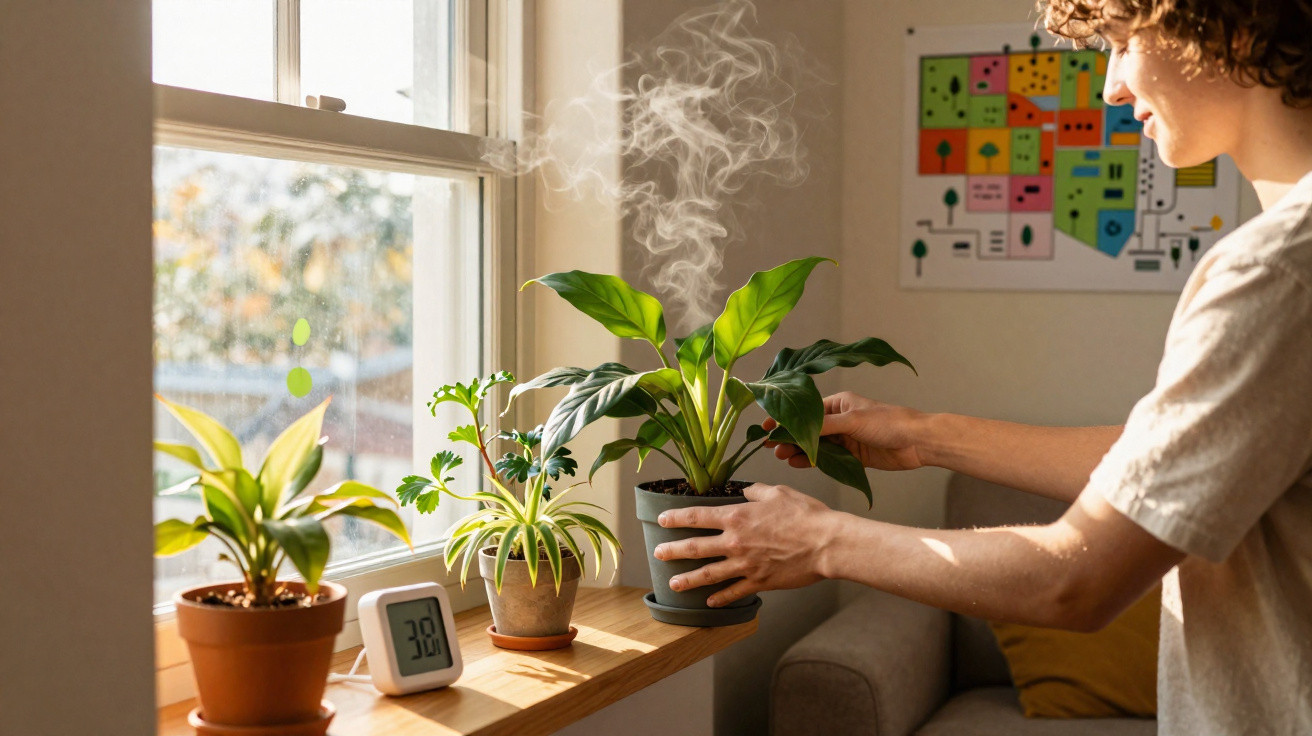
The first step is almost absurdly easy: place the plant nearer to a window than you might usually think appropriate. Do not leave it across the room or behind the television. Put it on the sill, or within a hand’s width of the glass where the species can tolerate that position. Then observe it during the following month. Fresh growth, closer gaps between leaves and richer colour are all your plant’s way of saying that it can finally breathe.
Then address the dry air. You do not need a greenhouse or a daily misting ritual that you will give up by next Thursday. Positioning a basic humidifier near several plants can make a major difference, particularly in winter. Even placing pots over a tray of water and pebbles can raise humidity slightly without leaving anything sitting in water.
Most of us know the feeling: standing in a quiet room, looking at one sad stem and wondering what went wrong. In many cases, you did not “fail” at plant care. Your plant simply went from a humid nursery to a living room that feels like the Sahara with Netflix.
“Once I pulled all my plants as close to the windows as my anxiety allowed, 80% of my so-called ‘plant problems’ basically vanished,” laughs Lila, who went from serial plant killer to the person friends now beg for cuttings.
- Move first, water second Before reaching for the watering can, ask yourself: “Is this plant near enough to a window to cast a clear shadow in daytime?” If it is not, deal with that before anything else.
- Cluster your plants Arrange plants together on a bright shelf or table. Collectively, they form a small microclimate and keep humidity a little higher where it is needed.
- Match plant to room, not moodboard Have a low-light bedroom? Choose ZZ plants and snake plants. Have a sunny kitchen? Fill it with herbs and succulents. Do not keep forcing rainforest divas to live in dark hallways.
Your home is a map, your plants are travellers
When you begin to view your home as a map of light and dryness, it becomes easier to match plants with the right places. The bright, hot window that scorches a fern can be perfect for a cactus. The dim corner that destroys a fiddle-leaf fig can become a comfortable spot for a tough snake plant that does not mind if your blinds are permanently half shut.
Realistically, nobody does this every day. No one walks around with a light meter at 3 p.m. on a Tuesday. You do not need equipment, though, to see where sunlight lands, where the air feels cooler or which windows remain bright on cloudy days.
Move through each room at different times: morning, midday and late afternoon. Notice where light falls on the walls. Which windows appear flooded with brightness, and which look grey? Hold out your hand and examine your shadow. A sharp, dark shadow means prime space for plants that need plenty of light. A gentle, blurred shadow suits low- to medium-light greenery. No shadow whatsoever? That is not suitable for anything other than plastic plants.
Once you have roughly mapped these conditions, your plants become more than decorations: they become residents. They have addresses rather than random places to be dropped.
In time, you will spot small signs that once seemed baffling. Long, stretched stems reaching towards the glass indicate insufficient light. Yellow lower leaves combined with soil that remains wet for a week point to too little light and too much water in a stagnant position. Crisp edges despite suitable soil usually mean dry air, often close to a heater or draught.
You are not cursed with a “black thumb”; you simply were not given the proper rulebook. Once the environment suits the plant, the drama reduces, your confidence returns, and your home gradually changes from a graveyard of good intentions into something living and evolving.
| Key point | Detail | Value for the reader |
|---|---|---|
| Light beats watering | Change the plant’s distance from the window and its room before adjusting your watering routine | Reduces 80% of common plant issues like yellowing, legginess, and leaf drop |
| Microclimate matters | Group plants together and use straightforward humidity boosts in the driest areas | Prevents crispy leaves and stress without costly equipment or complicated routines |
| Match plant to place | Use your home’s natural light map to decide where each plant should live | Makes “difficult” plants easier and improves your long-term survival rate |









Comments
No comments yet. Be the first to comment!
Leave a Comment