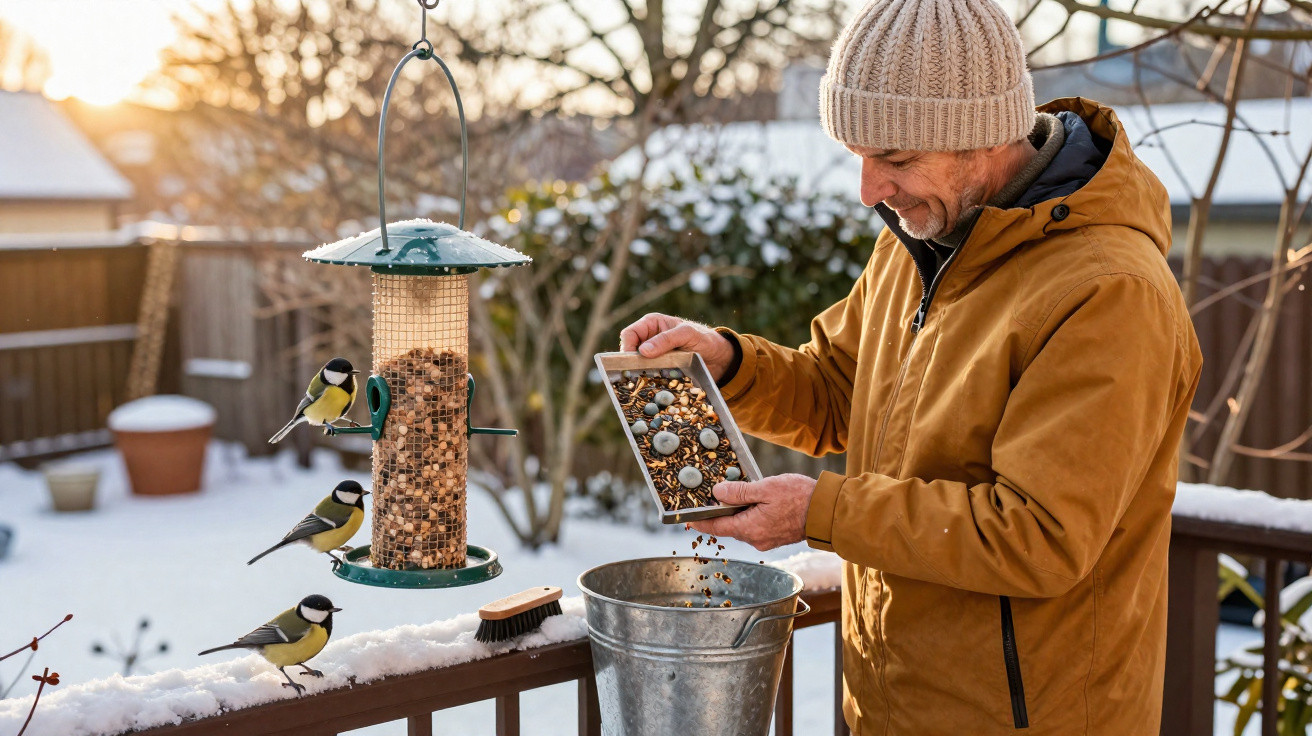
In a quiet winter garden, the activity of birds can feel like a daily miracle-until an unseen detail becomes a trap.
As the cold tightens its grip and the landscape becomes almost still, many people rush to put up bird feeders in the garden. The intention is kind: to help thrushes, tanagers, great kiskadees and other winged visitors through the toughest season of the year. Yet one widespread and rarely discussed habit can turn this act of care into a genuine danger to birds: allowing moisture to reach the seeds and remain there.
When a kind gesture becomes a hidden danger
In practice, the mistake often starts early. To avoid going outdoors in the cold every day, many gardeners fill trays and seed dispensers to the brim, thinking it will be “sorted for a while”. It seems convenient and generous. Winter weather, however, is unforgiving: persistent light rain, drizzle, mist, frost and even snow in some upland areas.
These conditions quickly cause seeds to take on water. Sunflower seeds, millet, crushed maize and peanuts all swell, soften and lose quality. From the outside, the feeder may still look well stocked. Inside, though, it is no longer holding energy-rich food, but a damp mass with fewer calories and significant health risks.
Once seeds become wet, they stop being “fuel” to keep birds warm and instead become a source of disease.
Mould, bacteria and fermentation: the moisture time bomb
The greatest threat cannot be spotted with the naked eye. The base of a feeder holding stagnant water, husk debris and wet seeds provides ideal conditions for fungi and bacteria to develop.
Fungal species such as Aspergillus can grow on poorly stored grains. In birds, this is associated with serious respiratory illnesses broadly known as aspergillosis. Bacteria in the Salmonella genus, meanwhile, multiply rapidly where moisture, dirt and droppings are mixed together.
On cold days, birds’ immune systems are already working at their limit to maintain body temperature. If an entire flock eats from the same contaminated batch of seeds, the outcome is predictable: diarrhoea, weakness, dehydration and death. Worse still, unwell birds continue visiting the feeding point, spreading pathogens to other individuals.
Wet seed in winter is like a “block of flats” for fungi and bacteria, right at the centre of the place where birds gather.
The ice effect: when food becomes a solid block
Water also brings another winter-specific problem beyond the health risk: freezing. A tray packed with already damp seed and exposed overnight to temperatures close to 0 °C turns into a compact block as hard as concrete.
For a small bird weighing 15 or 20 grams, trying to pull grains from this mass is almost impossible work. Every peck uses energy that cannot be replaced because the food will not come free. On a freezing night, that difference can determine survival.
The situation is harsh: the feeder looks full and inviting, but is effectively unreachable. Birds use up their last fat reserves in a futile effort to find food, then face the following night already exhausted.
How to set up bird feeders that keep seeds dry
The good news is that minor changes to feeder design can substantially reduce the problem. A few straightforward principles help keep feeding safe throughout winter.
Designs that offer better rain protection
- Tubular seed feeders: ideal for small seeds; the food remains sheltered in a closed cylinder with only a few openings.
- Feeders with a wide roof: the farther the roof projects over the feeding area, the fewer splashes reach the seed.
- A draining base: small holes or wire mesh allow water to run away rather than collect.
It is also worth considering the prevailing wind. Even with a roof, a feeder facing wind-driven rain will get wetter than necessary. Positioning it on a balcony, beneath an eave or under dense branches offers considerably more protection.
Portioning food is care: less at once, more often
Another crucial factor is the amount of food added at one time. The idea of “filling it for the entire week” works poorly during cold, damp spells.
The safest approach is to put out smaller portions, usually in the morning, sufficient for that day’s consumption. This leaves very little overnight, reducing the likelihood of fermentation, mould and freezing.
| Common habit | Risk to birds | Recommended alternative |
|---|---|---|
| Filling the feeder to the edge | Too many wet and fermented seeds | Moderate daily portions, based on observed consumption |
| Leaving the same food in place for several days | Build-up of mould, droppings and bacteria | Regular disposal and replacement with fresh seeds |
| Cleaning only “when it looks very dirty” | The feeder becomes a permanent source of contamination | Scheduled cleaning with warm water and vinegar |
Cleaning routine: what to do and what to avoid
Keeping feeders clean does not require specialist products. Warm water and white vinegar can help remove grease and reduce the microbial load. Mild washing-up liquid may also be used, provided it is thoroughly rinsed away with no residue left behind.
- Check the seeds after rain, drizzle or frost.
- Throw away any food with a sour smell, darkened grains or a sticky appearance.
- Brush corners and crevices where food remains become trapped.
- Allow the feeder to air-dry before filling it again.
The practical rule is simple: if you would not eat it, do not offer it to birds.
A global mistake with local consequences: why almost every gardener falls into this trap
Feeding wild birds has become increasingly popular in recent years, including in urban areas of Brazil. Many people follow photographs and quick social-media tutorials showing beautiful feeders constantly overflowing with seeds, but these rarely mention moisture, mould or bacteria.
The combination of good intentions, limited technical guidance and climate change-with more erratic winters, extended rainy periods and sudden cold snaps-creates a dangerous situation. Without realising it, a resident hoping to “help nature” may be contributing to disease outbreaks among birds in the neighbourhood.
Which foods are most affected by moisture?
Not every grain responds to water in the same way. Some spoil faster and need extra care.
- Oil-rich seeds (sunflower, peanuts in their shells, linseed): they become rancid quickly when damp.
- Crushed feeds and flours: these absorb large amounts of water, become sodden and ferment easily.
- Chopped fruit (banana, apple): in cold, damp weather, it turns into a slippery mass full of fungi.
Whole, dry grains generally last a little longer, but the issue does not disappear. Any food left exposed to damp weather for several consecutive days will eventually deteriorate.
Practical situations: what to do in different types of garden
In homes with large gardens, one option is to have two or three feeding points and rotate their use. While one feeder is in service, another can be kept in “quarantine”: emptied, washed and left to dry properly in the sun where possible.
In flats, covered balconies provide natural shelter from direct rainfall. Even so, moisture in the air can condense on cold nights. In these circumstances, closed seed dispensers and smaller portions, replenished more frequently, are worthwhile.
Anyone who travels regularly during winter may wish to reduce the number of feeders or ask a neighbour to monitor them. It is better to provide less food in good condition than leave a large quantity of spoiled food for days.
A technical detail that matters: thermoregulation
Small birds lose heat very quickly. To stay warm, they rely on energy-rich food, particularly fats and carbohydrates. When seeds are damp and fermented, their energy value falls. The bird may fill its crop but receive less “fuel” than it needs.
This daily deficit accumulates alongside the additional effort needed to cope with cold, wind and rain. Across a run of icy nights, a small management error, such as partly mouldy seeds, can make the difference between surviving until spring or not.
Simple actions that help protect birds
Small changes to everyday routines greatly reduce risks for feathered visitors:
- Watch birds’ behaviour: if many peck at and reject the same area of a feeder, something there may have spoiled.
- Alternate food types, prioritising drier seeds on rainy days.
- Remove snow, ice or standing water as soon as possible.
For people who enjoy involving children, checking the feeder can become a daily activity. It is a practical way to teach animal care, hygiene and environmental responsibility. Rather than simply scattering feed and watching from afar, the family can monitor the condition of the feeding space and see how small details, such as moisture, directly affect birds’ lives.


Comments
No comments yet. Be the first to comment!
Leave a Comment