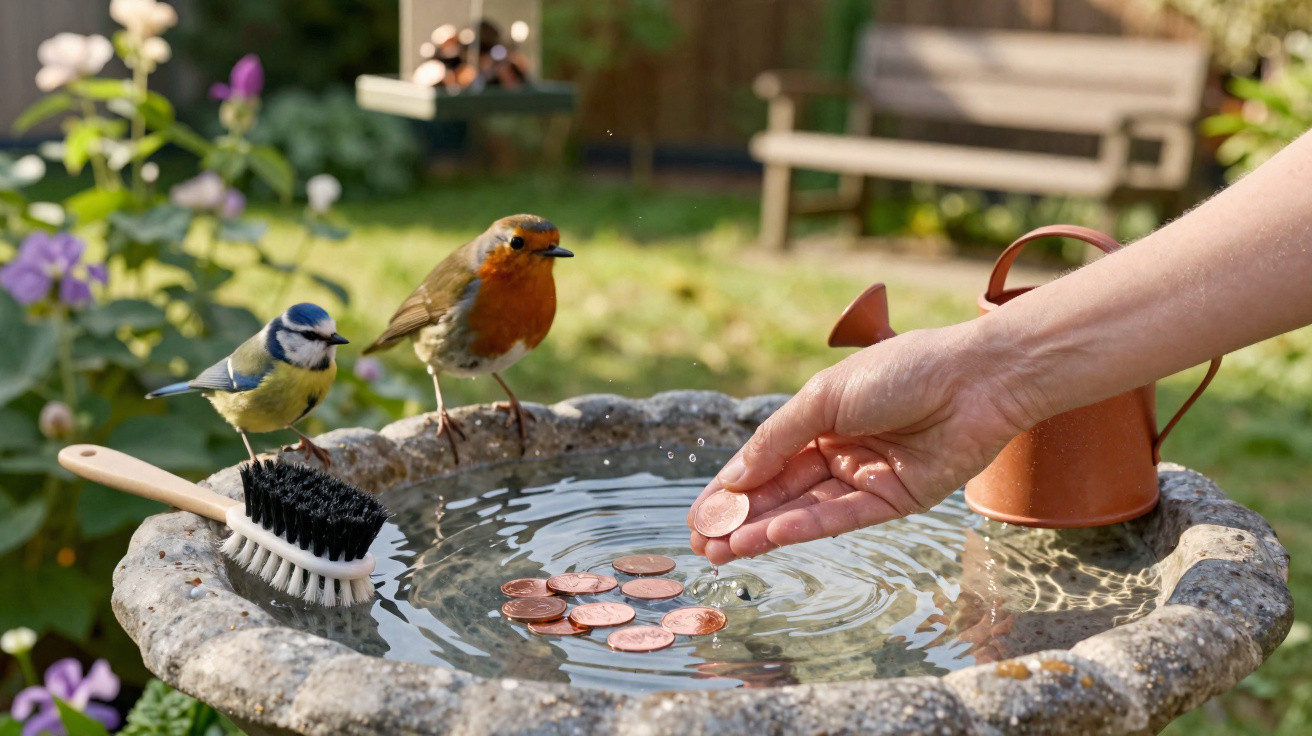
A curious tip is currently doing the rounds on social media: if you have a bird water dish or bird bath in the garden, place a single 1-cent coin in the water. Although this may sound like superstition at first, it is based on a very real issue – and on a chemical property that has made copper useful to people for centuries.
Why bird baths quickly turn green and develop algae
A bird bath attracts tits, blackbirds and sparrows – but only while its water remains clean. In reality, the situation often changes within just a few days: the bowl takes on a greenish, streaky appearance and can sometimes even develop a slightly stale smell.
This is caused by a combination of entirely normal garden conditions:
- Leaves, seeds and flower pollen land in the bowl.
- Birds leave droppings in the water.
- Sunshine heats the small amount of water considerably.
- The water remains still, with little movement and infrequent replacement.
Algae and micro-organisms thrive in this warm, nutrient-rich mixture. They multiply rapidly and the water goes off. This is unpleasant for birds and can even pose a risk to them.
“A dirty bird water dish does not just look unattractive; it can become a source of infection for wild birds in the garden.”
Animal welfare organisations have warned for years that germs, parasites and fungi can build up heavily in neglected bird baths. Where many birds drink and bathe every day, the likelihood of disease transmission rises – from harmless diarrhoea to serious infections.
There is a second issue, too: still, warm water can serve as a breeding site for mosquitoes. Anyone who never cleans their bird bath may unintentionally provide a nursery for mosquito larvae.
The copper coin idea: the principle behind it
Garden experts in the UK and elsewhere have recently highlighted a surprisingly straightforward trick: putting a single copper coin into the bowl. The principle is far from new – people once commonly placed copper objects in water containers to help keep the water fresh for longer.
This effect can be used in modern bird baths without resorting to expensive specialist products. In Germany, many people use 1- or 2-cent coins. Although their core is steel, they are coated with a thin layer of copper.
“When the copper surface comes into contact with water, tiny quantities of copper ions are released – slowing the growth of algae.”
In technical terms, this is described as a mild algicidal effect. Algae are not traditional “enemies” in the garden, but they should not be allowed to spread unchecked in the small basin of a bird water dish.
The effect is limited, however. A cent coin is not a replacement for cleaning; it simply gives you a little more time before the water visibly turns green again.
Using the 1-cent method safely in a bird bath
Anyone wishing to put a coin in a bird bath should follow a few simple rules to ensure the benefits outweigh any possible risk to wildlife.
Basic rules for a safe bird bath
- Replace all the water every one to two days.
- Scrub the bowl once a week using a brush or rough sponge.
- Do not use washing-up liquid, chemicals or chlorine.
- Use lukewarm water instead; for stubborn deposits, a little diluted vinegar can be used if the bowl is then thoroughly rinsed with clean water.
Only after cleaning should the coin be added. One 1- or 2-cent coin is generally sufficient for a small water dish. Wider, larger bowls may take two coins.
Getting the balance right matters: too much copper in a small amount of water could affect sensitive bird species. Specialists therefore advise against placing a whole pile of cent coins in a tiny basin. The rule is simple: use as little as possible, but as much as necessary.
How often copper coins should be replaced
Copper coins will visibly change over time. They become darker and may develop greenish or brown deposits. While this can look unappetising, it also indicates that the surface is actively reacting with water and oxygen.
Many guides recommend the following schedule:
- Replace coins every two to three months.
- Change them sooner if they appear heavily corroded or deposits can no longer be rubbed away.
- Do not scatter old coins around the garden; instead, keep them in circulation as normal or collect them.
People with very hard tap water will often notice deposits forming more quickly on metal objects. In this case, replacing the coins slightly earlier can make sense.
What copper can do – and its limitations
Copper has long been recognised as a material with antimicrobial properties. Germs die more quickly on copper door handles than on stainless steel, and in water pipes the metal can inhibit the growth of certain micro-organisms. This is the same effect being used, on a small scale, in a bird bath.
Even so, a cent coin is not an all-purpose solution. Garden owners should keep several points in mind:
- The small quantity of copper ions slows algae down but does not remove it completely.
- Mechanical scrubbing alone can deal with bird droppings, suspended debris and slime.
- A heavily soiled, slimy basin remains unhygienic even if it contains a coin.
- In very soft water, slightly more copper ions may dissolve than in hard water.
Anyone who leaves their bird bath uncleaned for months and relies only on copper coins is doing birds no favours. The coin is an aid, not permission to be careless.
Common mistakes that can harm a bird bath
Numerous household remedies for supposedly “self-cleaning” bird baths circulate online. Not every suggestion works in practice, and experts strongly advise against some of them.
“Bleach, pool algaecides and similar chemicals simply have no place in a bird bath.”
Examples of problematic options include:
- Chlorine cleaners and bleach: even tiny residues in the water can irritate birds’ eyes and mucous membranes.
- Algae treatments for garden ponds: their dosage is unsuitable for the very small volume of a bird water dish.
- Salt in the water: it can dehydrate birds and put strain on their kidneys.
- Scented cleaners: these often contain surfactants and fragrances that may damage feathers.
It is best to stick to simple measures: water, a brush, occasional diluted vinegar and, if desired, one or two copper-coated cent coins.
How to set up a good bird bath in the garden
The location and design of a bird bath both influence how quickly algae form and how readily birds will use it. Here is a brief overview:
| Aspect | Recommendation |
|---|---|
| Location | Partly shaded, rather than in full sun throughout the day |
| Base | Stable, slightly raised and clearly visible to birds |
| Water depth | No more than 5–8 centimetres, gently sloping towards the edge |
| Material | Ceramic, stone or durable plastic that is easy to clean |
| Safety | A few nearby shrubs for cover, but not directly above the bowl |
If a bird bath stands in full sun all day, its water heats up considerably. This speeds up algae growth and causes the water to evaporate faster. Moving it just a few metres to a partly shaded spot can make maintenance noticeably easier.
More useful than expected: drinking spot, bath and viewing point
A well-maintained bird bath benefits not only birds, but also the people living around the garden. During dry summers in particular, wild birds find fewer and fewer natural water sources in many residential areas. A simple bowl can then become an important meeting place.
Many amateur gardeners report that a clear sequence develops over the course of the day: sparrows arrive first, followed by blackbirds, then starlings and, with a little luck, even robins. Placing a bowl near a window provides free nature watching – and makes it easier to spot when the water no longer looks fresh.
Anyone already providing feeding stations for birds can do a great deal for the health of their regular visitors with a clean, well-positioned bird bath. The small 1-cent coin is just one element among several: it keeps the water clearer for a little longer, while the rest is in the hands of the garden owner.












Comments
No comments yet. Be the first to comment!
Leave a Comment