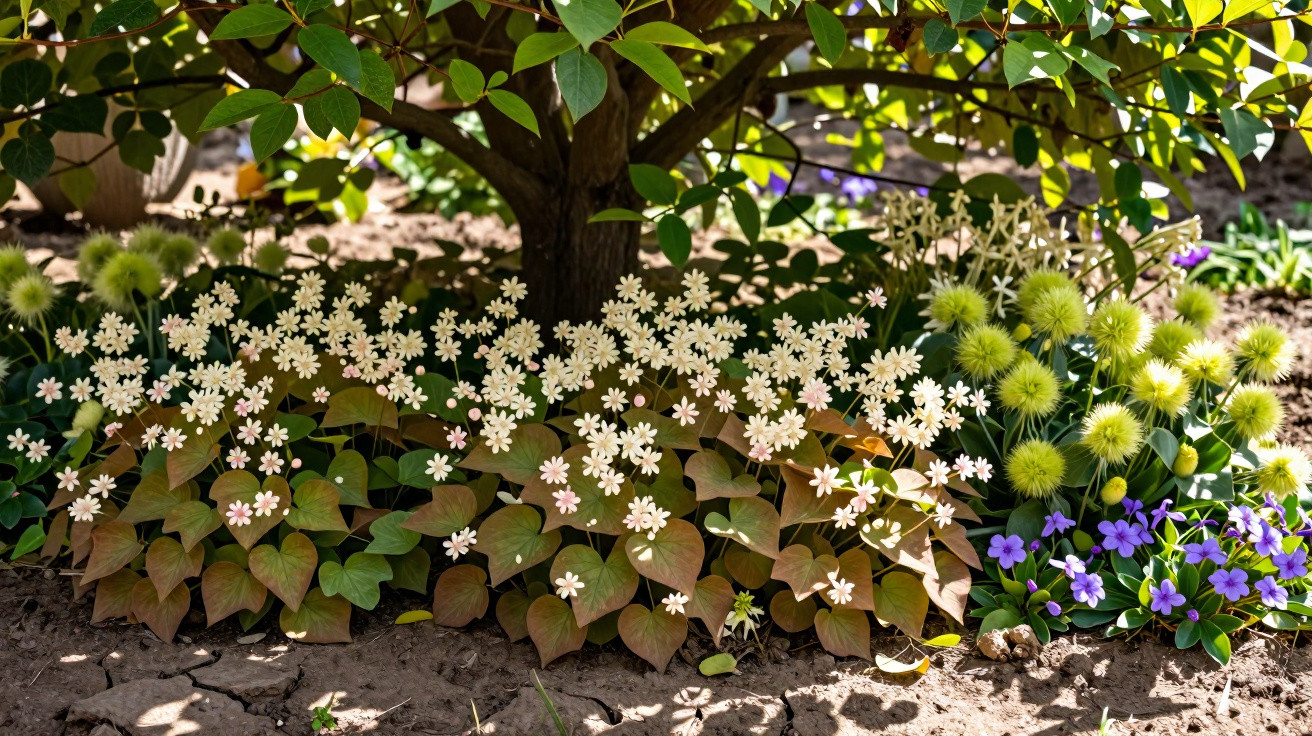
Many amateur gardeners despair of the notorious problem spots: beneath tall trees, alongside established thuja hedges, and in those dusty-dry, gloomy corners where every lawn seed fails and every newly planted perennial withers away. Yet there is a remarkably tough ground-covering plant for precisely these places. It often sits inconspicuously in the background at the garden centre, but it can turn lifeless patches into vibrant garden scenes.
Why seemingly nothing will grow beneath trees
Anyone who has tried to create a picture-perfect lawn beneath a pine or mature oak will know the story: a few blades emerge in spring, everything turns yellow in summer, and by autumn there is only dusty soil and exposed roots. The issue is not simply a lack of light.
Experts call these conditions “dry shade”. Such areas often receive fewer than two hours of direct sunshine daily, while being densely filled with roots that continually draw water and nutrients from the soil. Beneath a thick tree canopy, the ground can end up resembling a hard, cracked crust.
There is another well-documented effect: certain tree species release substances that inhibit the growth of other plants. Newcomers have an especially difficult time below particular pines, walnuts and spruces. Conventional perennials for shady borders generally cannot cope with this combination of drought, root competition and limited light.
Dry, dark and densely rooted: many favourite perennials fail in this extreme setting, while one specialised species makes use of exactly this niche.
Why traditional shade plants surrender here
The same plants repeatedly appear in gardening guides: hostas, astilbes and delicate ferns. They look wonderful in photographs, particularly in cool, fresh shady areas. The problem is that these plants require deep, humus-rich soil that remains consistently moist.
Right beside a tree trunk, however, they face entirely different conditions:
- the top few centimetres of soil dry out quickly;
- thick roots absorb every drop of water;
- the canopy and needles block much of the light;
- extra watering immediately disappears into the dense network of roots.
Many gardeners know the outcome: scorched leaves, sparse flowering and plants that disappear after two years. Bare earth returns, along with frustration from the garden chair.
The quiet heroine: Epimedium, the “fairy flower”
The answer to precisely these areas is often tucked away unobtrusively among the glossy-leaved perennials at the garden centre: Epimedium, commonly known here as fairy flower. Botany enthusiasts class it among the resilient ground covers that create dense carpets through underground rhizomes.
In spring, usually during April and May, delicate white, yellow, pink or warm orange flowers emerge, often with slender spur-like petals. They seem to hover above the foliage, lending unexpectedly airy character to otherwise bleak shade.
The foliage is at least as interesting: many varieties are evergreen, take on reddish or bronze tones as the year progresses, or feature pale speckles. Seen up close, this living carpet looks far more refined than ordinary ground cover.
Once properly established, fairy flower forms a dense, perennial carpet that suppresses weeds, tolerates dry shade and needs virtually no maintenance.
What makes Epimedium so resilient
This perennial appreciates loose, humus-rich soil at planting time, but once established it copes with a surprising amount of stress. It handles competing roots more successfully than many other perennials, tolerates extended dry spells and remains dependable in partial shade through to full shade.
It therefore excels exactly where lawn seed mixtures give up and classic shade plants struggle. For anyone who does not want to replant every year, it offers a lasting solution.
Step-by-step plan: planting problem areas successfully
Getting started properly is crucial. Treating fairy flower like any standard border perennial means missing its potential. A clear approach makes the difference.
The best time to plant
The ideal planting period starts with the first reliable autumn rains. The soil is still warm, roots grow quickly, and natural moisture supports young plants at no cost.
How to prepare the soil
- Carefully loosen the topsoil to a depth of around 5–10 centimetres.
- Do not damage large roots; simply loosen a little soil between them.
- Work in a thin layer of sifted leaf mould or mature leaf compost.
- Remove coarse sticks and thick twigs so the roots can maintain contact with the soil.
Before planting, thoroughly soak each perennial in a bucket of water for about 15 minutes, until no more air bubbles rise to the surface. In dry shade, this preparation can determine success or failure.
Spacing and initial care
For a continuous carpet, position the plants in a staggered pattern across the area:
| Plant spacing | Effect |
|---|---|
| approx. 30 cm in a staggered pattern | Area fills in within 2–3 years |
| closer (20–25 cm) | Faster effect, higher initial cost |
| wider (35 cm) | Cheaper, but more patience required |
Water thoroughly after planting, then water regularly during dry periods in the first season until a stable root network has developed. A light mulch of fallen leaves protects the soil without smothering the plants.
Maintenance afterwards is straightforward: in late winter, cut away old and damaged leaves so that the new growth shows to better effect. Very little else is needed.
Suitable companion plants for a brighter shady area
For some garden owners, a green carpet alone feels too uniform. The right companions can bring surprising life to dry shade without creating another high-maintenance task.
Alchemilla mollis: yellow-green highlights
Lady’s mantle (Alchemilla mollis) produces soft, light-green leaves on which raindrops sit like tiny pearls. In early summer, it sends up delicate clouds of yellow-green flowers that can look almost like spotlights in dark corners.
It works particularly well around the edges of an Epimedium carpet or in small gaps. Its colouring makes the entire space appear much brighter and more welcoming.
Vinca minor: a chain of flowers at the edge
Lesser periwinkle (Vinca minor) is another robust ground cover that can cope with root pressure and relatively poor soil. It produces creeping shoots and scatters violet or white flowers through the shade from spring into autumn.
Used around tree edges or alongside walls, it creates a layered arrangement: the firm carpet of fairy flower at ground level, cushions of lady’s mantle between it, and bands of periwinkle along the margins.
How a “dead” patch becomes a shade highlight
A typical example is the ground beneath a thirty-year-old pine or oak: only hard, dusty soil remains. Turf has long since dried out, and thick roots are partly exposed. A manageable amount of work is enough to change the picture permanently.
After gently loosening the soil, adding leaf mould and planting Epimedium at roughly 30-centimetre intervals, a visible transformation begins in the first season. Fresh green growth pushes up between the roots, while individual flowers appear in spring.
By the second year, a closed carpet has formed. The area suddenly looks like an intentional, designed shade border rather than a neglected leftover patch. Adding lady’s mantle and periwinkle in selected spots then creates a kind of natural “woodland room” at the base of the tree with little effort.
What gardeners should also know about dry shade
The phrase “dry shade” initially sounds contradictory. Many people associate shade with cool, moist conditions. Under urban trees or in front gardens beside roads, though, there is a kind of double pressure: little rain penetrates the canopy, while deep and shallow-growing roots draw out the remaining moisture.
Those who accept these areas and plant specifically with specialists such as Epimedium will save themselves considerable frustration, water and replacement purchases over time. In view of dry summers, these hardy shade-dwellers are becoming ever more appealing.
The potential for combining them with natural-garden elements is also interesting: early bulbs such as small daffodils or crocuses can be planted between cushions of fairy flower. They provide colour in early spring, before the tree canopy is fully in leaf. This allows the garden owner to make the best use of the brief surplus of spring light.
With a little planning, the notorious “problem area beneath the tree” can be transformed from an irritation into a distinctive feature that enhances the entire plot – and remains stable almost entirely by itself.

















Comments
No comments yet. Be the first to comment!
Leave a Comment