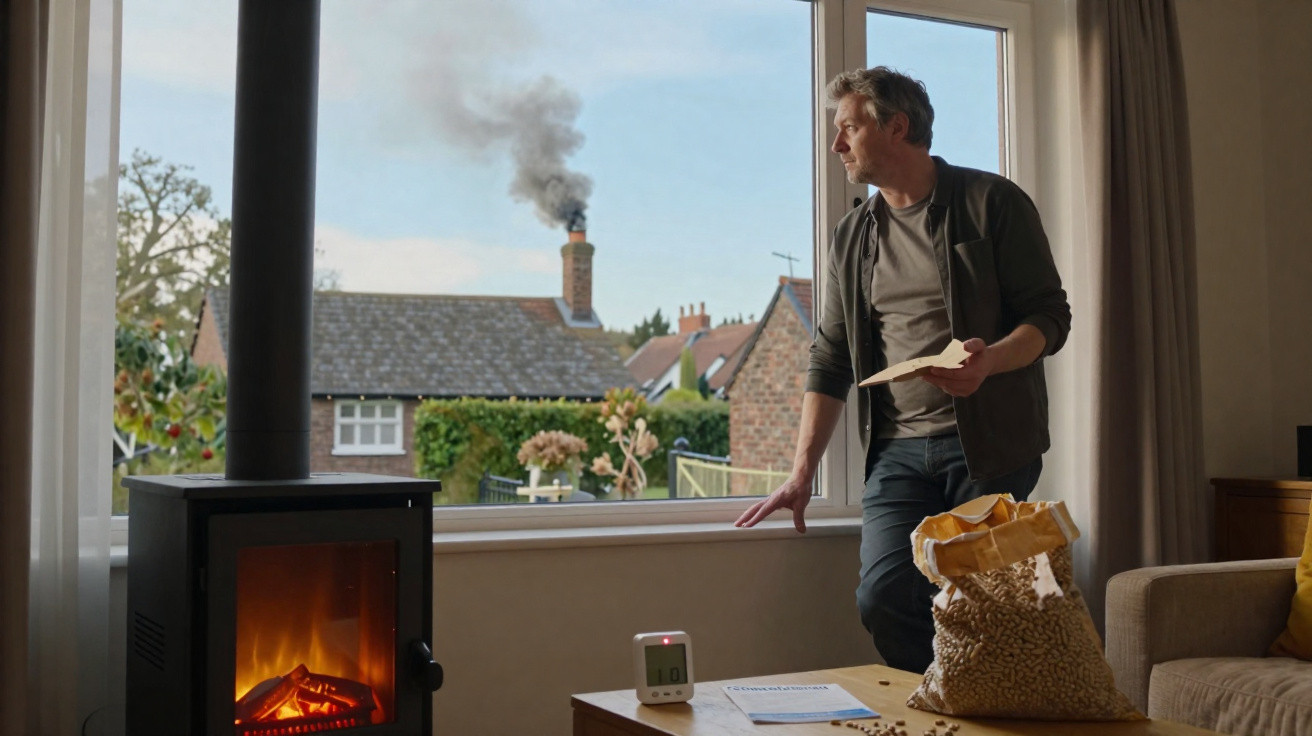
There was something faintly sweet in the cold air, mixed with a sharp sting that scratched at my throat. Standing on my balcony, I looked towards the neighbouring house and saw that its chimney was not giving off a clear plume of smoke, but a dense grey cloud. Down in the yard were stacks of sawn-up chipboard, old shelving panels and leftover varnish. “It’s only wood,” my neighbour called when I challenged him. And somewhere inside me, one part thought: fair enough, recycling saves money and sounds rather clever.
But my head was throbbing, my eyes were watering, and my weather app read “Air quality: poor”.
Sometimes, only a thin line of smoke separates sensible reuse from a dangerous shortcut.
When chimney romance becomes toxic haze
Anyone who has walked through a suburban neighbourhood on a still winter evening will know the feeling. The air is heavy, fires are blazing in chimneys everywhere, and the smell shifts between a cosy mountain cabin and building-site waste burning. In recent years, many households have moved from traditional logs to pellets. Efficient, standardised and easy to store: it sounds like modern heating.
At the same time, another habit has emerged: people put their “leftover wood” into the stove. Old cupboards, coated boards and pallets from online deliveries. On social media, people proudly share how they “waste nothing” and “use everything”. It sounds like a circular economy, yet increasingly it smells like something quite different.
Consider a typical scene repeated across the country. A tradesperson has filled their garage with timber offcuts: OSB boards, varnished doors and cut-to-size chipboard components. Officially, these should be disposed of as controlled waste, for a fee. Instead, a substantial amount ends up in the household fireplace. “It burns brilliantly,” he says, as blue-yellow flames lick upwards and sparks fly.
In the same town, a mother sits beside her child’s bed one evening. Her child is coughing despite not having a cold. Outside, the air is still and the smell from neighbouring homes lingers in the bedroom. She searches for particulate readings and finds a monitoring network run by a local citizens’ group. Every evening, the graph shoots upwards at the same time as the neighbourhood’s burning hour. Figures and instinct are saying the same thing this time.
Statistics on illegally burned waste wood are inevitably incomplete. Nobody willingly ticks a box saying, “I burn my old Pax wardrobe.” Even so, environmental authorities estimate that in some areas, as much as 10–20 per cent of material put into small combustion appliances is not permitted fuel at all. Chipboard, old chemically treated pallets and varnished mouldings: in short, wood that has long ceased to be a natural product.
Why is this happening? Part of the answer is straightforward: cost. Pellet prices have risen, while logs were virtually sold out during some winters. Anyone looking around the yard and seeing old furniture as “free energy” can feel almost foolish for not using it. There is also the reassuring feeling of throwing nothing away. We all recognise the satisfaction of finding a use for something that still seems worthwhile.
At the same time, pellets have greatly polished the image of wood heating. Automatic systems, clean combustion chambers and attractive efficiency ratings all help. That image rubs off on anything else that looks like wood. Pallets, planks and offcuts look similar enough. And when something looks like wood, it is easy to assume that it will be fine. In everyday life, people are happy to ignore the fact that glues, paints and preservatives can produce a toxic cocktail of pollutants at high temperatures.
The sobering truth is that a chimney does not end in the sky.
Every pollutant released has to end up somewhere else: in lungs, on building facades and in gardens. When we burn waste, we shift the cost away from our own wallets and on to neighbours, the NHS and the climate. Calorific value is not the only value a material has. Some waste is “cheap” only until it is set against hospital statistics.
Pellet systems are often seen as climate saviours, but that view is too narrow. Yes, pellets made from certified residual wood can form part of a sensible transition in heating, provided they are produced cleanly, filters are fitted and modern technology is used. But once a stove becomes an all-purpose incinerator, the calculation changes. Emissions of particulate matter, nitrogen oxides, heavy metals and organic pollutants can then quickly reach levels that have nothing to do with sustainable heating.
Anyone wanting to use wood without turning their neighbours and the climate into an involuntary dumping ground should start with one simple rule: burn only fuels explicitly approved for the purpose. That means untreated, dry logs, certified pellets and perhaps clearly labelled briquettes. No chipboard, no stained boards and no pallets marked with stamps you do not understand.
A useful practical test is this: if you cannot say with certainty how the wood has been treated, it does not belong in the stove. Full stop. Otherwise, that supposed recycling trick rapidly becomes an empty gesture. Those who take it seriously sort materials consistently and plan their wood supply generously, rather than sawing up the old coffee table in a panic in February.
What many people underestimate is that most modern wood and pellet stoves operate even reasonably cleanly only when used correctly. Wood that is too wet, insufficient draught and keeping the fire ticking over at a low smoulder all cause incomplete combustion and thick smoke. A stove quietly chugging away may feel cosy, but it can be a serious polluter.
The most common mistake is constantly trying to keep the fire low in order to save fuel. It sounds sensible, but it creates far more smoke and soot. Better practice is to heat strongly, briefly and at a high temperature, then allow the stove to cool. And yes, that takes more effort, attention and routine. Let’s be honest: nobody likes getting up every 40 minutes to add more wood. Many still do it only halfway, out of convenience, and that is exactly where the problem for neighbours begins.
It helps to set aside time once a year to review your own heating routine. What really goes into the stove? What does the smoke look and smell like when I go outside to check? Do I talk to my neighbours about it, or simply hope that nobody complains? These small, uncomfortable questions are often more effective than any new regulation.
“Heating with wood is not a romantic campfire; it is a small industrial plant in a residential area – just without a shift supervisor,” says an air-quality expert I spoke to by phone.
Anyone who does not want their heating system to become the centre of conflict in the street can follow a few simple guidelines:
- Use only certified pellets and untreated, dry wood
- Never burn painted, glued or treated wood, including “offcuts”
- Do not merely put up with the chimney sweep; ask specifically about optimising the system
- Go outside once and consciously look at and smell your own smoke
- Speak to neighbours before resentment builds up
Ultimately, one uncomfortable realisation remains: what looks like ingenious upcycling in your own cellar can look like thoughtlessness out in the street. Sometimes, only a chimney draught separates smart resource use from social unfairness. And yes, the state can filter, regulate and provide incentives. But the decision over whether an old chest of drawers goes to the recycling centre or into the stove still rests in our hands.
Perhaps responsible heating begins precisely when your instincts say: “I actually know this is not a good idea.”
| Key Point | Detail | Added Value for the Reader |
|---|---|---|
| Burn only approved fuels | Certified pellets and untreated, dry logs | Readers can immediately review and adjust how they heat |
| Waste wood is not “free” fuel | Glued, painted and treated wood releases toxic substances | Explains why apparent recycling shifts health and climate costs elsewhere |
| Stove operation makes the difference | Heat quickly and at a high temperature instead of allowing it to smoulder “forever on low” | A practical way to reduce particulate pollution and odours directly |






Comments
No comments yet. Be the first to comment!
Leave a Comment