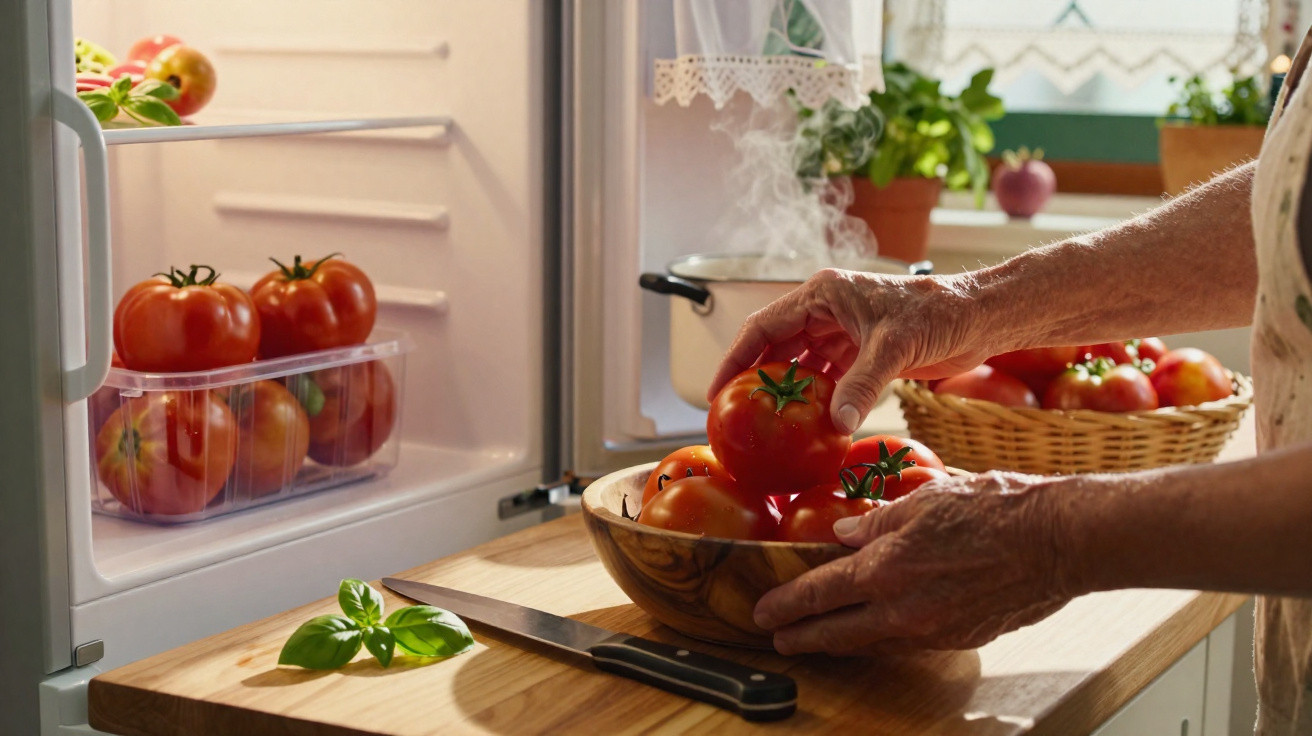
Many tomatoes lose their flavour before they ever reach the plate – and the mistake nearly always starts with how they are stored at home.
Most people automatically put tomatoes in the fridge. It seems practical and tidy, and the assumption is that they will “keep longer”. Yet this very habit can strip the fruit of the quality that makes it a summer icon – its aroma – within just a few hours. This is not culinary fussiness; it is straightforward chemistry.
Why cold temperatures make tomatoes virtually silent
Tomatoes originally come from tropical regions, and their entire biological system is adapted to warmth. As soon as temperatures drop below about 10°C, something crucial happens inside the fruit: its natural ripening process stops.
Ripening governs more than colour and firmness; above all, it shapes flavour. More than 400 so-called volatile aroma compounds have been identified in a tomato. A small selection of these produces the distinctive, intense tomato aroma released when you bite into a ripe fruit.
“Under fridge conditions, these aroma compounds collapse dramatically – up to two thirds disappear in less than a week.”
Researchers in France have shown that storing tomatoes at around 4°C causes large parts of their aroma components to disappear. The flesh may still look exactly the same, but in flavour terms the tomato is merely a pale imitation. It is like a bottle of perfume with two thirds poured away: you can still smell something, but its depth has gone.
The explanation is that the enzymes which create aroma compounds barely function, or cease functioning altogether, in cold conditions. Production of these volatile molecules falls away, so the tomato no longer “smells” as it should. What often begins in a chilled supermarket display then continues in the fridge at home.
The invisible genetic damage caused by the fridge
The most dramatic effects occur at genetic level. A team at a US university examined more than 25,000 genes in different tomato varieties before, during and after a cold shock.
Their finding was that cold puts tomatoes under stress. Numerous genes reduce their activity, including those that encode enzymes responsible for aroma formation. Even more troublesome is the process behind this: an epigenetic alteration known to specialists as DNA methylation.
Put simply, particular sections of genetic material are chemically marked and therefore permanently silenced. Even when the tomato is later left at room temperature again, these genes remain inactive. The “aroma factory” does not restart.
“The widespread hope that ‘I’ll only chill them briefly and take them out in good time’ works only within very narrow limits.”
In tests, tomatoes were chilled for seven days and then kept at room temperature for several more days. The aroma compounds that had been lost did not return. In other words, if a tomato has spent a prolonged period in genuinely cold conditions, even leaving it on the worktop to “warm up” for hours will do very little.
When a tomato breaks down inside
Flavour loss is accompanied by a second issue: texture. Tomato cells contain a great deal of water. When temperatures become very low, tiny ice crystals form within them, rupturing the delicate cell membranes.
As the fruit warms up again, water leaks from the damaged cells into the spaces between them. The familiar result is a tomato that feels mealy, watery and slightly mushy. Very little remains of the crisp, juicy texture of a freshly ripened tomato.
What grandmother’s kitchen knew long ago
In many Mediterranean homes, tomatoes have traditionally never gone into the fridge. They are kept in baskets, on plates or in cool larders at ordinary room temperature. The practice comes from experience: both flavour and texture simply remain better this way.
Modern research confirms precisely this. Decades of genetic and chemical studies lead to a conclusion that would make any Italian nonna nod: tomatoes belong in the air, not in a low-powered icebox.
The best way to keep tomatoes truly fresh
The good news is that the answer is simple and costs nothing. Tomatoes are happiest at room temperature, in a fairly cool, dry spot away from direct sunlight.
“Ideal place: a basket or plate on the worktop, well away from radiators and the windowsill.”
Practical tips for storing tomatoes at home
- Do not put them in the fridge – at least not normally ripe tomatoes.
- Store them at room temperature, ideally between about 16 and 22°C.
- Keep them out of direct sunlight, otherwise they will continue ripening too quickly.
- Place them stem-side down, as this reduces evaporation from their most vulnerable area.
- Store them separately from other fruit, particularly apples and bananas, which release plenty of ethylene.
- Buy only as many as you will eat within four to seven days.
The stem area is a kind of weak point in a tomato. Placing the fruit with this side down on a smooth surface means it dries out less quickly. Keeping tomatoes away from fruit that produces large amounts of ethylene slows ripening and prevents them from going from perfect to overripe overnight.
Are there exceptions to the “no fridge” rule?
The situation is not entirely black and white. If tomatoes have only been in the fridge for a very short period – around one or two days – some of their aroma can be saved by taking them out early enough. Around 24 hours at room temperature gives the fruit an opportunity to regain at least a little flavour.
However, the window for recovery is limited: the longer they remain in the cold, the greater the genetic blockage. After a week at the latest, the damage becomes permanent. So, if refrigeration is unavoidable because of limited space, move the tomatoes out again as quickly as possible.
How cold alters the balance of flavour
Tomatoes are not tasty solely because they create scent molecules. The balance between sweetness and acidity is equally important. Their principal sugars are fructose and glucose, while their key acids are citric acid and malic acid.
At room temperature, this interaction continues to develop: sugar levels rise slightly and acidity falls very slightly. This creates the rounder, fully ripe character people love in summer tomatoes.
“In the fridge, this development literally freezes – the tomato remains more acidic and seems flatter.”
This is why many people describe fridge tomatoes as “watery” or “empty”. It is not only the missing aroma compounds that cause this, but also the disrupted fine balance between sugar and acidity.
What to do with tomatoes that are already too soft
Sometimes a punnet of tomatoes simply sits around for too long. Before the fruit collapses completely, there is a very sensible solution: put it in a saucepan or the oven. Very ripe tomatoes contain concentrated flavour compounds, making them ideal for cooked dishes.
Ways to use ripe tomatoes
- Make a quick tomato sauce with fresh tomatoes, onions, garlic and a little olive oil.
- Roast tomatoes in the oven with salt, pepper and herbs, then serve them over pasta.
- Cook down tomato purée or coulis, then fill jars or freeze it.
- Make oven-dried tomatoes by gently confiting them at a low temperature with olive oil and herbs.
Heating does alter aromas, but it does not simply make them vanish. Many flavour compounds can even become more noticeable as water evaporates and the tomato becomes more concentrated. This allows you to get the most from an overripe fruit.
Why supermarket tomatoes have often already lost out
Part of the issue starts long before you go shopping. Many wholesalers store tomatoes under refrigeration to extend their shelf life and minimise losses in transit. As a result, the fruit may reach the shop with an aroma deficit already in place – before it then enters the fridge at home.
Anyone who values flavour should therefore watch for a few signs: tomatoes displayed at room temperature, seasonal varieties grown locally, and fruit with a strong fragrance all offer better prospects. Tomatoes that already feel clammy and cold in the shop have usually experienced their cold shock.
A short glossary for the curious
Volatile aroma compounds are tiny molecules that pass easily into the air. They reach our nose and define the smell of food – and therefore a large part of the “flavour” we perceive.
DNA methylation is a chemical marking on genetic material. It turns genes down or switches them off completely without changing the actual DNA sequence. In tomatoes, this process means certain aroma genes remain permanently impaired after cold stress.
Once you understand these processes, you are unlikely to put tomatoes thoughtlessly into the vegetable drawer again. A simple move to the worktop is often enough to turn bland, watery spheres back into fragrant summer fruit.














Comments
No comments yet. Be the first to comment!
Leave a Comment