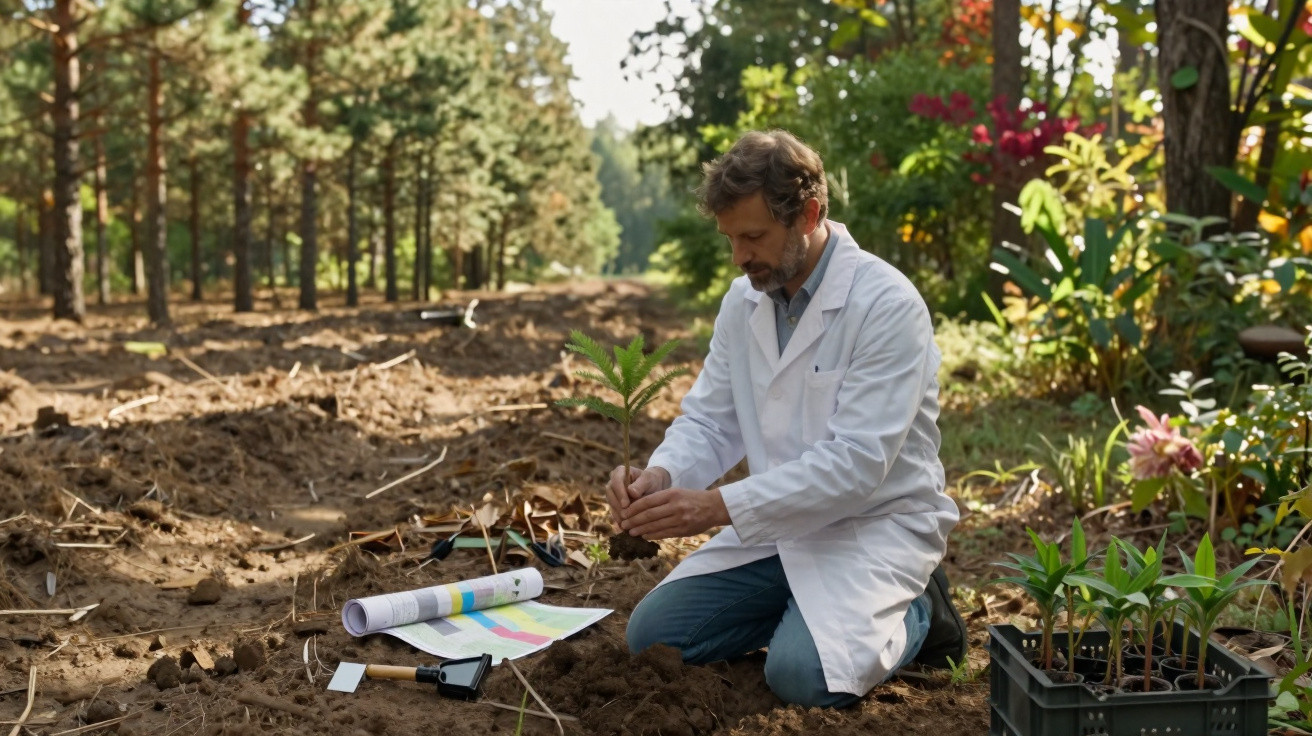
The mayor snips a green ribbon, cameras fire and the crowd counts down while the first sapling is planted. Children clutch cardboard placards about “saving the planet”, volunteers mop sweat from their brows, and a drone buzzes above to capture the ideal aerial image of a brand-new “forest”.
Two years on, that same plot has become a cemetery of brittle sticks and plastic supports, ringed by eroded ground and a fence no one recalls putting up. The photographs remain in fundraising emails. The trees do not.
Some scientists are now willing to voice what has long gone unsaid.
When ‘plant a tree’ becomes a dangerous reflex
In theory, tree planting seems like the perfect feel-good answer to climate change. Put a sapling in the soil, trap some carbon and leave feeling less guilty. It works neatly on a T-shirt, in a corporate PowerPoint presentation or across a charity banner.
But the picture on the ground is far more complicated. Forest ecologists visit “reforestation” schemes and find a very different reality: struggling young trees planted in unsuitable places, drawing water from vulnerable soils and pushing out grasslands and wetlands that were already performing an essential, if overlooked, climate role.
The message is easy. Reality is harsher.
Consider the huge tree-planting drives in northern India. State governments proudly declare that tens of millions of saplings have been planted in one day. Images show politicians holding spades and thousands of people gathered along riverbanks.
When researchers later returned to some of these locations, they found survival rates so poor they were almost brutal. Many seedlings had gone into the ground during the height of the dry season. Others were planted on land used by pastoralists, who abruptly lost grazing areas, creating conflict and unspoken resentment.
From satellite imagery, the claimed new forests are barely visible. At ground level, local communities experience the strain rather than the shade.
The reasoning appears so obvious that it is rarely challenged: trees take in CO₂, therefore more trees equal less climate change. But that overlooks uncomfortable questions about where they are planted, which species are chosen and why. A forest established in the wrong location can heat the local climate because it darkens a previously light surface that reflected sunlight.
Monoculture plantations of quick-growing pine or eucalyptus can hold carbon temporarily, only to burn or be harvested and release much of it again. Where these plantations replace biodiverse savannahs or peatlands, they may wipe out ecosystems that were already holding enormous carbon stores beneath the ground.
What appears green is not necessarily green for the planet.
The right way to plant a tree (and when not to)
The most practical scientists are not calling for people to “stop planting trees”. Their advice is to slow down and ask three questions beforehand: What grew here in the past? Who lives here today? Who will look after these trees in ten years’ time?
The strongest projects usually begin by walking the site rather than buying seedlings. Local residents can identify seasonal water routes, sacred groves and historic animal trails. Ecologists analyse the soil, examine old maps and speak to farmers about pests and prevailing winds.
Only after that should they decide on the species, spacing and locations that genuinely have the potential to become forest again.
One major error is to treat trees as moral points in a video game. One flight, ten trees. One burger, one sapling. Most of us recognise that moment when a website offers to “offset” guilt with a single click.
The blunt sentence absent from the posters is this: a badly placed tree can do more damage than no tree at all. Planting on natural grasslands damages native wildlife. Covering peat bogs with saplings drains water and releases ancient carbon.
Picking up a spade feels heroic. Asking whether you ought to use it feels slower.
“Tree planting has become the climate world’s selfie,” says a forest scientist I spoke to. “Looks great, travels fast, but often says more about us than about what the land really needs.”
Don’t start with a seedling
Begin with a map, local expertise and a clear understanding of what the landscape looked like before intense human pressure.Protect what’s already working
Ancient forests, peatlands, mangroves and even untidy-looking scrub often store more carbon and sustain more life than any new plantation could.Think ‘assist nature’, not ‘fix nature’
At times, the most effective option is to fence off damaged land and allow natural regeneration to proceed at its slow, quiet pace.Plan for 30 years, not 30 minutes
Who provides water, who owns the land, who gains and who loses? If those answers are vague, the scheme probably is as well.Question the easy offset
When a company claims to be “carbon neutral” through tree planting, check where it is happening, how long it will last and which ecosystem is being changed.
So what do we do with this uncomfortable truth?
Once the flaws in the tree-planting narrative become visible, they are difficult to ignore: glossy campaigns, “one trillion trees” promises and corporate forests that exist more on Instagram than in rain and soil.
That does not mean giving in to cynicism or doing nothing. Instead, it points towards a more grown-up response: fiercely defending existing forests, restoring damaged land with humility and reducing emissions at their source rather than exporting guilt to saplings on the other side of the world.
Some of the most effective climate measures are almost too unglamorous to become popular online: insulating a building, eating slightly less meat and voting for people who understand ecosystems rather than simply photo opportunities.
Let’s be truthful: nobody manages all of this every day. Life is busy, complicated and filled with competing concerns. Yet the next time a promise appears to “save the planet” with a tree, it may be worth stopping to ask a better question. Not “how many?”, but “where, how, and for whom?”.
| Key point | Detail | Value for the reader |
|---|---|---|
| Question easy tree solutions | Planting in the wrong place can warm the land and release concealed carbon | Avoid backing projects that feel positive but damage the climate |
| Protect existing ecosystems first | Ancient forests, peatlands and grasslands often hold more carbon than new plantations | Understand where your money and effort can make a genuine difference |
| Look beyond offsets | Meaningful climate action also requires cutting emissions at the source | Direct your energy towards changes that outlast a photograph |
FAQ:
Question 1 Are scientists really saying we should stop planting trees altogether?
Not in most cases. Many researchers argue that we should plant fewer, better trees in places that naturally support forests, alongside robust protection for ecosystems that already exist.Question 2 Why can planting trees make climate change worse?
Planting on grasslands, wetlands or peatlands can destroy ecosystems that retain vast quantities of carbon in the soil, alter local water cycles and even darken surfaces so that they absorb more heat.Question 3 Are commercial tree plantations bad for the planet?
They may be valuable for timber and livelihoods, but when they displace native forests or rich savannahs, they reduce biodiversity and create carbon stores that last only for limited periods.Question 4 What should I look for in a trustworthy reforestation project?
Involvement from local communities, native species, long-term monitoring, openness about survival rates and a clear commitment not to replace natural non-forest ecosystems.Question 5 If tree planting isn’t enough, what can individuals actually do?
Use less energy, support forest-protection organisations, eat lower on the food chain, vote for nature-literate policies and regard any “offset” claim as only a small part of a far larger puzzle.












Comments
No comments yet. Be the first to comment!
Leave a Comment