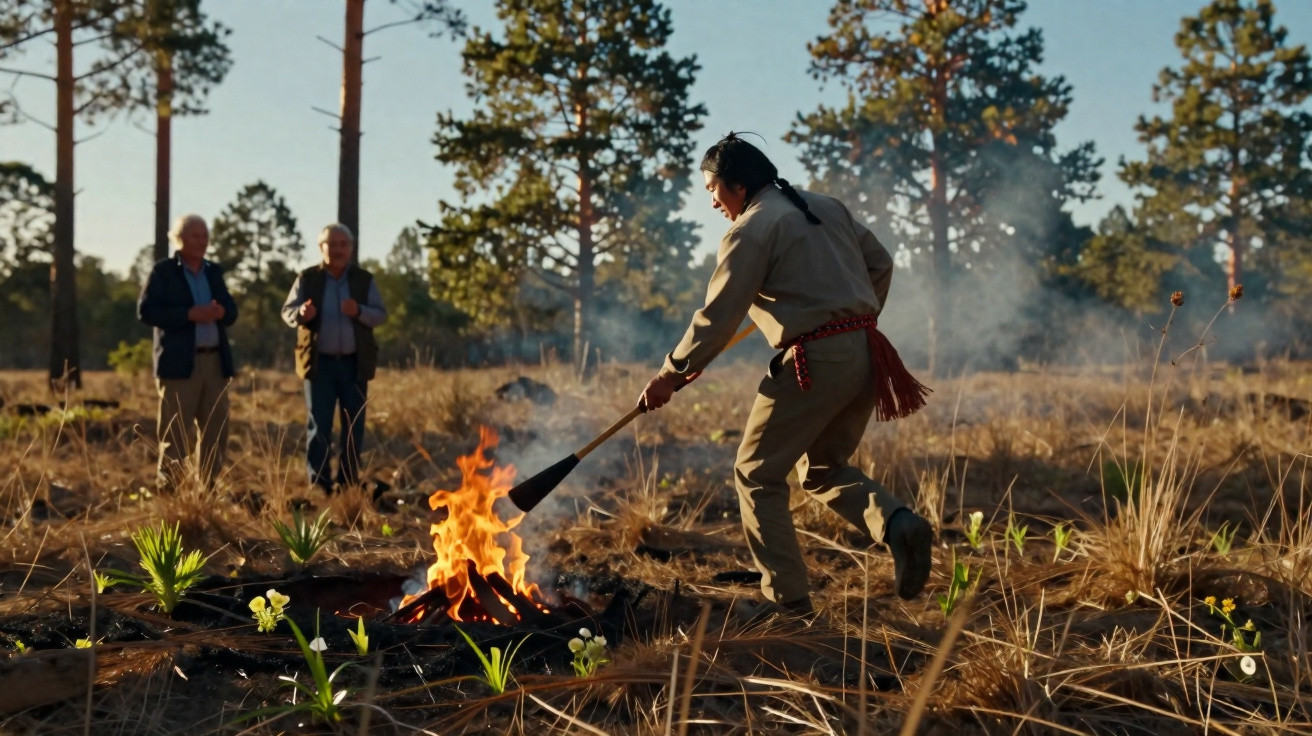
A small group in high-visibility vests watches from a distance as an Aboriginal fire practitioner moves slowly along a boundary line. Holding a drip torch, he speaks softly to the earth as he walks. Birds wheel above him. The air is warm without being suffocating, carrying the smell of a campfire rather than a disaster. This bears little resemblance to the wildfire images we have learned to dread on our screens. It is something more ancient and more restrained – and, as increasing numbers of governments recognise, much more intelligent. Across the globe, thousands of Indigenous fire practices are returning from the margins. Forests are being reshaped, as are the people who care for them. The most unexpected change may be the one for which we are least ready.
When “good fire” returns to the land
On a cool northern California morning, the forest seems remarkably calm for somewhere devastated by a catastrophic fire only five summers earlier. Blackened stumps still rise like broken teeth, yet a gentle green mosaic has emerged between them. Young black oaks are pushing through the ash in places. A Karuk fire keeper smiles while indicating beargrass and edible bulbs – plants that had almost vanished after a century of fire suppression. This area formed part of a cultural burn the previous year: a deliberately lit, low-burning fire carried out in settled conditions. Its flames were no taller than a knee and moved slowly enough for people to walk alongside. It appears almost uneventful – and that is precisely its purpose.
Comparable scenes are no longer rare experiments, from Arnhem Land in Australia to Canada’s boreal forests. In Australia, Indigenous ranger groups now jointly manage tens of millions of hectares through “cool burns” lit early in the dry season. Satellite evidence shows a sharp fall in late-season, intense wildfires where these schemes have expanded. In western Arnhem Land, these burns have reduced destructive fires by about 50% and substantially lowered greenhouse-gas emissions, producing carbon credits that support local employment. Similar accounts come from Brazil’s Xingu region, where Indigenous brigades combine traditional burning with contemporary weather models, and from Portugal, where shepherds and Indigenous-connected pastoralists are bringing back patchy burns to safeguard hill villages. The same lesson appears again and again: smaller planned fires today lead to fewer frightening fires later.
Researchers examining these initiatives repeatedly reach the same conclusion: Indigenous fire is not simply a technique, but an entirely different way of interpreting a landscape. Western fire management has generally treated fire as an enemy to suppress. Indigenous knowledge systems instead understand it more as a relative requiring care, direction and respect. That perspective alters everything. Rather than waiting for a devastating blaze, practitioners read the seasons, moisture, wind and species to judge when fire can be beneficial instead of destructive. They burn in mosaics, retaining unburnt shelters for insects, birds and mammals. This varied pattern forms natural firebreaks, lowers soil temperatures and helps a wider range of plants emerge. Seen this way, many supposed “natural disasters” seem less like misfortune and more like the consequence of a damaged relationship with fire.
How Indigenous fire knowledge works in practice
The approach can appear misleadingly straightforward. A cultural burn commonly begins with walking, long before anyone lights a match. Practitioners travel through country, testing moisture in leaf litter, observing ant mounds and feeling the breeze on their faces. They discuss the people who once lived there, the food plants that previously flourished and the birds that have fallen silent. Only afterwards do the tools appear: a drip torch, a smouldering branch or sometimes no more than dry grass ignited from an ember. Fire is placed carefully in narrow lines or small circles, then permitted to creep and pause. People remain close, reading its behaviour moment by moment. If the wind rises, they stop. It is less an act of control than a conversation.
For land managers raised around large yellow fire engines and emergency sirens, such a method may seem unsettling. There is no fixed timetable or checklist saying “light on this date, finish by that date”. Indigenous burners frequently speak of waiting until the land is “ready”. This may involve holding off for years in a forest harmed by repeated megafires, or responding swiftly in grassland that is about to become too dry. Let us be honest: hardly anyone does this every day in large forest-management agencies. Yet the projects that allow for this slower, attentive rhythm are producing notable outcomes: cooler flame heights, fewer trees killed and soils that remain more stable after heavy rain. The contrast is tangible when people speak quietly at a fire line instead of yelling above a roar.
Misunderstandings continue to arise wherever this knowledge is being restored. Agencies can sometimes treat Indigenous burners as inexpensive labour added to the end of a conventional fuel-reduction programme, rather than as equal partners setting the strategy from the outset. Meanwhile, communities already burdened by colonisation and dispossession may understandably fear that their knowledge will be extracted, repackaged and sold back to them. The human dimension matters as much as the technical one. Projects that arrive with drones and modelling software while overlooking relationship-building often struggle. At its worst, “good fire” can easily become another box-ticking exercise, emptied of its history and meaning. At its best, something more delicate yet more powerful begins to grow: shared authority, reciprocal learning and a new understanding of who decides what burns and what does not.
What Indigenous fire can teach us – even if we never strike a match
For people who do not manage land, Indigenous fire may seem like a remote specialist concern. It is not. The thinking behind it transfers surprisingly well. Consider its approach to risk. Rather than moving between paralysis – no fire at any cost – and panic – emergency suppression at all cost – Indigenous burners take small steps that can be reversed. A thin strip in one place, a small patch in another, followed by time to observe. It is a continual process of adjustment rather than a single heroic intervention. In ordinary life, this resembles dividing immense climate challenges into achievable measures: community fuel breaks, neighbourhood preparedness days and discussions with local councils about smoke windows and cultural-burn permissions.
There is a subtler lesson, too, about whose knowledge is respected. We have all experienced the moment when an expert arrives to explain a problem without ever asking what local people are seeing for themselves. Indigenous-led fire projects reverse that pattern. Elders, hunters, women gathering food plants and children noticing insects all hold part of the answer. For readers, the practical implication is clear: when your town or region discusses fire, ask who is absent from the table. Are Indigenous nations making decisions on their own homelands, or merely being “consulted” once plans have already been drafted? Are local observations of the seasons treated seriously, or stored away and forgotten? The answer becomes evident later, in whether a community is caught unawares by the next plume of smoke or has helped shape the decision behind it.
“Fire was never the enemy,” says Yuin fire practitioner Uncle Noel Webster. “The enemy was forgetting how to live with it.”
In historical terms, that forgetting was rapid. A few generations of forceful suppression, logging and settlement removed thousands of years of careful burning from official maps. Restoring it requires different decisions about who has authority. It can also require confronting fear, grief and even guilt over mishandled fires or lost knowledge. Those involved in such projects describe community meetings where there are as many tears as technical details. Readers can support this change through three straightforward actions:
- Support Indigenous-led fire programmes and land councils in your area.
- Ask local politicians to finance long-term cultural burning rather than one-off work.
- Question narratives that portray every fire as a disaster and every forest as “fuel”.
None of this means becoming a firefighter. It does mean becoming the kind of citizen who sees smoke and asks more thoughtful questions.
Forests that remember, futures that burn differently
Walk through a forest shaped by regular cultural burning and the difference is felt physically before the mind fully registers it. Light reaches the ground rather than stopping at the canopy. You can see where you are placing your feet. Shrubs occur in clumps instead of forming an unbroken wall, while leaf litter is springy rather than knee-deep and tinder-dry. Birds move between the layers. In some places, old trunks bear scars – marks of fire that represent not trauma but survival through dozens of cool burns. Many Indigenous languages have no equivalent of “wilderness” as the term is used in modern conservation; country is intended to be in dialogue with people, not sealed off from them. Restoring good fire begins that conversation again.
The intensity of this moment comes from a collision between different timescales. Climate change is accelerating droughts and heatwaves, transforming neglected landscapes into powder kegs. At the same time, communities are carefully reviving knowledge that nearly disappeared within living memory. These forces pull in opposing directions. Whether they meet in anything resembling balance will depend on choices made now: how rapidly land agencies can transfer decision-making power, how courageously politicians can speak about “living with fire” without paying for it at the next election, and how willing the rest of us are to accept planned smoke today in order to prevent catastrophe tomorrow. The story of Indigenous fire revival is still being written, one flickering line at a time.
| Key point | Detail | Why it matters to readers |
|---|---|---|
| Good fire reduces bad fire | Cultural burning reduces fuel loads in small, controlled patches, limiting the intensity and spread of later wildfires. | It helps explain why more planned burning can mean fewer terrifying fire seasons. |
| Knowledge is as vital as tools | Success relies on Indigenous leadership, local observation and long-term relationships, rather than solely on drip torches and helicopters. | It encourages readers to look beyond technology when assessing fire policies or proposed solutions. |
| Everyone has a role | Supporting Indigenous-led programmes, changing public narratives and taking part locally all affect how fire is managed. | It sets out practical ways to act, even for people who never work on a fire line. |









Comments
No comments yet. Be the first to comment!
Leave a Comment