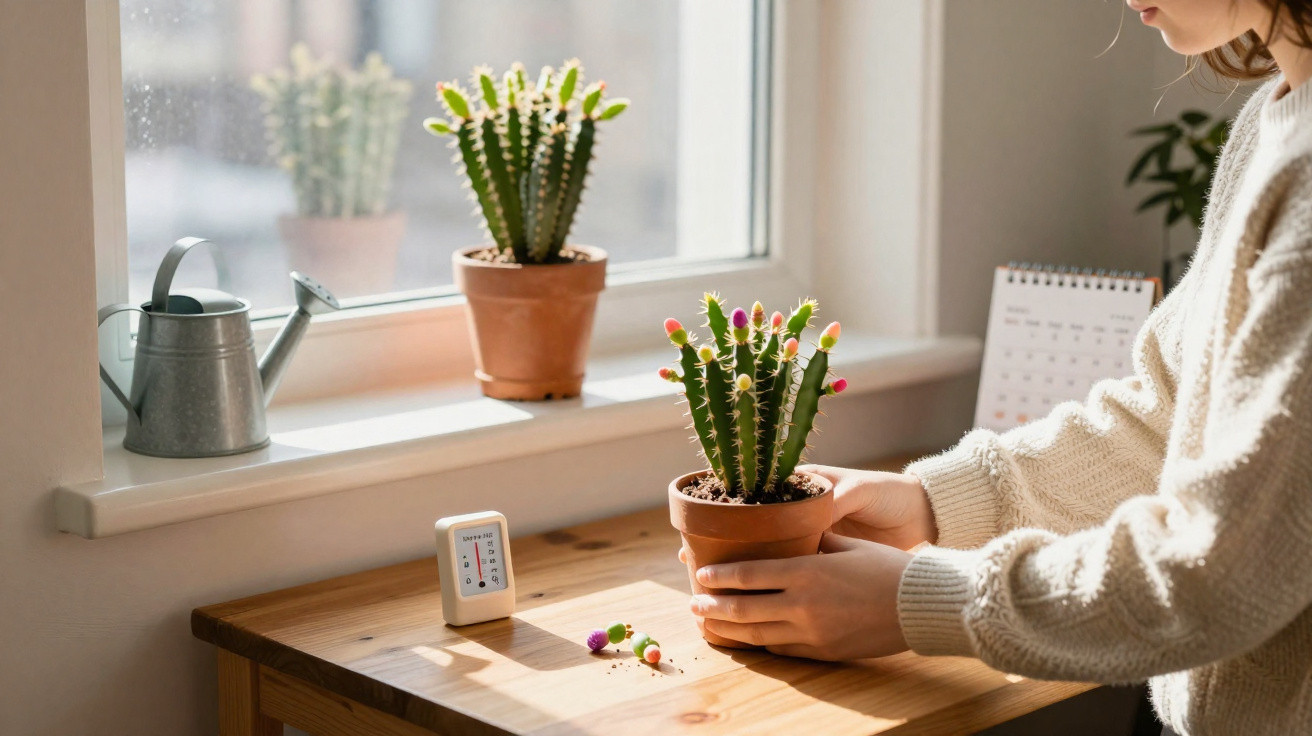
It stays richly green and looks healthy – yet your Easter cactus produces not a single flower in time for the holidays.
Many plant lovers know the disappointment: during its first year, the Easter cactus is covered in blooms, but by the second, only a green pot remains on the windowsill. The plant is alive and appears healthy, yet spring passes without any colourful stars. This does not mean you have a “bad” cactus; in most cases, a very specific winter-care mistake is responsible.
What makes the Easter cactus so special
The Easter cactus (botanically Rhipsalidopsis or Hatiora) is not a desert plant. It originates from the humid forests of South America, where it grows epiphytically in the forks of branches, receiving filtered light and consistently humid air. That is a completely different environment from that of a typical spiny cactus from dry grassland.
This background also explains how it behaves on a windowsill:
- It prefers bright light, but not harsh direct sunshine.
- It needs an airy, light growing medium that does not become waterlogged.
- It favours cooler locations over hot ones.
- Its natural flowering period is spring, usually from March to May.
It is easy to confuse it with a Christmas cactus. However, the latter flowers in winter and has more deeply serrated, “toothed” segments. The Easter cactus has more rounded, softer-looking segments and starts flowering considerably later – provided conditions are right.
“The key to abundant flowers lies not in spring, but in the winter months beforehand.”
The most common Easter cactus mistake: winter conditions that are too warm and bright
An Easter cactus needs a clearly defined rest period, and this is where many homes fail to provide the right conditions. The plant remains in a warm living room at almost 20 °C, is exposed to lamp light in the evening, and continues to be watered almost unintentionally. The result is lush green growth but no buds.
To flower, the Easter cactus needs something like a winter regime: cooler, darker and drier. Without this break, it may form fresh shoots, but flower buds will not develop.
The ideal yearly schedule for your Easter cactus
If you want to prepare your Easter cactus specifically for flowering at Easter, use this general rhythm as a guide:
| Period | Temperature | Light | Watering |
|---|---|---|---|
| March–August (growth) | 18–23 °C | Bright, without direct midday sun | Every 1–2 weeks; allow the surface to dry out |
| September–October (transition) | 15–18 °C | Bright, slightly reduced | Gradually reduce watering, with longer intervals |
| November–January (rest period) | 10–15 °C | Only around 8 hours of daylight, with long darkness | A small amount every 3–4 weeks |
| February (waking phase) | 18–20 °C | Move to a brighter position again | Increase slightly, without soaking the compost |
The rest period should last for at least eight weeks, and ideally up to twelve. Every night matters at this stage: the cactus needs around twelve hours of genuine darkness. That means no constant television light, no living-room lamps until midnight and no streetlight shining directly through the window.
Creating the perfect winter rest period
From late autumn, move the Easter cactus into a cool room, such as a stairwell, a lightly heated guest room or beside a north-facing bedroom window. The important points are:
- Keep temperatures consistently between 10 and 15 °C, without allowing frost.
- Do not place it directly above a radiator or on underfloor heating.
- Daylight is beneficial, but avoid artificial light extending the day late into the evening.
When it comes to watering, less is better than too much during this period. The shoots may feel a little firmer or look slightly slimmer, but they should not become wrinkled and soft. A small glass of water every few weeks is generally more than enough.
“The typical mistake is not dryness, but wet compost in cool conditions – which quickly leads to root rot.”
Watering, feeding and repotting: caring for your Easter cactus properly
During its growing season, from spring until late summer, you can be rather more generous with care again.
Watering correctly without waterlogging
The Easter cactus likes moisture, but it does not tolerate “wet feet”:
- Water once the upper layer of compost has dried out.
- Tip away excess water from the saucer after a few minutes.
- If indoor heating makes the air very dry, mist it occasionally with low-limescale water.
Soft, glassy segments usually indicate rot caused by excess moisture rather than thirst. In that case, the plant urgently needs drier conditions and may also require fresh compost.
The right growing medium for plenty of buds
Ordinary potting compost is often too heavy and compact for an Easter cactus. A loose, well-aerated mix that reflects its epiphytic way of life is a better choice. A suitable blend might include:
- 2 parts high-quality houseplant or cactus compost
- 1 part perlite, pumice, lava granules or coarse sand
- Optionally, a small amount of fine pine bark for structure
Repotting every two to three years is sufficient, ideally immediately after flowering. The plant normally copes best with being moved then and can begin the new season straight away in fresh compost.
Why buds suddenly drop shortly before Easter
It is particularly frustrating when the buds finally appear, only to fall off shortly before the holidays. Stress is often the cause:
- The pot has been moved to a different position.
- Cold draughts from frequent airing.
- The heating has suddenly been turned up sharply.
- The root ball has dried out completely after several days of being forgotten.
The Easter cactus is sensitive while it is in bud. Try to keep its position as stable as possible during this time. Avoid drastic temperature changes and do not keep moving it between the windowsill and a table.
“While the buds are growing, the Easter cactus is a creature of habit: a consistent place and consistent care will bring successful flowering.”
Common practical questions
Can an Easter cactus go on the balcony in summer?
Yes, it can do very well outdoors if the position is suitable. A sheltered spot in partial shade is ideal, such as an east- or west-facing balcony. Direct midday sun can easily scorch the segments. Rain is not a problem, provided water can drain away freely and the pot never remains permanently wet.
Does the Easter cactus need fertiliser?
From March to August, a weak liquid fertiliser every four to six weeks is enough, such as a fertiliser for flowering plants or cacti, diluted slightly. Do not fertilise at all during the winter rest period: the plant should genuinely “slow down” at that time.
How to tell whether your winter routine is working
When the Easter cactus is returned to a warmer, brighter position in late winter after a cool, darker phase, the first buds often appear at the shoot tips after a few weeks if it has been cared for well. If they do not appear, check three things:
- Was the temperature genuinely below 16 °C for an extended period?
- Was there true darkness at night, without constant sources of light?
- Was watering kept very sparing during the rest period?
Even minor deviations can disrupt the flowering trigger. Once you understand these adjustments, you can fine-tune them deliberately the following winter.
Ultimately, the Easter cactus is not a “diva”; it is simply consistent. It flowers reliably when its internal calendar is right. Give it a cool break, provide darkness at night and protect it from wet roots, and around Easter you will usually be rewarded with an impressively dense ring of star-shaped flowers – often for many years in succession.














Comments
No comments yet. Be the first to comment!
Leave a Comment