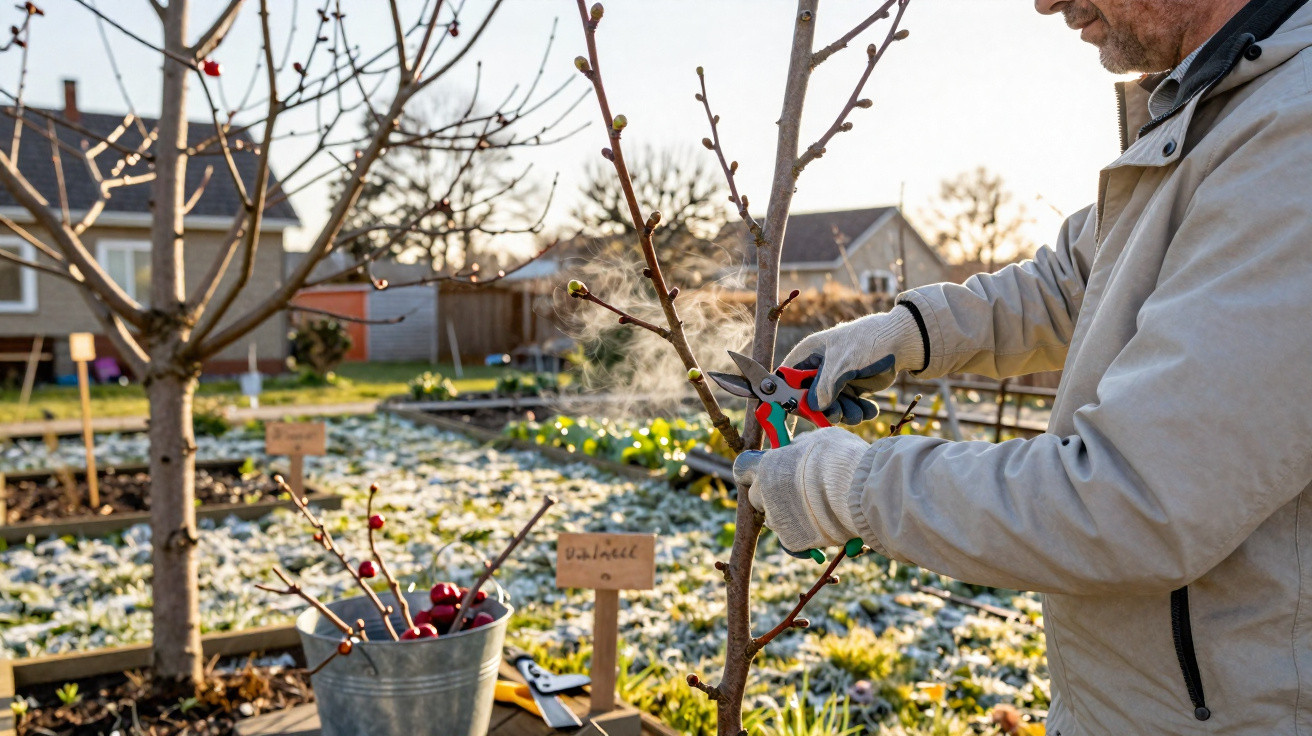
Leave pruning a few days too late and, come summer, the fruit bowl may already be half empty.
Four popular fruit trees in particular are highly sensitive to poor timing.
Many amateur gardeners keep putting off winter pruning until spring suddenly seems to be on the way. That is precisely what can backfire with apple, pear, peach and cherry trees. Failing to prune these trees correctly and in good time can mean fewer blossoms, vulnerable branches and disappointing yields. March is the crucial period that determines how full the baskets will be in summer.
Why pruning before mid-March matters so much
Depending on the region, fruit trees often begin their sap flow as early as late February or early March. The buds start to swell and the tree “wakes up”. The ideal window for winter pruning comes just before this point – in many areas, until around 10 March.
“Pruning too late drains the crown of the energy needed for flowering and leaves the door wide open to pathogens.”
Pruning early offers several benefits:
- Rapid wound healing: Cut surfaces seal before pests and fungi become fully active in spring.
- Improved light distribution: More sunlight reaches the fruiting shoots, producing stronger flowers and more flavoursome fruit.
- A stable structure: Weak, crossing or steeply upright shoots are removed before they snap under the weight of fruit.
- Focused energy allocation: Rather than directing its energy into unnecessary wood, the tree can invest it in flower buds and healthy growth.
Important: the calendar is only a guide. The ideal time may arrive earlier in mild regions and somewhat later in exposed, colder locations. Frost-free, dry days and buds that are still dormant matter more than the date itself.
Four fruit trees where correct pruning determines the harvest
Apple tree: a classic that needs regular pruning
Apple trees are among the fruit trees that quickly become unproductive without routine winter pruning. Their crowns become overcrowded, the interior is shaded and diseases can spread more easily.
Typical pruning objectives include:
- Remove dead and diseased branches: These can be identified by dry bark, missing buds and brittle wood.
- Shorten or remove water shoots: These strongly upright shoots use a great deal of energy but produce very little fruit.
- Thin the crown: Take out branches that cross, rub together or grow inwards.
- Encourage fruiting wood: Retain shorter, slightly horizontal shoots with plenty of buds – these are where the apples will later develop.
A well-trained apple tree has a small number of strong scaffold branches, with open, well-lit fruiting shoots between them. This allows leaves and fruit to dry more quickly, making fungal problems such as scab less likely.
Pear tree: similar to apple, but more sensitive
Pear trees often respond more sensitively to severe intervention than apple trees. The basic approach is the same, but pruning should generally be more restrained.
Gardeners should pay particular attention to:
- Gentle pruning: It is better to prune moderately several times than to cut the tree back radically in one go.
- A slender crown: Pear trees naturally favour tall, narrow growth. The aim is a stable crown that is not overloaded.
- Creating light channels: A few carefully positioned cuts allow sunlight to reach the inside of the crown.
When pruned early in the year using sharp tools, pear trees respond well with smooth bark, vigorous new growth and cleanly formed fruit.
Peach tree: the harvest depends on last year’s wood
With peaches, pruning largely decides the harvest. The tree bears fruit almost entirely on shoots produced in the previous year. Anyone who hesitates or prunes incorrectly can easily be left with only a few meagre fruits in summer.
“Peaches bear fruit on last year’s wood – leaving old shoots in place reduces your harvest.”
A typical approach to peach pruning is:
- Identify old fruiting shoots: These carried fruit in the previous year, often look aged and have few vigorous buds.
- Encourage strong young shoots: Leave robust, well-lit new shoots in place, as they will carry the following season’s fruit.
- Do not remove all short shoots: Some short shoots have several flower buds and are ideal for flavoursome peaches.
Because peach trees are susceptible to fungal diseases such as peach leaf curl, it is especially important to prune only in dry weather, use clean tools and keep the crown open.
Cherry: a special case requiring a different approach
For sweet and sour cherries, the main pruning period is not late winter. These trees are sensitive to heavy cuts during the cold season. Large wounds heal poorly, while fungal diseases can enter through pruning cuts.
For this reason, many gardeners recommend carrying out the main work immediately after harvesting in summer:
- Prune only lightly in winter: Dangerous, dead or broken branches can of course still be removed in winter.
- Carry out shaping and thinning after harvest: In summer, wounds close more quickly and the risk of infection falls.
- Avoid severe pruning: Cherries are prone to gummosis if too much wood is removed at once.
Despite this particular requirement, the March date still matters for cherry trees. Inspecting the tree now, removing dead or unhealthy-looking sections and planning summer pruning lays the foundations for healthy trees.
Essential rules for perfect fruit tree pruning
A few straightforward yet vital principles apply regardless of the species.
| Rule | Why it matters |
|---|---|
| Prune only with sharp, clean tools | Produces smooth cuts, causes less crushing and supports better wound healing |
| Remove wood that is dead, diseased or damaged | Removes sources of infection and helps the tree conserve energy |
| Thin the crown rather than leaving it ragged | Light and air can reach every area, allowing fruit to ripen more evenly |
| Always cut just above an outward-facing bud | New shoots grow away from the crown instead of making it denser |
There are also several conditions that many people underestimate:
- Never prune in frost or wet weather: Wet cut surfaces provide ideal entry points for fungi, while frost damage delays healing.
- Disinfect tools between trees: A cloth dipped in alcohol is enough to avoid spreading diseases.
- Protect large wounds: On thick branches, a wound sealant can help limit infection.
Practical examples from everyday gardening
A common mistake in a terraced-house garden is an apple tree that has not been pruned for years. Its crown has grown tall, the inside is bare and only a few small fruits hang around the outer edges. Cutting it back drastically now will trigger masses of water shoots. A staged approach is better: reduce it moderately over two to three years, correct a few scaffold branches each late winter and remove troublesome water shoots in between.
Another situation involves a peach tree in a container or against a house wall that suddenly produces hardly any fruit. The reason is often an excess of old wood in the tree. A decisive prune in late winter is worthwhile here: remove old fruiting wood, retain strong young shoots, and keep the crown narrow and airy. A clear difference in both flower numbers and fruit size can be seen as early as the following season.
The risks of pruning too late – and how to limit them
Missing the March window does not mean you need to reach for the saw and give up. Some risks can still be reduced:
- Avoid severe pruning in late spring: At this time, trees are full of sap, so heavy cuts weaken them considerably.
- Make up only gentle corrections: Individual branches that are clearly in the way can still be removed later, provided conditions are dry.
- Rely more on summer pruning: Especially for cherries and very vigorous apple or pear trees, carefully targeted summer pruning can slow growth and bring the crown back into order.
Anyone just starting out with fruit trees benefits from one simple principle: prune a little every year rather than carrying out a radical operation every few years. This keeps the structure manageable, the tree healthy and the harvest consistent.
How correct pruning pays off in the long term
Well-maintained fruit trees not only produce more fruit, but remain productive for longer. An apple tree can deliver reliable harvests for several decades if pruning, location and care are properly matched. The crown remains stable, branches break less often, and the tree copes better with hot spells and wet periods.
There is also the matter of flavour: fruit receiving sufficient sunlight ripens more evenly, develops more aroma and stores better. This is particularly noticeable with storing apples and pears. For many amateur gardeners, the March pruning date is therefore not merely a routine task, but the real starting signal for the new gardening season.












Comments
No comments yet. Be the first to comment!
Leave a Comment