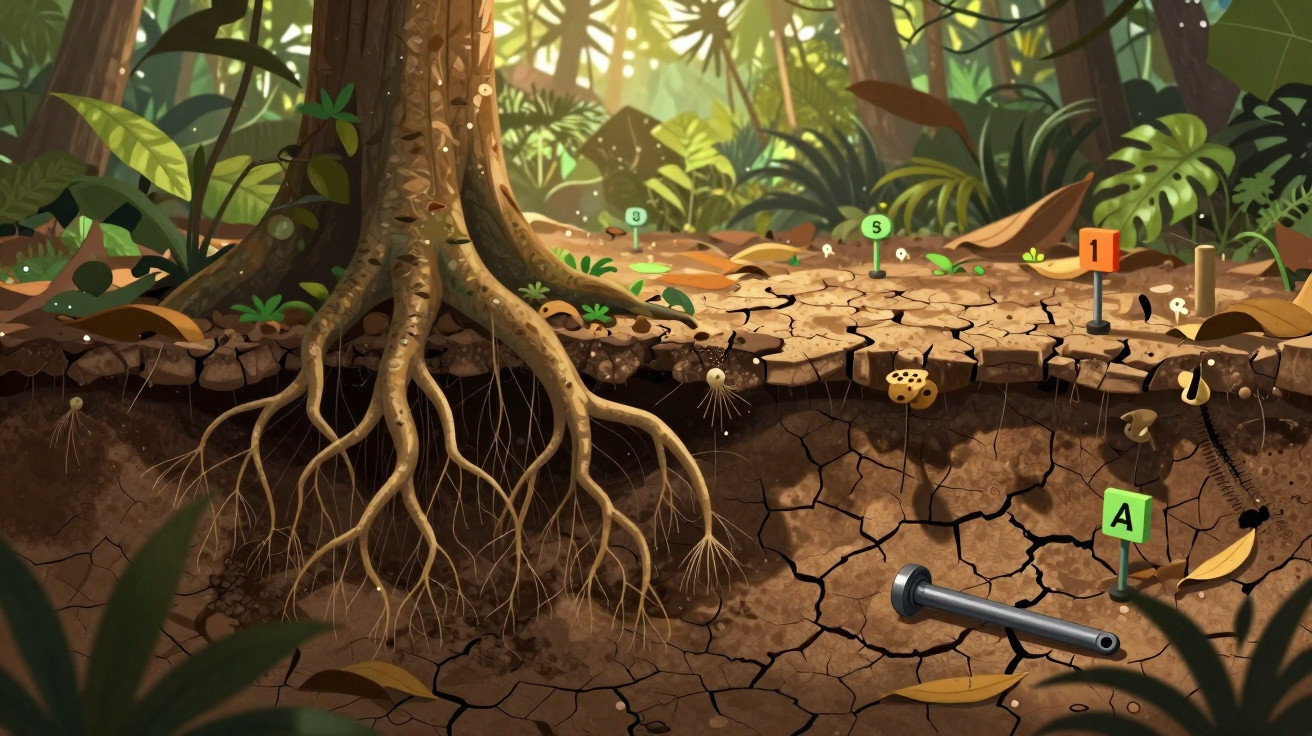
In Panama’s rainforests, scientists have observed tree roots extending farther and deeper below ground as they pursue the remaining pockets of water during increasingly severe droughts. Although the change appears to be a resourceful means of survival, researchers caution that it could merely be a short-lived response to an accelerating climate crisis.
Tropical roots shift as droughts become more widespread
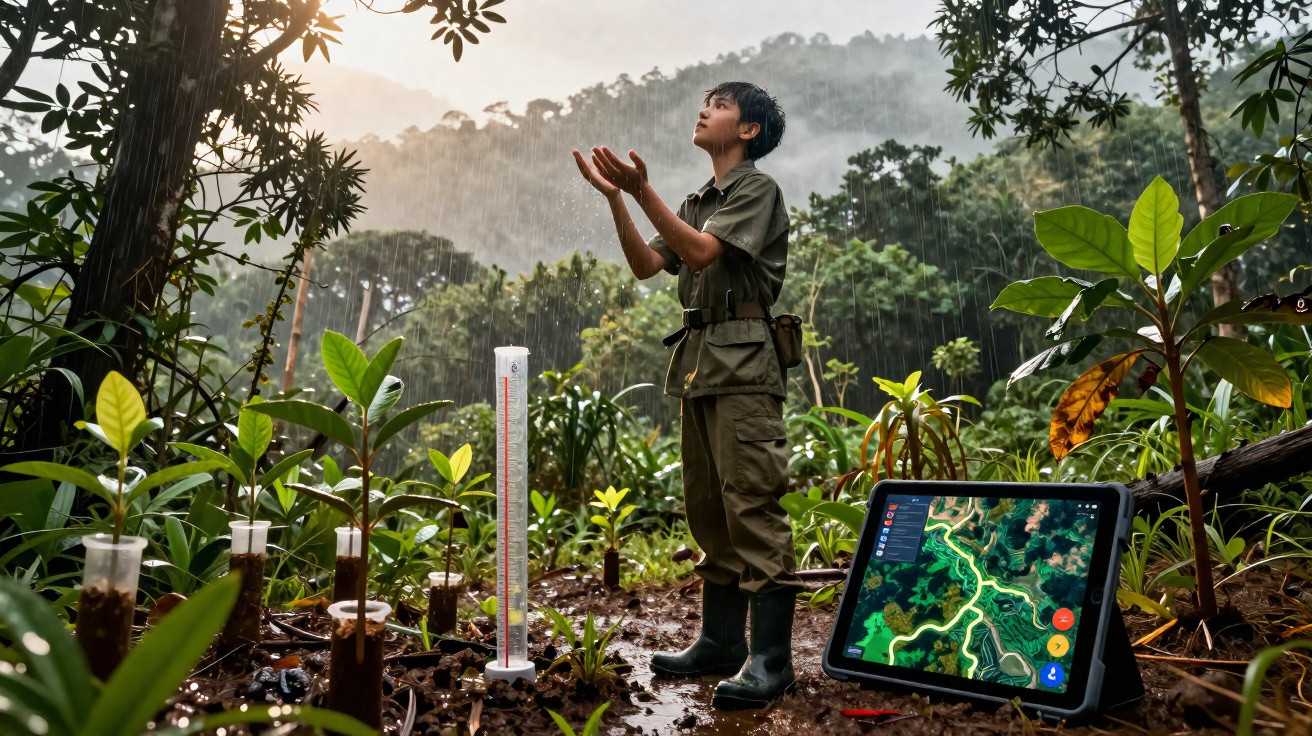
Tropical forests are commonly associated with unending rain, water-laden foliage and waterlogged ground. That familiar image is beginning to disappear. Climate change is altering rainfall cycles, disrupting wet seasons that were once reliable and regular. More prolonged dry periods are leaving parts of the rainforest parched and under pressure.
A long-term experiment in Panama has shown how trees react beneath the ground when rainfall can no longer be depended upon. Scientists used roof-like installations to redirect some rain away from several areas of undisturbed forest, reducing precipitation. They then monitored the roots’ response over years rather than simply a few months.
The forest floor looked almost unchanged, but underground the architecture of the trees was being redrawn in slow motion.
Fine roots close to the surface, which usually take up water and nutrients, started to diminish. Meanwhile, fresh roots developed farther down the soil profile, reaching layers that retained moisture for longer. In effect, the trees shifted resources away from shallow, rapidly produced roots and towards deeper roots built to last.
This reaction points to a measure of resilience. Trees are not simply passive casualties of a drying climate. They can modify where and how they search for water, even where doing so requires them to reorganise a living network developed over decades.
Hidden costs of a drought survival strategy
The research, published in New Phytologist, presents a more complex picture than simply “deeper roots, problem solved”. By following root biomass and production over time, the scientists found that this reorganisation involves compromises that may undermine forests over the longer term.
Fine roots in upper soil are crucial for taking in nutrients including nitrogen and phosphorus, while also making an important contribution to carbon storage. When these near-surface roots decline, less organic material is deposited close to the surface. This weakens the soil’s ability to retain carbon and sustain the diverse network of organisms that enables tropical forests to operate.
Every extra centimetre of depth gained by roots comes at a price: energy that is no longer available for growth, reproduction or wood formation.
Producing roots at greater depth demands substantial energy. Trees have to direct carbohydrates made through photosynthesis in their leaves towards creating and maintaining these underground lifelines. Those resources are then unavailable for widening canopies, enlarging trunks or locking carbon into durable wood.
Fungi become silent partners
To compensate for the reduction in surface roots, many trees seem to depend more strongly on mycorrhizal fungi. These fungi establish close relationships with roots and send microscopic filaments through the soil to gather water and nutrients beyond the reach of roots alone.
- Fine roots decrease near the surface during chronic drought.
- Deeper, thicker roots grow to reach the moisture that remains.
- Mycorrhizal fungi play a greater role in obtaining nutrients.
- Total biomass and carbon storage in soils may fall.
Although this relationship improves efficiency, it also has constraints. Fungi require moisture and organic matter themselves. As the upper layers of soil become drier and lose carbon, fungal networks may contract or alter their composition, limiting the support they are able to offer.
A global climate warning sign
Tropical forests rank among the world’s biggest natural defences against climate change. They absorb vast quantities of carbon dioxide, storing it in timber, foliage and soil. Processes below ground, where roots interact with minerals and microbes, can substantially determine how much carbon remains stored.
Where trees devote more energy to deeper roots and less to growing branches and trunks, their effectiveness as carbon sinks declines. At the same time, fewer surface roots mean lower litter inputs into the soil, slowing the creation of stable carbon compounds.
As roots chase water deeper into the ground, the forest’s ability to hold back greenhouse gases may quietly erode.
The Panama experiment has run for only several years, despite many tropical trees living for centuries. This creates a major unresolved question: will these root changes be able to match decades of worsening heat and changing rainfall, or do they represent a temporary coping mechanism that will eventually break down?
Winners, losers and changing forests
Tree species do not all react alike. Certain species can quickly redirect resources towards deeper roots, while others adapt more slowly or do not possess the anatomical features needed to break through compacted soil. Over time, these contrasts could change the composition of tropical forests.
Species that cope badly with persistent drought may decline or disappear from some areas, whereas drought-tolerant species may spread. This would transform both the appearance of forests and the ecological roles they perform, including providing habitats and supporting particular insect and animal communities.
These changes have wider effects. Shifts in tree species may alter fire danger, because some species produce more combustible litter than others. They may also affect local climate, as different forest canopies reflect sunlight and release water vapour differently.
When deeper roots cannot solve drought
The central finding from the Panama research is not that trees cannot respond. Rather, it is that their adaptive capacity has limits which the climate system is testing rapidly. Deeper roots may compensate for several years of below-average rain, but become less useful where droughts occur repeatedly or exceptional heat dries even the lowest soil layers.
Roots can only extend so far physically. Bedrock, compacted horizons and water-saturated layers without oxygen can stop their advance. Across some tropical landscapes, such barriers may sit only a few metres beneath the ground.
| Adaptation mechanism | Short-term benefit | Long-term risk |
|---|---|---|
| Deeper root growth | Access to residual moisture during drought | Reduced energy for growth and carbon storage |
| Decline of shallow roots | Lower maintenance costs in dry soil | Loss of nutrients and soil carbon near surface |
| Stronger fungal partnerships | Improved water and nutrient uptake | Vulnerability if soils become too dry or degraded |
Key concepts behind the science
Two scientific ideas help explain the processes unfolding in these forests: “root plasticity” and “tipping points”. Root plasticity is a plant’s capacity to change the shape and distribution of its roots as conditions change. The Panama study indicates that tropical trees possess more plasticity than once thought, particularly when drought persists.
Tipping points are thresholds after which an ecosystem can quickly move into a different state. In tropical forests, one concerning tipping point is a shift from dense, humid woodland towards more open, savanna-like vegetation after heat and drought exceed certain levels. Alterations to root systems may signal early that trees are approaching these thresholds.
What Panama’s roots reveal about future forests
Climate and vegetation computer models are beginning to account for root behaviour, although many still oversimplify what occurs underground. The latest findings from Panama provide specific data that can improve these models, including the speed at which roots grow deeper, the quantity of biomass lost near the surface and the extent of fungi’s response.
When improved models are used to simulate future conditions, they frequently produce a mixed outcome. In certain regions, deeper roots postpone widespread tree death. Elsewhere, particularly where drought coincides with deforestation or fire, forests nevertheless become thinner or collapse. Decisions about local land use can therefore intensify or reduce the pressures caused by global warming.
For people living along the edges of these forests, root responses are not merely theoretical. Deeper roots may hold slopes together and lower landslide danger during severe storms, but weakened trees can be more likely to fall in strong winds. Shifting tree species may also change when water arrives and how reliably it flows for communities downstream.
The roots of tropical trees are delivering a clear message from beneath the soil: adaptation is under way, but it is working intensely simply to keep pace with a changing climate.













Comments
No comments yet. Be the first to comment!
Leave a Comment