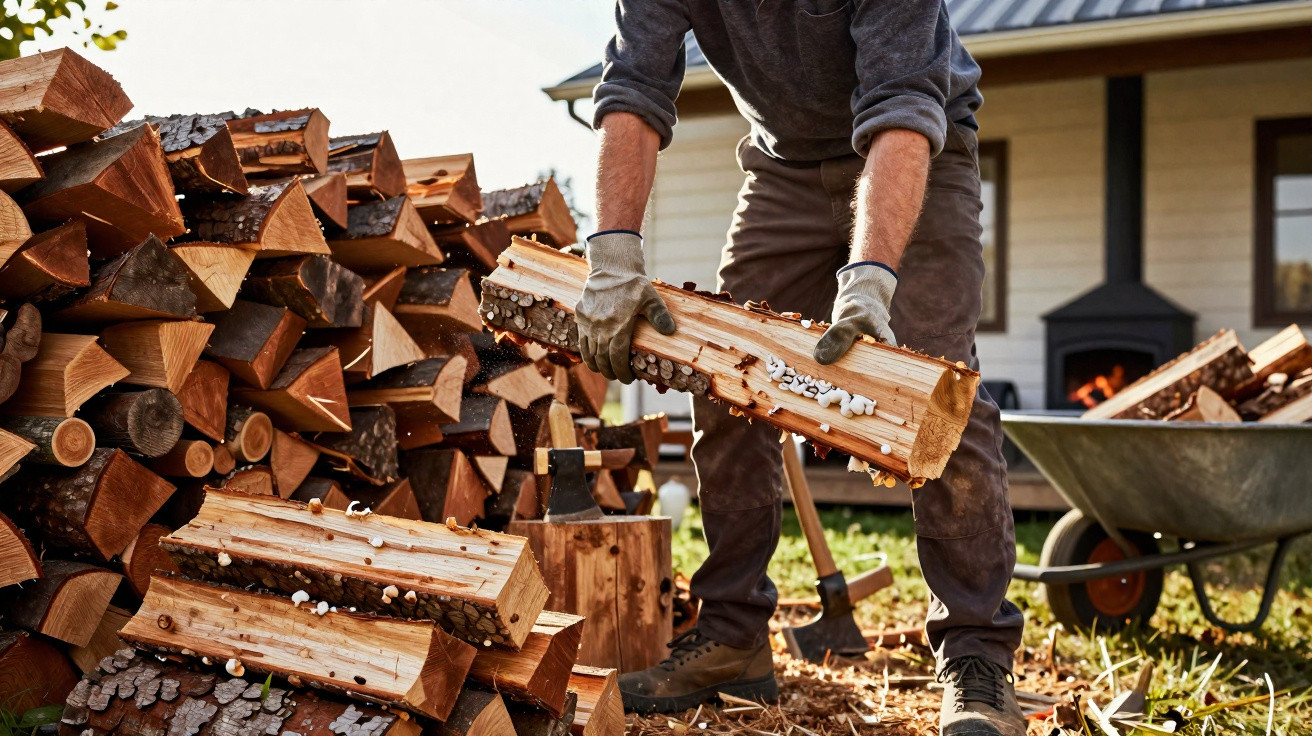
A little dusty, slightly lighter than the rest and easy to take from the top of the stack. You dropped it beside the stove, and a fine cloud of beige powder rose from the bark, rather like old face powder. Perhaps you pushed it aside with your foot and thought nothing of it. Just a log being a log.
Then, later, you spot the same dusty coating appearing on other pieces of firewood. A faint mushroom-like odour lingers in the shed. One end of the stack has begun to look almost mummified, leaning where it once stood solidly. Press a finger into one log and it yields, as soft as stale bread.
That is often when the question arrives: is this dry rot, and could my house be next?
How to recognise dry rot on firewood before it spreads
Dry rot is not especially dramatic at first sight. There are no huge mushrooms or brightly coloured slime patches. It commonly begins as a thin white or grey ‘skin’ across the firewood’s surface, resembling flattened cotton wool. On certain logs, it becomes yellowish or pale brown, producing fine strands that work their way into splits and follow the grain. It can appear remarkably deliberate, almost as though roots are feeling their way onwards.
Lift a suspect log and the difference is often immediate. Rather than feeling dense and reassuringly heavy, it may seem unexpectedly light. When tapped, it produces a flat, lifeless sound instead of a crisp knock. Split it open and the centre may fall apart into brittle, cube-like fragments. This dry, blocky texture is one of dry rot’s most familiar signs.
Picture a shed at the bottom of a damp garden, partly shaded by trees. In early autumn, the owner piles a fresh delivery of firewood tightly against the wall and pulls a plastic sheet over it ‘in case it rains’. There is no sun, no air movement and the ground remains wet after summer downpours. By January, the rear third of the stack appears dusty and washed out, as though it had been dusted with flour and left untouched for a year.
That situation is extremely common: wood stores with poor ventilation, plastic tarpaulins sealed to the ground, and firewood placed directly on soil or concrete. Every one of these arrangements forms a damp pocket that fungi thrive in. Dry rot spores are everywhere, drifting around harmlessly until they encounter the right combination of moisture and still timber. At that point, an unseen risk becomes visible damage.
Despite its name, dry rot is not dry at the start. The fungus requires damp timber to take hold, generally wood with moisture content above 20%. It works through the fibres and consumes the wood’s structural components, leaving a cracked, crumbly core behind. Once it is established, the wood may look and feel dry even while the fungus continues to spread.
This is why a log can appear perfectly seasoned from across the garden while being riddled with rot within. The fungus travels in filaments and can sometimes cross gaps in masonry or move beneath floors to reach fresh timber. With firewood, you will usually notice surface mycelium and the distinctive brittle break. In a building, the consequences can be far more serious. Learning to identify these early signs on logs gives you an important warning signal.
Removing dry rot from firewood safely and thoroughly
The most effective approach is uncompromisingly straightforward: isolate the wood, then remove it. Once you suspect dry rot, do not keep taking logs from random areas of the stack. Proceed systematically instead. Set up a quarantine area and move any questionable logs there, well away from the house and without resting them against a shed or fence. Where the problem is slight and your home’s timber is unaffected, many people opt to burn the affected logs promptly in a hot stove with a good draw.
If the rot is extensive or close to structural timber, regard those logs as waste rather than fuel. Put them in bags and take them to a green-waste facility, or follow local guidance for disposing of contaminated timber. Next, reset the storage space: empty it, sweep away powder and wood fragments, then allow it to dry completely. A single decisive clear-out can sometimes prevent years of recurring, low-level trouble.
Most of us respond only once the harm can be seen, which is entirely understandable. Few people lose sleep over the moisture content of a firewood stack. On a hectic day, it is easy to tip a fresh delivery into the shed, shut the door and hope it will be fine. Unfortunately, dry rot often gets the upper hand in that ‘I’ll deal with it properly later’ moment.
The same errors crop up nearly everywhere: placing logs directly on soil or unprotected concrete, packing them hard against a wall, wrapping the whole stack in a tarpaulin like a Christmas present, or allowing garden clutter to stop the air circulating. Let’s be honest: nobody really checks, rotates and measures moisture every day. Even so, small changes made only once each season can reduce the risk dramatically.
One building pathology specialist told me something memorable:
“Dry rot isn’t a mystery problem. It’s a moisture problem that stayed unsolved for too long.”
That observation applies as much to a stack of logs as it does to a hundred-year-old beam above your sitting room. The aim is to make your firewood an unfriendly environment for fungus: airy, raised from the ground and given time to dry fully before storage. Treat your log store as a small ecosystem that you are gradually steering in the right direction.
For a quick reminder, follow these habits:
- Stack logs on pallets or rails rather than directly on the ground.
- Keep a gap between the woodpile and every wall or fence.
- Cover the stack only from above, leaving the sides open to the air.
- Bring older wood to the front and burn it before newer logs.
- Avoid storing firewood in basements, crawl spaces and damp garages.
Storing firewood without inviting dry rot indoors
After seeing what dry rot can do, it is difficult to view a log pile in quite the same way. There is a quiet pleasure in building a stack that can breathe: orderly rows, bark generally facing downwards, and gaps between logs acting like little chimneys. Sunlight and wind become allies. The timber darkens consistently, the ends split in tidy radial cracks and the fungal dust never shows up.
Some households make this a seasonal routine. On the first properly crisp autumn day, they go to the log store, run a hand over the stack, choose a few pieces at random and split them. The sound reveals plenty: a clean, bright crack compared with a dull, fibrous tear. Healthy wood has a recognisable smell, and so does a pile in which something is quietly beginning to go wrong.
Most of us know the sinking feeling of opening the shed on a wet Sunday to find leaning stacks, a damp smell and a corner of logs so soft that you could almost leave a thumbprint in them. It may feel like failure, but it is also useful information. Firewood quickly shows where water is getting in around your home, how well the garden drains and how long walls remain cold and shaded.
Dry rot on logs seldom comes down to one poor choice. More often, it results from several small oversights: a gutter overflowing beside the log store, a downpipe splashing water back, or a low patch of garden that turns muddy every winter. Putting these issues right does more than save a few logs; it alters the moisture balance across your property.
There is another useful way to think about it: firewood is not merely fuel, but an early-warning sensor. If rot appears repeatedly, something larger nearby is remaining damp for too long. That might be a timber deck, the shed structure or even a structural joist that is usually out of sight. Dry rot depends on continuity, flourishing where damp timber connects with more damp timber in darkness.
Interrupt that continuity and you interrupt its strategy. Create airflow beneath the stack. Keep logs separated from exterior walls. Allow in sunlight wherever possible. It is not glamorous work and it will not attract many social-media likes. But it quietly safeguards what matters: a warm, safe home without unpleasant surprises concealed behind plasterboard.
Once you begin to see things this way, even a modest stack of firewood becomes a conversation with its surroundings. The logs reveal whether last winter’s repairs worked. The shed’s smell tells you how this year’s rain is affecting the space. And when your next batch of oak has none of that powdery dust, the reward is there, glowing quietly in the stove on a cold evening.
| Key point | Detail | Why it matters to the reader |
|---|---|---|
| Identifying dry rot visually | Beige dust, white/grey mycelium, and wood that is light and brittle | Helps identify early signs before the issue worsens |
| Improving the storage area | Isolating affected logs, cleaning the space and improving ventilation | Reduces the chance of spread to the house or other woodpiles |
| Changing storage habits | Raised wood, kept away from walls and covered only from above | Protects future firewood deliveries and avoids repeating the same errors each winter |















Comments
No comments yet. Be the first to comment!
Leave a Comment