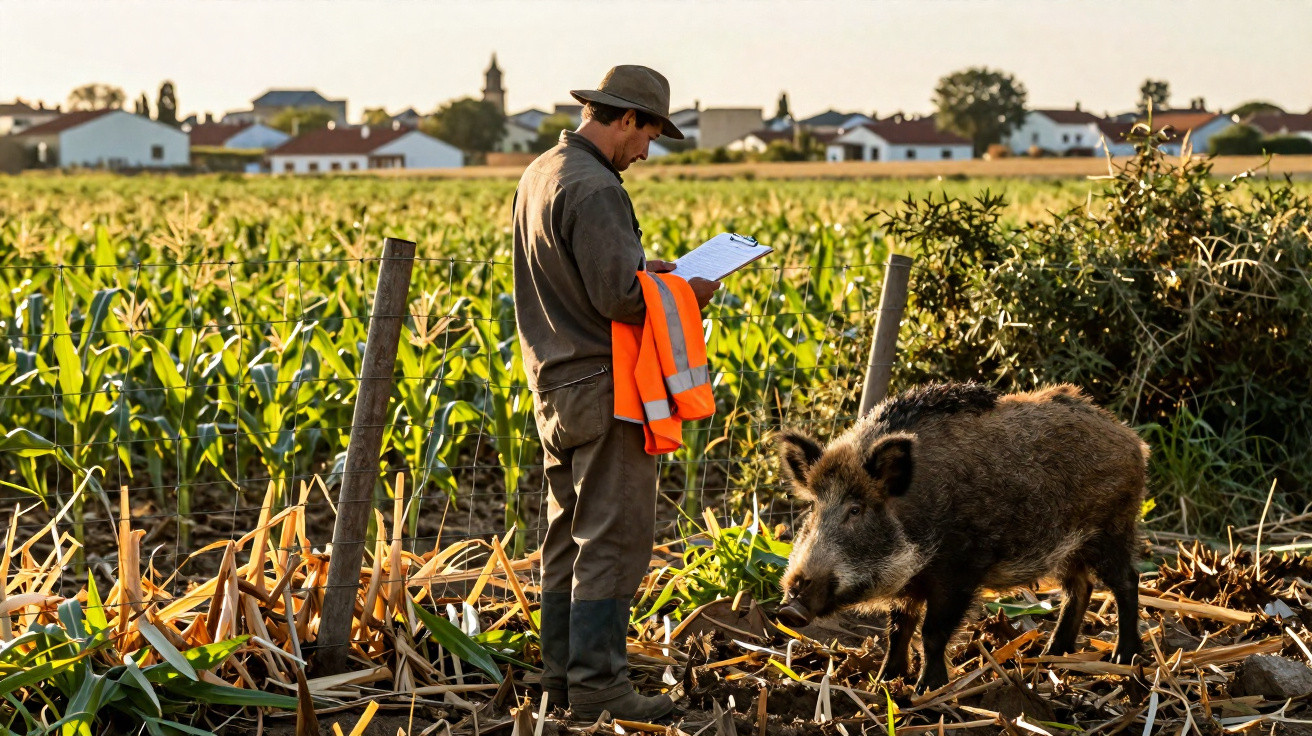
Wild boar moving closer to farmland and woodland is one of the main causes of conflict in rural areas, pitting those who work the land against wildlife. “There are many complaints from farmers and forestry producers,” acknowledged Carlos Fonseca, a researcher at the University of Aveiro.
Mário Gomes, president of the Union of Parishes of Aveleda and Rio de Onor in Bragança, where the villages lie within the Lombada National Hunting Zone, one of Portugal’s largest, told JN that “many farmers” complain every year about damage caused by big game.
“At this time of year, there is a great deal of damage to grazing land and wet meadows, because there are still few crops in the vegetable plots, which have only recently been planted. There are complaints every year. It is unavoidable, as chestnut trees are also damaged and people become angry,” the local authority representative said.
Wild boar damage to agriculture and forests
Even so, people affected by damage caused by wild boar or deer are generally left to absorb the losses, as support is rarely available. “In my parish, people have given up asking to be compensated for the damage. They get no response, and the procedure is bureaucratic, complicated and nobody accepts responsibility,” Mário Gomes said.
The Institute for Nature Conservation and Forests (ICNF) told JN that, “under the law”, damage caused by animals must be paid for by hunting associations, because “the managing bodies are responsible for the damage”. However, Carlos Fonseca noted that most hunting associations are small and have low membership fees. “They do not have substantial financial resources” to compensate for wildlife damage, the researcher said.
He therefore suggests establishing local initiatives involving parish councils and municipal authorities to find ways of adding gastronomic value to these species.
“They are animals with considerable value as game meat. Value chains need to be created so that the returns remain in the areas where the animals cause damage,” he said.
The issue is not confined to Portugal. Images of wild boar moving into urban ecosystems are becoming increasingly common in major cities such as Barcelona and Berlin. In Portugal, sightings have occurred mainly in Arrábida, Setúbal, but also in Coimbra. “Wild boar are increasingly occupying ecosystems where they were far less likely to be found until recently, and we must learn to live with them,” says Carlos Fonseca, stressing that they are wild animals and therefore raise health concerns. “People cannot and should not behave towards them in the same way as they do with domestic animals,” the researcher cautioned.
Notes
Starting with 14 areas
The action plan began with an initial study covering 14 pilot areas for the project’s implementation. Each area is a management unit comprising one or more hunting zones. They were selected to represent hunting realities, including types of hunting zones, as well as the country’s environmental and ecological diversity, land management and land uses.
Two added
Two further pilot areas were included to address geographical gaps in the sample. In total, 16 pilot areas covering 21 hunting zones were examined, along with Arrábida Natural Park.
Control
For nationwide population control of the species, a reduction of between 20 and 30% over a period of 5 to 10 years was proposed.
Data
1674
wildlife road collisions recorded by Infraestruturas de Portugal in 2024
1403
animal-related accidents recorded by the GNR during the first half of 2025






Comments
No comments yet. Be the first to comment!
Leave a Comment