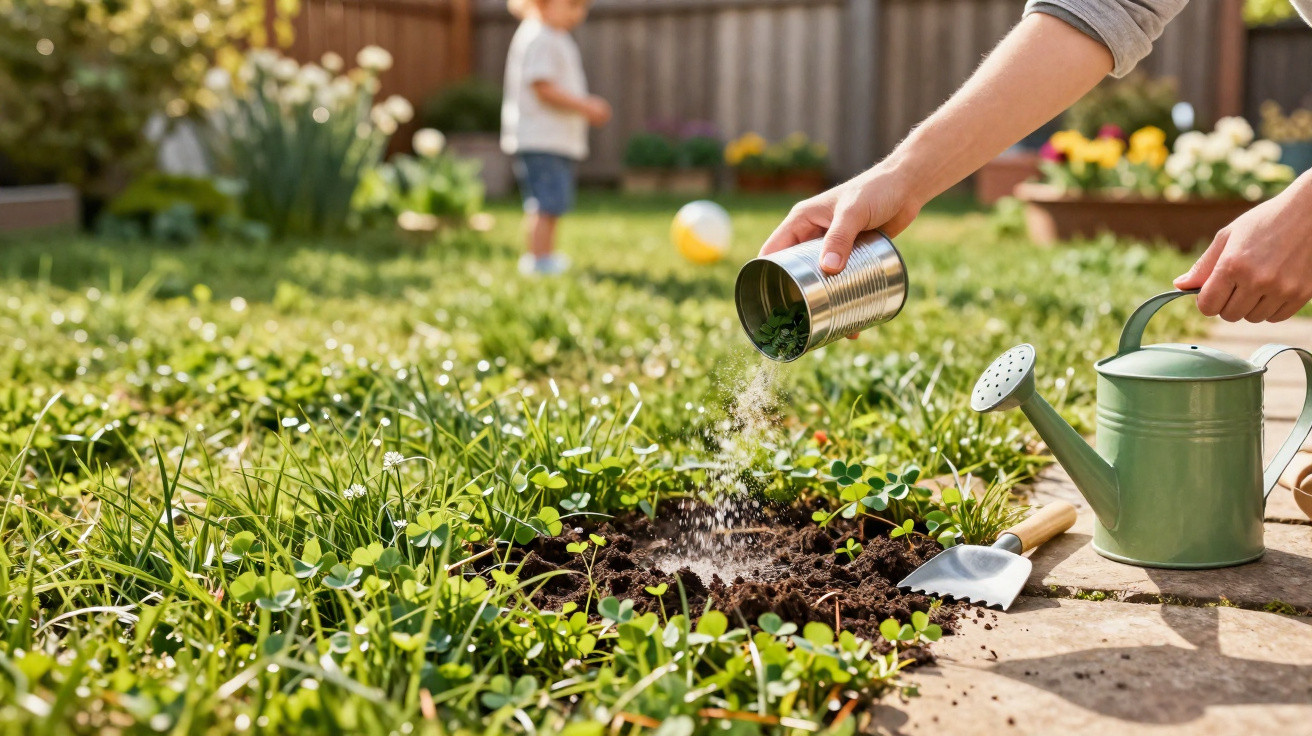
After winter, a lawn often reveals its true condition: bare patches, yellowed areas and dry sections. The usual reaction is to buy new lawn seed, overseed and hope for the best. But anyone wanting to avoid that stress every spring could choose another option that amateur gardeners in Poland have long embraced: a lawn mixture containing so-called microclover seed.
Why lawns suddenly develop bare patches
Before tackling the problem, it is worth briefly considering the causes. Bare areas rarely appear “just like that”.
- Frost and waterlogging: During winter, roots may freeze or rot in persistently wet ground.
- Heat and drought: Shallow roots dry out in summer, causing the turf to break up.
- Heavy use: Children playing, dogs, paddling pools or trampolines compact and crush both grass blades and soil.
- Nutrient deficiency: Weak grass cannot compete with moss and weeds.
- Incorrect mowing: Grass cut too short scorches more quickly and develops gaps.
All of this creates the familiar lunar landscape across a green lawn. This is precisely where microclover comes in.
Microclover: what lies behind the trend
Microclover is a very small-leaved form of white clover. It grows low, generally reaching only 3 to 8 cm, and blends into the existing turf.
“Microclover fills gaps, strengthens the lawn – and later saves on fertiliser and water.”
Unlike ordinary clover, microclover does not look out of place in a lawn. Its leaves are so fine that they visually merge well with the texture of the grass. Many garden owners do not even recognise it as clover at first glance.
The key benefits of microclover at a glance
- High tolerance of foot traffic: Children, dogs and garden parties – microclover can cope with plenty of wear.
- Improved drought resistance: The plant develops deep roots and manages with less water.
- A nutrient provider: As a legume, microclover fixes nitrogen from the air and releases it into the soil.
- Rapidly fills bare areas: The plants spread close to the ground and grow over empty patches.
- Less fertiliser required: The nitrogen it fixes provides the soil with more natural nutrition.
This can be a decisive advantage, particularly in gardens where watering is difficult or expensive.
How to sow microclover correctly in bare lawn patches
The best time is early spring, once night frosts are no longer expected. This gives the plants time to establish strong roots before summer.
Step-by-step guide for problem areas
- Clear the area: Remove old dead grass, moss and weeds with a rake or scarifier.
- Loosen the soil: Lightly break up the top layer so the seeds can make contact with the ground.
- Level the surface: Fill uneven spots with a little garden soil or lawn topsoil, then rake it smooth.
- Mix the seed: Combine microclover seed with some sand or a small quantity of lawn seed to ensure even distribution.
- Sow the seed: Scatter the mixture thinly over bare areas. Do not sow too densely, so the plants have room to develop.
- Firm it down: Gently press the seed into place with a board, your feet or a roller so it cannot blow away.
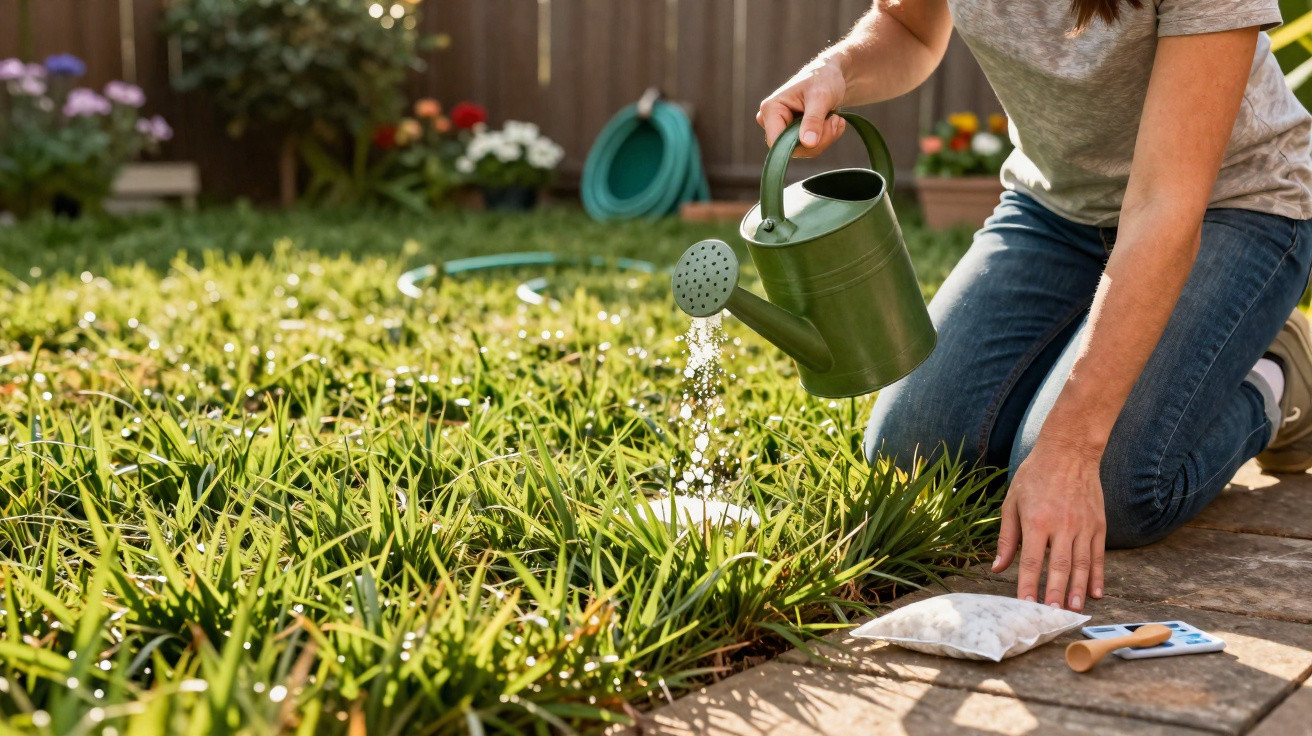
- Water: Water lightly and regularly during the first few weeks; the soil must never dry out completely.
“The better the seeds’ contact with the soil, the faster the brown patches disappear.”
How to care for a microclover lawn properly
Once the microclover has established itself, much of the work takes care of itself. Even so, garden owners should keep a few points in mind.
Mowing, watering and fertilising: what changes
| Care task | Without microclover | With microclover |
|---|---|---|
| Mowing | Often weekly, with a cutting height of 4–5 cm | Similar, as microclover generally remains below the cutting line |
| Watering | Frequent watering is needed in hot weather | Slightly less frequent, because clover copes better with dry periods |
| Fertilising | 3–4 fertiliser applications a year are common | Can be reduced considerably, as clover contributes nitrogen |
The first mow should take place once both the grass and clover are well established. After that, the microclover usually becomes an unobtrusive part of the overall appearance.
Where microclover works well – and where it does not
Microclover is not a miracle cure for every area, but it offers a highly practical solution to many typical lawn problems in private gardens.
Ideal for family gardens and troublesome areas
- Play lawns subject to heavy use
- Sunny to partially shaded positions
- Sandy or relatively nutrient-poor soils
- Areas that are difficult to water
- Lawns with regularly recurring dry patches
Microclover is less suitable where an absolutely uniform, almost “sterile” ornamental lawn is required – for example, in front of prestigious buildings or in meticulously maintained front gardens where every other plant species is unwelcome.
How much seed is actually needed?
For a completely new lawn, manufacturers generally state coverage information on the packet. Anyone only filling patches will need substantially less.
As a rough guide:
- 2–5 g of microclover seed per square metre for bare areas in an existing lawn
- A slightly larger amount where numerous open patches are close together
Many amateur gardeners permanently add a small portion of microclover seed to their usual lawn seed. This gradually creates a robust mixed sward without clover becoming visually dominant.
Common mistakes when using microclover
Anyone who simply scatters seed “somewhere” will often be frustrated by patchy results later on. Common pitfalls are easy to avoid.
- Sowing into soil that is too cold: Below a soil temperature of around 8°C, the seed germinates slowly or not at all.
- Covering it with too much soil: Microclover needs light to germinate, so a very thin covering is entirely sufficient.
- Watering inconsistently: Especially during the first two to three weeks, the areas should be kept evenly moist.
- Leaving areas uncleared: If thatch, moss and root debris remain, young plants have hardly any space to grow.
The science behind nitrogen fixation
Microclover’s greatest “trick” takes place invisibly beneath the soil. The plant forms a symbiotic relationship with specific bacteria living on its roots. These microorganisms can fix nitrogen from the air and convert it into a form that plants can use.
Some of this nitrogen later enters the soil when leaves, roots or small pieces of plant material die and decompose. This creates a natural base fertiliser that also benefits the surrounding grasses. That is exactly why gardens with microclover often need less mineral fertiliser – easing the burden on both household budgets and groundwater.
Practical additions for a permanently dense lawn
Anyone already renovating a lawn can combine a few further measures to make the result more durable:
- scarify once a year, or rake out thatch with a garden rake
- aerate very compacted soil with a fork or specialist equipment
- work sand into the soil after aerating to reduce waterlogging
- in high summer, water less often but deeply
Combining this care approach with microclover seed gives you a far better chance of getting rid of those troublesome brown patches for the long term. Step by step, a tired, patchy lawn becomes a resilient green surface that can easily withstand play, sunshine and short dry spells.












Comments
No comments yet. Be the first to comment!
Leave a Comment