Many amateur gardeners will recognise the situation: an orchid that once flowered profusely is now sitting on the windowsill with nothing but bare stems. You water it without much conviction, wait for a miracle and are almost ready to put it in the food-waste bin. Yet one particular kitchen leftover, used properly around the roots, may help get the plant growing again surprisingly quickly.
When an orchid is bare: dead or simply resting?
Before trying household remedies, take an objective look inside the pot. An orchid without flowers is not necessarily beyond saving. After a long flowering period, Phalaenopsis varieties often take a rest phase during which they produce no buds.
- Healthy roots: green or silvery, firm and free from soft patches
- Leaves: still flexible, even if they appear slightly limp
- Smell: neutral to faintly earthy, never rotten
In this condition, the plant is merely resting. Improving its conditions and giving it targeted support is usually enough. It becomes critical when the roots are brown, soft and slimy, while the pot smells of decay. The only solution then is to trim back to healthy root sections and repot into fresh bark substrate; even the best fertiliser would otherwise be wasted.
Moisture and light: creating the right indoor climate
Phalaenopsis originate in tropical areas, where they frequently grow on tree trunks rather than in soil. They prefer an airy growing medium and humidity levels that an ordinary living room rarely provides. Professional growers recommend around 50 to 70 per cent humidity, whereas many homes fall well below 40 per cent in winter.
A straightforward arrangement can help:
- Place the pot on a saucer filled with expanded clay pebbles or gravel.
- Add a little water to the saucer, ensuring that the bottom of the pot remains dry.
- Choose a bright position away from intense midday sun.
As the water evaporates, it raises humidity around the plant while the roots remain well aerated. Phalaenopsis also benefit from a modest temperature difference: roughly 18 to 22°C during the day and four to eight degrees cooler at night. This slight “temperature shock” signals to the plant that it should begin forming new flower buds.
Cooked maize as a gentle booster for orchid roots
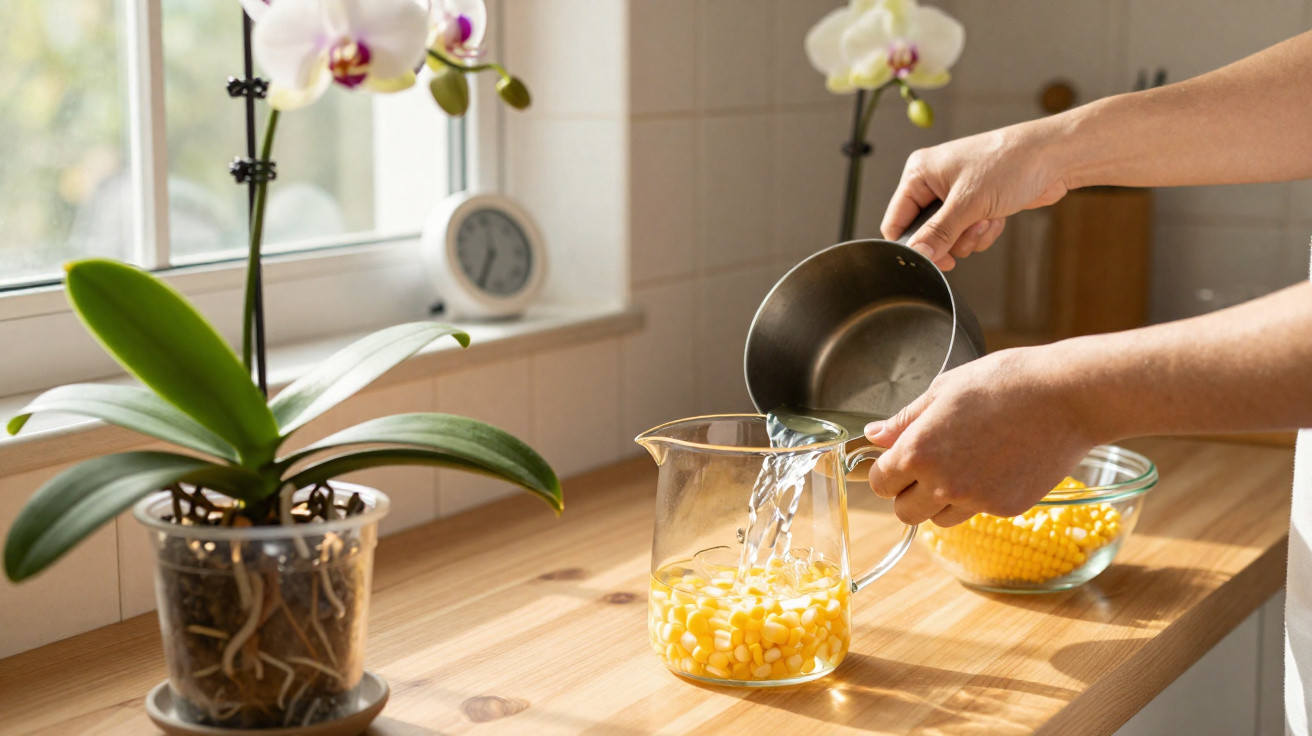
Fertiliser is where things become particularly interesting. Rather than reaching for synthetic bottled products, some gardeners use something that commonly ends up in the saucepan anyway: cooked maize and its unsalted cooking water.
“The starch in maize feeds microorganisms in the substrate, which in turn strengthen the orchid – a gentle cycle that stimulates root activity.”
Bark substrate contains countless microorganisms, including mycorrhizal fungi. These form connections with the roots, improve nutrient uptake and help stabilise the plant. The carbohydrates present in maize provide food for these microorganisms. Maize also contains trace amounts of minerals such as magnesium, phosphorus and potassium.
The effect is comparable to the well-known “rice water method” shared in many gardening communities. Here too, decomposing starch and small amounts of nutrients provide a mild boost without scorching sensitive roots, which is a risk with conventional fertilisers used at excessive strength.
Important limits of this household remedy
Despite the hype, maize is not a miracle cure. It can support a well-maintained orchid, but it cannot compensate for an unsuitable position, months of waterlogging or roots that have completely rotted away. Anyone who continues watering in semi-darkness while heating the room will not see an explosion of flowers simply by using maize.
The correct order is therefore important: first improve the location, watering routine and humidity, then use the kitchen trick. Used this way, the method is considerably more reliable.
How to make homemade maize fertiliser
The preparation is easy, but hygiene and dosage are essential. Even minor mistakes can burden the substrate or encourage mould.
| Step | Method |
|---|---|
| 1. Prepare the base | Allow around 100 grams of cooked, unseasoned maize to cool. |
| 2. Blend | Blend it finely with 1 litre of lukewarm water. |
| 3. Filter | Pass the liquid through a very fine sieve or cloth so that no pieces enter the substrate. |
| 4. Store | Keep it in a clean bottle in the refrigerator for no more than 24 to 48 hours. |
| 5. Discard | Throw it away immediately if it develops a cloudy film or a sour smell. |
For a standard-sized pot, one to two teaspoons of this liquid every three to four weeks during the growth phase are sufficient. Importantly, the substrate should be lightly moistened first, so the maize solution spreads evenly and does not put concentrated stress on individual roots.
Watering correctly: soak rather than splash
Many orchids suffer from too much water rather than too little, especially when water is left standing in the cachepot. A tried-and-tested approach is the soaking method:
- Place the transparent inner pot in lukewarm water.
- Leave it for around ten minutes, until the roots have absorbed enough water.
- Allow the pot to drain thoroughly before putting it back into the cachepot.
This is usually enough every ten to fifteen days. Between waterings, the substrate should remain relatively airy and dry. Unsalted maize cooking water can be added to the watering water in very small quantities once or twice a month, but only if no other fertilisers are being used, so that nutrient levels do not become excessive.
Common mistakes that prevent flowering
To understand why the plant is refusing to flower, it is worth taking a critical look at its everyday conditions. The same issues appear time and again:
- A location that is too dark: north-facing windows, curtains or large trees in front of the window deprive the plant of energy.
- Constant wetness: water remains in the cachepot, bark begins to rot and roots die off.
- Old, broken-down substrate: fine, dusty material replaces airy bark, leaving little oxygen around the roots.
- No temperature variation: day and night remain equally warm, so the plant receives no signal to form buds.
- Over-fertilising: applications are too frequent, concentrations are too high and root tips become scorched.
Keeping these factors largely under control greatly improves the likelihood that the maize trick will produce a visible boost rather than merely ease a guilty conscience.
Risks and sensible combinations with other fertilisers
Household remedies are gentler than mineral fertilisers, but they carry risks of their own. An overly strong maize solution can make the substrate sticky, attract bacteria and mould, and stress delicate roots. An unpleasant microclimate can develop quickly, particularly in poorly ventilated pots with limited drainage.
It can therefore make sense to combine the method with a liquid fertiliser formulated specifically for orchids, added in a very heavily diluted form to the soaking water, for example every four weeks at the minimum dose. In between, the plant can receive a small amount of maize solution every few weeks. This creates a two-part strategy: precisely targeted minerals alongside an organic stimulus for the microorganisms in the substrate.
Why orchids react so sensitively to small changes
Phalaenopsis have a specialised root tissue known as velamen. This sponge-like layer absorbs water in a surge and then dries out again. It thrives on alternating moisture levels, but not on waterlogging. If too much organic material is added and does not dry properly, the velamen quickly loses its stability.
That is precisely why a finely filtered and very sparing application of maize solution makes sense. It provides food for fungal partners and bacteria without altering the substrate structure too severely. Keeping this in mind encourages more cautious dosing and closer observation of the plant’s response.
As a rule of thumb, if the orchid develops fresh, light-green root tips and new leaf growth within a few weeks, you are on the right track. Flowers often follow only later, sometimes months afterwards. Patience is as important for this group of plants as keeping a watchful eye on light, air and a few spoonfuls of kitchen magic.












Comments
No comments yet. Be the first to comment!
Leave a Comment